Identification Features
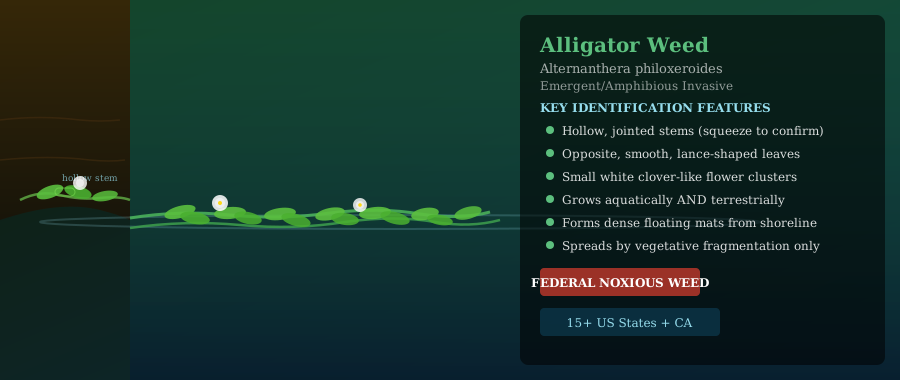
Alligator weed (Alternanthera philoxeroides) is one of the most habitat-versatile aquatic weeds in the United States, capable of growing in fully aquatic, semi-aquatic, and terrestrial environments. Its identification features: opposite, lance-shaped leaves (5–10 cm long, 1–3 cm wide), bright to deep green, with a prominent midrib; hollow, jointed stems — this is the single most diagnostic feature; and small, white, clover-like flowers in round clusters (1 cm diameter) on long stalks rising above the foliage. Stem cross-section is distinctly hollow, unlike all other common emergent aquatic weeds.
The hollow stem test: break a stem and check the interior — hollow with a smooth interior wall is diagnostic for alligator weed. No other common emergent aquatic plant has this combination of opposite lance-shaped leaves and hollow stems. In aquatic form, alligator weed floats in thick, interlocked mats rooted at the margins; in terrestrial form, it grows as a dense groundcover in moist soils up to 100 m from the water. Identification guides →
| Feature | Description |
|---|---|
| Stem | Hollow interior — DIAGNOSTIC |
| Leaves | Opposite, lance-shaped, 5–10 cm |
| Flowers | White, clover-like, round clusters on stalks |
| Legal status | Federal noxious weed |
Biology and Spread
Alligator weed reproduces almost entirely vegetatively in North America — seed production in U.S. populations is rare. The primary spread mechanism is stem fragmentation: any stem segment with a node can root and establish a new plant. This makes boat traffic and flood events potent dispersal vectors. Rhizome spread from established plants extends the colony at the margins. The terrestrial growth form allows alligator weed to colonize levees, road shoulders, and agricultural fields beyond the water's edge, making it unusual among aquatic weeds in its ability to invade upland habitats.
The plant is frost-sensitive but much more cold-tolerant than water hyacinth. It dies back to the root crown in freezing weather but resprouts vigorously in spring from overwintering root tissues. In coastal Texas and Florida, growth is essentially year-round. Reproduction biology →
Ecological Impacts
Dense alligator weed mats in aquatic environments impede navigation, block water flow in drainage canals and irrigation ditches, and displace native emergent plant communities in riparian zones. The aquatic mats can be large enough to trap sediment, gradually filling in waterways. In agricultural settings, the terrestrial growth form invades pastures, crop fields, and orchards, reducing yield and complicating harvesting. The combination of aquatic and terrestrial invasion makes alligator weed particularly costly — management programs must address both growth forms simultaneously.
Distribution
Established across the Gulf South — Florida, Louisiana, Texas, Mississippi, Alabama, Georgia, South Carolina — and California. Isolated occurrences in other southeastern states. Southeast distribution →
Control
Imazapyr (Arsenal Powerline, Habitat) and glyphosate (aquatic formulations) applied in fall are the most effective systemic herbicides for alligator weed — fall application when plants are translocating photosynthate to rhizomes maximizes root kill. 2,4-D is effective for aquatic forms. Biological control using three host-specific insect agents (a flea beetle, stem-boring moth, and thrips) provides suppression in warm-climate states but requires establishment programs. All chemical treatment requires state permits. Control methods →
Control and Management Summary
Alligator weed management requires addressing both the aquatic mat form and the terrestrial growth form simultaneously. Contact herbicides (diquat, endothall) suppress aquatic mats but do not kill the rhizome — systemic herbicides (triclopyr, imazapyr) applied to terrestrial growth provide longer-term suppression by killing root tissue. Biological control using the alligator weed flea beetle (Agasicles hygrophila) has provided suppression of the aquatic form in southeastern U.S. locations, though cold temperatures limit flea beetle effectiveness north of Zone 8. Complete eradication from a site is generally not achievable once fully established — multi-year integrated programs combining systemic herbicide with biocontrol and mechanical clearing of terrestrial spread are the standard approach for sites requiring active management. Biological control methods → | Chemical control →
Frequently Asked Questions
Why is alligator weed considered worse than most aquatic weeds?
Alligator weed presents a unique management challenge because it is amphibious — it can thrive in both fully aquatic and terrestrial environments. Most aquatic weed management tools (aquatic herbicides, mechanical harvesting) address the aquatic form, but terrestrial infestations require completely different equipment, herbicides, and management approaches. A treatment program that successfully controls the aquatic mat may leave untreated terrestrial colonies along the bank that immediately reinfest the water. Effective programs must address both growth forms simultaneously, significantly increasing cost and complexity.
Federal Noxious Weed Status and Legal Obligations
Alligator weed is listed as a Federal Noxious Weed under the Federal Noxious Weed Act, making the interstate transport, importation, and sale of alligator weed plant material illegal in the United States. Landowners and water managers who discover new alligator weed infestations are generally encouraged — and in some states legally required — to report detections to their state department of agriculture or department of natural resources. Early detection and rapid response programs are most effective when new infestations are still small enough to be contained. A confirmed new infestation in a previously unaffected water body should be reported to the state noxious weed authority immediately, before any treatment attempt, as federal and state eradication support resources may be available for early-stage infestations that would not be available for established populations. U.S. distribution →
Full Species Profile: Visit the Alligator Weed authority page →