Identification Features
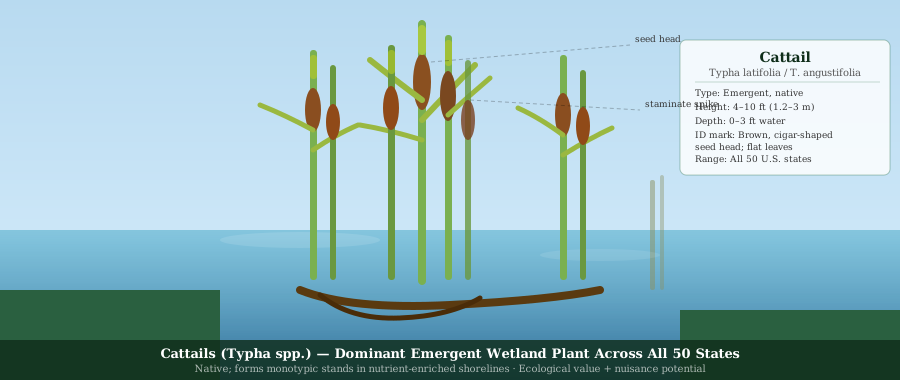
Cattails (Typha spp.) are among the most recognizable plants in North America. The brown, sausage-shaped seed head (technically a spike of thousands of tiny flowers) on a tall stalk is iconic and immediately distinctive. In North American water bodies, two species are most common: broadleaf cattail (T. latifolia) with overlapping male and female spikes on the same stalk (no gap between brown spike and tan pollen portion); and narrowleaf cattail (T. angustifolia) with a distinct gap between the male pollen-producing portion (above) and the brown female spike. Both are native to North America.
Leaves are flat, strap-shaped, 1–3 cm wide (broadleaf) or 0.5–1.5 cm wide (narrowleaf), sheathing the stem at the base. Plants grow 1.5–3 m tall in most conditions. A hybrid between the two species (T. × glauca) is common where both parents coexist and has been implicated in the aggressive monoculture formation seen in Great Lakes coastal wetlands and prairie potholes.
Ecological Role and the "Native Nuisance" Question
Native cattails play a fundamental role in North American wetland ecology. Dense cattail stands provide essential nesting habitat for marsh birds including red-winged blackbirds, marsh wrens, and American bittern. Muskrats, beavers, and multiple invertebrate species depend on cattail. The dead stems provide winter insulation for overwintering insects. And cattails actively filter and retain nutrients — cattail-dominated zones in wetland treatment systems effectively reduce nutrient loading to downstream water bodies.
The management challenge arises when cattails — driven by nutrient enrichment of wetlands from agricultural runoff and atmospheric nitrogen deposition — expand beyond their natural ecological densities to form dense monocultures that displace the diverse native emergent plant communities of prairie potholes, coastal marshes, and lakeshore wetlands. In this expansion mode, they reduce biodiversity, impair waterfowl habitat quality, and in severe cases can fill in open water areas. The expansion is most severe in the Great Lakes region and the Prairie Pothole region of the Midwest, where landscape-scale nutrient loading has shifted conditions in favor of cattail dominance.
Biology
Cattails spread laterally through underground rhizomes (rootstocks) at rates of 1–4 meters per year under favorable conditions. Each plant also produces thousands of wind-dispersed seeds annually from the brown spike — each seed has a cottony parachute that allows long-distance wind dispersal. A combination of seed establishment in disturbed areas and rhizome spread from established colonies drives population expansion. The hybrid T. × glauca appears particularly aggressive in northern wetlands. Reproduction biology →
Distribution
Cattails are found in wetlands, lake margins, ditches, and roadside pond margins throughout all 50 U.S. states. T. latifolia has the broadest range; T. angustifolia is primarily in the northern and eastern U.S. The hybrid dominates in many Great Lakes wetlands.
Management
Cattail management requires a careful balance between restoring natural densities (desirable) and eliminating ecologically valuable habitat (undesirable). Nutrient reduction is the primary long-term solution for addressing the conditions driving expansion. Direct management options for restoration of native plant diversity include: fall/late summer herbicide application with imazapyr or glyphosate (systemic, kills rhizome network); water level manipulation (fall drawdown exposes rhizomes to freezing, reducing stand density); and mechanical removal combined with replanting of native alternatives. All chemical treatment requires state permits. Control methods →
Frequently Asked Questions
Are cattails good for a pond?
In moderation, yes. A narrow band of native cattails along a pond margin provides wildlife habitat, shoreline stabilization, nutrient uptake, and nesting cover for waterfowl and marsh birds. Problems arise when cattails expand to cover large areas of a shallow pond, reducing open water, impairing recreational use, and displacing other native plant species. The appropriate management response depends on your goals — if you want to maintain open water and diverse native plants, limiting cattail coverage to 20–30% of the shoreline margin is a reasonable target for most small ponds.
Can I eat cattails?
Yes — cattails are edible, and multiple parts of the plant are used as food. Young shoots emerging in spring are eaten raw or cooked (similar to leek or asparagus). The pollen from the male flower spike (yellow, produced in early summer) can be collected and used as a flour supplement. The immature green female spikes can be cooked and eaten like corn-on-the-cob. The starchy rhizomes can be processed to extract flour. This edibility has been utilized by Indigenous peoples for thousands of years. Of course, only harvest from water bodies free of contamination.