Overview
Chara is not a true plant but a complex multicellular green alga native to North America, found worldwide in clear, calcium-rich, low-nutrient lakes and ponds. It forms dense beds in shallow water and has a distinctive strong, garlic-like odor. Far from being a nuisance, chara is generally considered highly ecologically beneficial — an indicator of excellent water quality, a waterfowl food source, a sediment stabilizer, and a natural algae suppressor.
Identification Characteristics
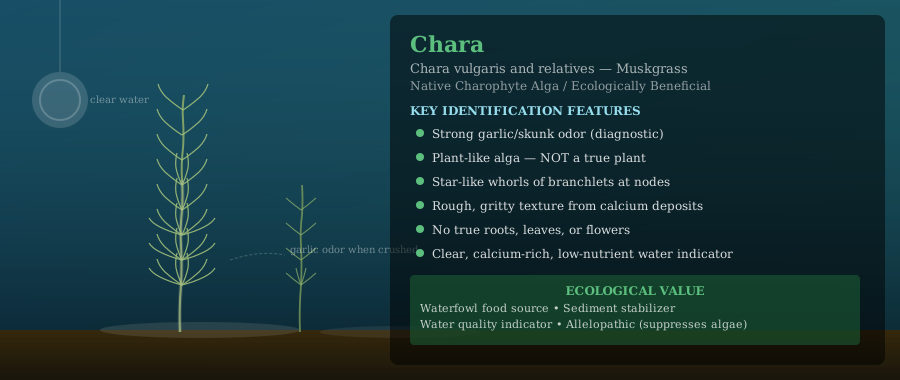
Chara's most reliable identification characteristic is its distinctive, strong garlic- or skunk-like odor when crushed or disturbed. No other common aquatic plant or alga produces this smell. If you squeeze a handful of the plant and detect a strong garlic odor, you have chara.
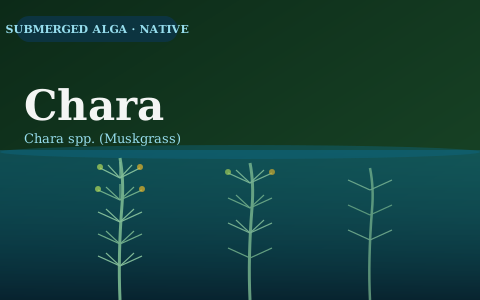
Visually, chara forms a striking plant-like structure with a central "stem" bearing whorls of branchlets at regular nodes. The branchlets themselves have smaller sub-branchlets, giving the whole plant a star-whorled, somewhat structured appearance that resembles a small pine branch underwater. However, chara is an alga — it has no true roots, stems, leaves, or flowers in the botanical sense.
The texture is rough and gritty due to calcium carbonate deposits on the cell surfaces — a phenomenon called encrustation or calcification. This rough, almost crunchy texture distinguishes chara from most soft aquatic plants. Running your fingers along a chara branch will feel like running them along fine sandpaper.
Chara can be confused with its close relative Nitella, which lacks the garlic odor, has a smoother texture (less calcified), and typically grows in slightly different water quality conditions. Distinguishing chara from nitella is covered in our Chara vs. Nitella guide.
Growth Habit & Ecology
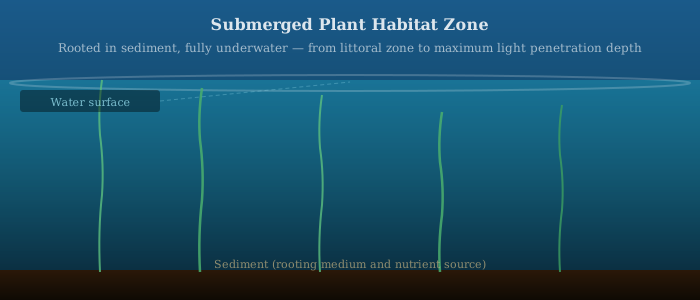
Chara grows attached to sediment through root-like rhizoids that anchor the plant but do not absorb nutrients in the way true plant roots do. The plant absorbs nutrients and carbon dioxide directly from the water column through its cell walls. This nutrient uptake mechanism makes chara highly competitive in low-nutrient (oligotrophic) environments where true aquatic plants may struggle.
Growth is typically most vigorous in spring and early summer, with beds reaching their maximum coverage and density. In deeper, clearer lakes, chara can grow at depths of 10–30 feet where light reaches the bottom in sufficient quantity. In shallower, turbid conditions, growth is limited to shallower depths where light penetration is adequate.
Chara reproduces by oospores — reproductive bodies produced at the nodes — and by vegetative fragmentation. The hardy oospores can remain dormant in sediment for decades, germinating when conditions become favorable. This long dormancy period means that chara can re-establish in a water body long after an episode of nutrient enrichment or turbidity has passed and water quality has improved.
Habitat Preferences
Chara is strongly associated with clear, hard-water, low-nutrient (oligotrophic to mesotrophic) lakes, ponds, quarries, and spring-fed systems. It is most abundant in regions with naturally calcareous geology — where groundwater flowing through limestone or dolomite delivers high concentrations of calcium and bicarbonate — including the glaciated upper Midwest, Great Plains, Great Lakes region, and parts of the Northeast. Clear spring-fed lakes in Florida, Texas, and the arid Southwest also support chara communities.
The most critical habitat parameter is water clarity and light penetration. Chara requires sufficient light to reach the substrate at the depths where it grows — typically 2–20 feet, with exceptional populations in very clear lakes extending to 30 or more feet. Because chara is sensitive to shading, it is one of the first species to decline when nutrient loading increases and turbidity rises. Water bodies with a Secchi depth (water clarity measurement) consistently above 6 feet are most likely to support diverse chara communities.
Low nutrient levels are equally important. Chara thrives in phosphorus concentrations below approximately 15–20 micrograms per liter (μg/L); as phosphorus rises above this threshold, phytoplankton blooms cloud the water and eliminate the light chara requires. The presence of healthy, dense chara beds is considered one of the most reliable indicators of oligotrophic, high-quality water — and conversely, the disappearance of chara from a water body is an early warning of deteriorating water quality.
Spread Mechanisms
Chara spreads through both reproductive and vegetative pathways, though it is generally not an aggressive colonizer. Its primary reproductive structure is the oospore — a hard, egg-like reproductive body produced at nodes that can remain dormant in sediment for decades. Oospores are transported by waterfowl, particularly diving ducks that consume chara and excrete viable oospores, by flooding events, and by clinging to equipment and water-adjacent animals.
The dormancy of chara oospores is ecologically important: oospores can persist in lake sediments through extended periods of poor water quality — years or even decades — and germinate when water quality improves and conditions become favorable again. This means that lakes which once supported chara but lost it to eutrophication may have a viable oospore bank that could support chara recovery if water quality is restored. Lake restoration programs targeting improved water clarity sometimes rely on this oospore bank for natural chara reestablishment.
Vegetative fragmentation also occurs — pieces of chara detached by boat propellers, fish feeding, or wave action can establish new colonies in suitable conditions. Equipment, boats, and wading gear can transport chara fragments between water bodies.
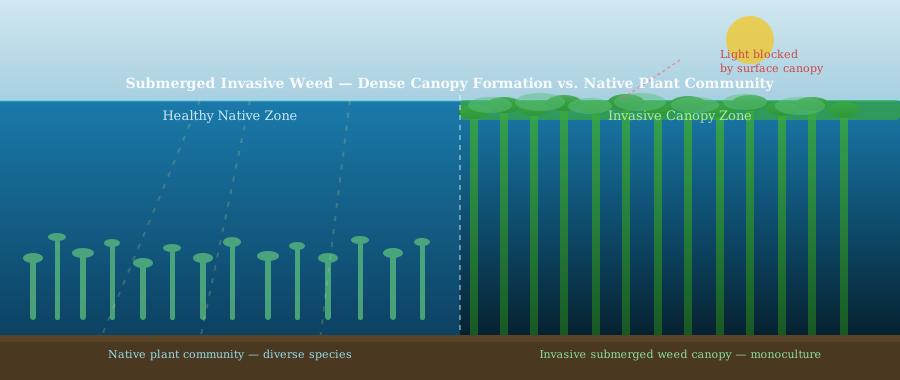
Unlike most aquatic invasives, chara spread is self-limiting: the species' strict habitat requirements mean that it cannot establish in water bodies that lack adequate light, calcium, and low nutrient levels. This makes chara's spread fundamentally different from invasive species like hydrilla or milfoil — it will not colonize degraded water bodies and poses no threat to ecosystems outside its narrow ecological niche.
Seasonal Growth Pattern
Chara follows a distinct seasonal pattern that varies with water temperature and depth. In temperate regions, spring growth begins in April–May as water warms and light penetrates clearly to the lake bottom. Growth is most vigorous in spring and early summer when light is strong, temperatures are optimal (50–70°F), and nutrients are relatively low.
Peak biomass typically occurs in June and July, when chara beds reach their maximum density and areal extent. In shallow, clear lakes, summer chara beds can be extensive — covering substantial portions of the littoral zone from 1–15 feet or deeper. These dense summer beds are the prime habitat for diving waterfowl that feed on chara oospores.
Growth slows in midsummer as water temperatures rise above 77°F in shallow zones, and as competition for nutrients may increase slightly. Chara beds tend to thin somewhat in late summer but rarely disappear entirely. In deeper water (below the thermocline), temperatures remain cooler and chara may remain active through late summer.
Fall and winter: As temperatures drop in October and November, above-ground growth decreases and beds thin. However, unlike most aquatic plants, chara does not completely disappear from the water column in winter in many northern lakes — it maintains reduced but active growth through cold months in some systems. Oospores produced through the growing season persist in sediment year-round, providing a reproductive reserve regardless of above-ground conditions.
Ecological Impact
Chara's ecological impact is almost entirely positive. Dense chara beds provide important ecological services that benefit both the aquatic ecosystem and adjacent upland habitats.
Waterfowl habitat and food: Chara beds are prime feeding areas for diving ducks, particularly canvasbacks, ringnecks, and coots, which consume chara oospores directly. Waterfowl management programs at wildlife refuges specifically maintain chara beds for this purpose.
Water quality indicator: The presence of chara is one of the strongest botanical indicators of oligotrophic, high-quality water. Chara is highly sensitive to nutrient enrichment and turbidity — when phosphorus levels rise above approximately 15–20 ppb, chara typically declines and is replaced by more tolerant eutrophic-adapted plants. A water body with healthy chara beds is generally a water body with good water quality.
Sediment stabilization: Dense chara beds physically stabilize bottom sediments, reducing internal nutrient loading from sediment disturbance.
Allelopathy: Chara produces allelopathic compounds that suppress the growth of algae and cyanobacteria, contributing to clearer water and reduced algal bloom frequency in oligotrophic lakes.
Control Methods
Because chara is ecologically beneficial and an indicator of good water quality, most aquatic managers and ecologists recommend against controlling chara unless it is causing clear, documented problems in a specific management context. The loss of chara from a water body is often a sign of deteriorating water quality, not a management success.
The most common reason people contact their local natural resources agency about chara is the garlic odor, which is strongest in warm weather when chara is actively growing or when disturbed. Education about the plant's ecological value and water quality indicator status is often the most appropriate "management" response.
When chara control is genuinely necessary — for example, in recreational swimming areas or boat launch zones — targeted mechanical removal (raking) is the most ecologically sensitive approach. Copper-based herbicides (chelated copper, copper sulfate) are effective and commonly used where chemical control is warranted, but may harm fish at high concentrations and require careful application. State permits are required.
Do not over-manage chara: aggressive removal of chara beds can trigger a shift to filamentous algae or cyanobacterial dominance, which are far more problematic from a water quality and recreational perspective.
Important: Always obtain required permits before applying any aquatic herbicide or introducing biological control agents. Requirements vary by state. Contact your state department of natural resources or environmental protection agency for guidance.
Distribution in the United States
Chara and related charophyte algae are found throughout the continental United States, with highest abundance in regions with hard, calcium-rich, clear water — the glaciated upper Midwest, Great Plains, and Northeast. Clear, spring-fed lakes in Florida, Texas, and the Southwest also support chara communities.
Chara has declined significantly over the past century in many regions due to eutrophication. Water bodies that historically supported diverse chara communities have shifted to dominance by green algae, cyanobacteria, or invasive aquatic macrophytes as nutrient loading increased from agriculture, development, and wastewater. The loss of chara communities is both an ecological consequence and an indicator of declining water quality.
Frequently Asked Questions
Is chara harmful to swim in or touch?
Chara is not harmful to humans. The garlic odor, while unpleasant, is not a sign of toxicity. Unlike cyanobacteria (blue-green algae), chara does not produce toxins. Swimming through chara beds is safe, though the rough texture from calcium encrustation can feel somewhat scratchy on bare skin.
Why does chara smell like garlic?
The garlic odor comes from sulfur-containing compounds (particularly hydrogen sulfide and dimethyl sulfide) produced by chara's cellular metabolism. The smell is strongest when the plant is disturbed, crushed, or actively growing in warm weather. This distinctive odor is the most reliable field identification character for chara and is not shared by any other common aquatic plant.
Is chara the same as algae?
Chara is technically an alga — specifically a complex multicellular green alga in the Division Charophyta — but it looks and behaves more like a plant than a typical alga. Unlike true algae (which lack organized tissues), chara has a complex cellular structure with nodes and internodes, grows from a substrate, and has specialized reproductive structures. It is not a true plant because it lacks seeds, flowers, and vascular tissue.
Should I control chara in my pond?
In most cases, the answer is no. Chara is ecologically beneficial and an indicator of good water quality. If chara is present in your pond, it is a sign of relatively clean, clear water. The garlic odor, while noticeable, is not harmful. If chara is causing specific problems (obstructing a dock or swim area), targeted mechanical removal is appropriate; aggressive chemical control is generally not recommended.
References & Further Reading
- Blindow, I. (1992). Long- and short-term dynamics of submerged macrophytes in two shallow eutrophic lakes. Freshwater Biology 28:15–27.
- Kufel, L. & Kufel, I. (2002). Chara beds acting as nutrient sinks in shallow lakes — a review. Aquatic Botany 72:249–260.
- van den Berg, M.S., et al. (1998). The role of Characean algae in the restoration of lakes. Australian Journal of Botany 46:1–13.
- Hilt, S. & Gross, E.M. (2008). Can allelopathically active submerged macrophytes stabilize clear-water states in shallow lakes? Basic and Applied Ecology 9:422–432.