The Biology Basis of Management
Every effective aquatic weed management decision rests on biological knowledge. The timing of herbicide application, vulnerability to mechanical control, persistence after treatment, likelihood of reinfestation, and potential for biological control — all are determined by plant biology. A herbicide applied at the wrong growth stage may be ineffective. A water drawdown timed incorrectly may fail to kill target propagules. Understanding what the plant is doing biologically, and when, directly determines management outcomes.
This hub covers the core biological principles governing aquatic weed ecology: how plants photosynthesize under water, how they acquire nutrients, how they reproduce, how they persist through management interventions, and how they interact with the physical environment. Each topic links to deeper guides for species-specific detail.
Photosynthesis and Light Requirements
All aquatic weeds photosynthesize — converting light energy and carbon compounds into sugars that fuel growth. But light under water imposes fundamentally different constraints on submerged plants compared to terrestrial or floating plants.
Light Attenuation in Water
Light intensity decreases exponentially with depth. The rate of attenuation depends on water clarity — clear lakes attenuate light slowly (plants colonize to significant depth), while turbid or algae-laden water attenuates light rapidly (restricting plant growth to the uppermost layer). Turbidity is measured by Secchi depth; a Secchi depth of 1.5 meters generally predicts maximum plant colonization depth of approximately 4–6 meters under typical conditions.
Hydrilla is exceptional: it can photosynthesize at light levels as low as 1% of surface irradiance — far below what most native submerged species can tolerate. This allows hydrilla to colonize turbid water where no natives survive and to grow significantly deeper in clear lakes than competing species. This low-light tolerance is a primary explanation for hydrilla's competitive superiority. Light and temperature effects on growth →
Carbon Acquisition
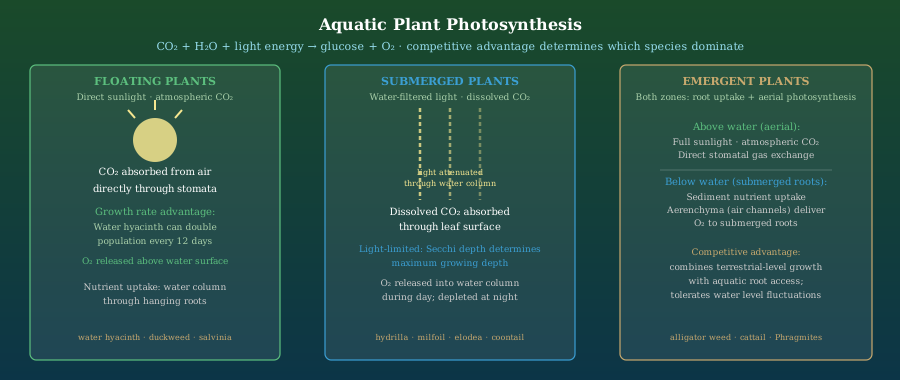
Submerged plants use dissolved inorganic carbon (CO₂ and bicarbonate) from the water for photosynthesis, while floating plants use atmospheric CO₂ directly. Hydrilla is more efficient at bicarbonate use than most native submerged species, giving it another competitive advantage in carbonate-rich waters.
Nutrient Acquisition and Eutrophication
Aquatic plants acquire the nutrients needed for growth — primarily nitrogen, phosphorus, potassium, calcium, and micronutrients — from two sources: the water column and the sediment (via roots and rhizomes). Most rooted submerged plants acquire the majority of their phosphorus from sediment porewater via their root systems, while floating plants acquire most nutrients from the water column.
Eutrophication — the enrichment of water bodies with nitrogen and phosphorus from human activities — is the primary driver of nuisance aquatic plant growth in most U.S. water bodies. When phosphorus (typically the limiting nutrient in freshwater) exceeds approximately 10–30 μg/L, ecological balance often shifts toward plant-dominated states. Addressing eutrophication through watershed nutrient management is the only sustainable long-term approach to controlling native nuisance species. How nutrients drive aquatic weed growth →
Reproductive Strategies
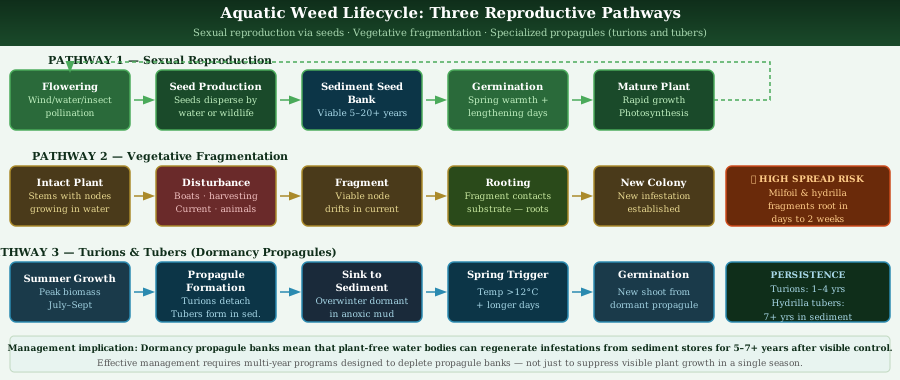
Aquatic weeds use two primary reproductive pathways — sexual (via seeds) and vegetative (via clonal propagation) — and most problematic species exploit both. The balance between these pathways, and the resilience of each, is critical to management planning.
Sexual Reproduction
Many aquatic weeds produce seeds that persist viable in sediment seed banks for years or even decades. Curly-leaf pondweed germinates from turions in late summer–fall, enabling cool-season growth before native species resume. Water hyacinth seeds remain viable in sediment for up to 30 years — one reason eradication is essentially impossible once a population establishes and produces seeds. How aquatic weeds reproduce →
Vegetative Fragmentation
Vegetative fragmentation — the detachment of plant pieces that independently root and establish new plants — is the primary spread mechanism for most invasive submerged and floating aquatic weeds. A single stem node of hydrilla or Eurasian watermilfoil can establish a new plant. This fragmentation biology creates a critical management vulnerability: physical disturbance that generates fragments without complete removal can spread the infestation. Boating through dense milfoil beds, inadequately contained mechanical harvesting, and even herbicide treatment can all distribute propagules. Understanding vegetative fragmentation →
Turions and Tubers
Some of the most management-resistant aquatic weeds produce specialized dormant propagules:
- Turions: Compact, dormant vegetative buds produced on stems or leaf axils that detach, sink to the sediment, overwinter, and germinate in spring. Hydrilla and curly-leaf pondweed produce abundant turions. Turions are resistant to herbicide treatment because they are metabolically dormant during the vulnerable growth phase when herbicides are most effective.
- Tubers: Underground starch-storage organs produced by hydrilla at the base of its roots. Hydrilla tubers can remain viable in sediment for 4+ years even after all above-ground biomass is eliminated. This persistence is the primary reason hydrilla eradication programs have failed. Turion and tuber formation →
Dormancy and Overwintering
Most aquatic weeds have evolved mechanisms to survive seasonal cold-water conditions:
- Turions and tubers (hydrilla, curly-leaf pondweed) remain metabolically dormant in sediment through winter and resume growth when water temperatures warm in spring.
- Rhizome crowns of emergent species (cattails, Phragmites) survive below the frost line even when above-ground stems are killed by freezing.
- Duckweed and watermeal produce dormant structures that sink to the sediment in fall and rise to the surface in spring.
- Coontail forms dormant stem tips that sink to the sediment in fall, overwintering without special structures.
Understanding overwintering mechanisms is critical for management timing. Winter drawdowns designed to expose and freeze hydrilla tubers must achieve the right temperatures for sufficient duration. Dormancy and overwintering →
Biology Topics in This Hub
How Aquatic Weeds Reproduce
Sexual reproduction, seed banks, and vegetative strategies driving rapid spread.
Vegetative Fragmentation
How a single fragment can establish a new population — the key mechanism of invasive spread.
Turion and Tuber Formation
Dormant propagules that persist in sediment and ensure survival through adverse conditions.
Rooted vs. Free-floating Growth
Physiological differences between sediment-anchored and freely floating plant forms.
Light and Temperature Effects
How light availability and water temperature control growth rates and species distribution.
How Nutrients Drive Growth
Nitrogen, phosphorus, and eutrophication as the primary fuel for nuisance plant blooms.
Dormancy and Overwintering
How aquatic weeds survive winter through seeds, turions, tubers, and metabolic dormancy.
Frequently Asked Questions
Why are aquatic weeds so difficult to eradicate?
The biological persistence mechanisms of aquatic weeds make complete eradication of established populations essentially impossible for most species. Hydrilla tubers persist viable in sediment for 4+ years after all above-ground plants are killed; turions and seeds provide additional propagule banks; any surviving plant fragment can regrow. For floating and emergent species, rhizomes and stolons that escape mechanical removal regrow rapidly. Even with continuous, multi-year management programs, the goal is long-term suppression to low densities — not elimination. Prevention of new introductions is therefore far more cost-effective than eradication attempts.
How does eutrophication cause aquatic weed blooms?
In most freshwater systems, phosphorus is the primary nutrient limiting plant growth. When phosphorus levels increase — from agricultural runoff, lawn fertilizers, septic effluent, or urban stormwater — this limitation is lifted and aquatic plant biomass can increase dramatically. The enrichment process (eutrophication) typically shifts water bodies from clear, macrophyte-dominated states to turbid, algae-dominated states or dense single-species aquatic weed infestations. Nutrient management — reducing phosphorus inputs to the watershed — is the only sustainable long-term solution to eutrophication-driven weed blooms.
What are turions and how do they affect management?
Turions are specialized, compact, dormant vegetative buds produced by certain aquatic plants — most notably hydrilla and curly-leaf pondweed. They form on stems or leaf axils, detach from the parent plant, sink to the sediment, overwinter in a dormant state, and germinate when water temperatures warm. Turions are resistant to herbicide treatment because they are metabolically inactive during the growing season when herbicides are applied to actively growing plants. Management of turion-producing species requires multi-year programs that address new plant growth each season while the turion bank is gradually depleted.
What temperature range do aquatic weeds grow in?
Growth temperature ranges vary significantly by species. Tropical species like water hyacinth and hydrilla grow fastest in water temperatures of 28–35°C (82–95°F) and are killed or severely stressed by frost. Temperate species like Eurasian watermilfoil grow actively in 15–25°C (59–77°F) and can photosynthesize under ice. Curly-leaf pondweed is adapted for cool-water growth — most active fall through spring (10–20°C / 50–68°F) and naturally senescing in summer. Climate warming is gradually expanding the potential range of warm-water species northward.
What is allelopathy and which aquatic weeds use it?
Allelopathy is the production and release of chemical compounds that suppress the germination or growth of competing plants. Eurasian watermilfoil has been shown to release polyphenolic compounds that inhibit cyanobacterial growth in some studies; chara releases chemicals that can suppress other algae and aquatic plant seedlings. Allelopathy in aquatic systems is difficult to study definitively because chemical effects are confounded with direct physical competition. Allelopathy may contribute to the competitive superiority of some invasive species but is rarely the primary mechanism driving their success.
References and Further Reading
- Sculthorpe, C.D. (1967). The Biology of Aquatic Vascular Plants. Edward Arnold, London.
- Barko, J.W., D. Gunnison, and S.R. Carpenter. (1991). "Sediment interactions with submerged macrophyte growth and community dynamics." Aquatic Botany, 41, 41–65.
- Kirk, J.T.O. (1994). Light and Photosynthesis in Aquatic Ecosystems, 2nd ed. Cambridge University Press.
- Chambers, P.A., et al. (1999). "Light and nutrients in the control of aquatic community structure." Journal of Aquatic Plant Management, 37, 1–7.
- Scheffer, M. (2004). Ecology of Shallow Lakes. Kluwer Academic Publishers, Dordrecht.
- Madsen, J.D., et al. (1991). "The biomass turnover of hydrilla." Journal of Aquatic Plant Management, 29, 14–20.