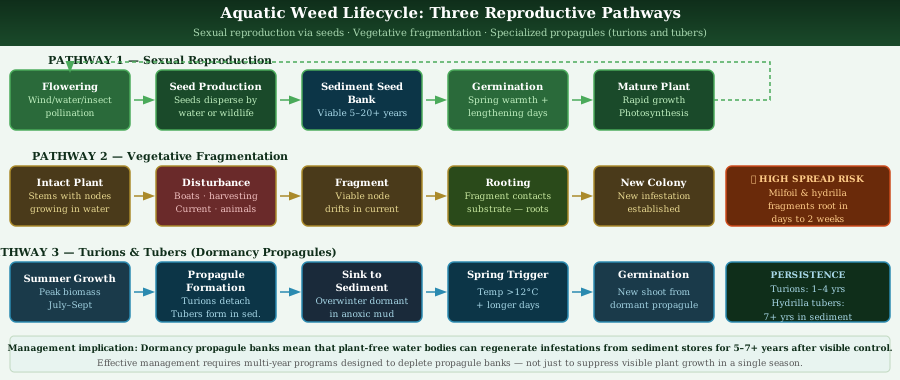
The Most Powerful Spread Mechanism in Aquatic Weed Management
Vegetative fragmentation — the detachment of plant parts that root and grow into new individuals — is the single most important spread mechanism for many of the most problematic invasive aquatic weeds. It converts management activities themselves into potential spread vectors: the very act of cutting, harvesting, or disturbing these plants can create hundreds or thousands of viable propagules. Understanding fragmentation biology is not just academic — it directly governs which mechanical control techniques are safe to deploy and which will worsen an infestation.
The Biology: How Fragments Root and Grow
Plant stems contain meristematic nodes — the junction points where leaves attach to the stem, containing undifferentiated cells capable of producing both roots and new shoots. When a stem fragment containing one or more intact nodes contacts a suitable substrate (soft sediment, shallow water), the node can initiate adventitious roots within 1–14 days under warm-water conditions. The fragment does not need to be fresh — studies have documented viable establishment from milfoil fragments that have been in the water for up to 30 days.
The efficiency of fragmentation as a reproductive strategy is extraordinary. A single Eurasian watermilfoil stem section of 5 cm containing one viable node is sufficient to establish a new plant. Dense milfoil beds produce an estimated 250 million viable fragments per hectare per growing season from natural breakage alone — and any mechanical disturbance multiplies this by orders of magnitude. The mathematical reality is that a single harvesting pass in an uncontained milfoil bed can release millions of viable fragments into a water body. Eurasian watermilfoil management →
High-Risk Species for Fragmentation Spread
Not all aquatic plants have equal fragmentation risk. Species are classified by their fragmentation invasiveness based on three factors: node viability after detachment, rooting success from fragments, and the probability of natural or mechanical fragmentation during normal growth and management. The highest-risk species:
- Eurasian watermilfoil (Myriophyllum spicatum): The paradigmatic fragmentation-invasive species. Brittle stems break easily at nodes, fragments float for days to weeks before rooting, and viability is high across a wide temperature range. Documented spread by harvesting equipment, boater traffic, and even swimming is extensive. Species profile →
- Hydrilla (Hydrilla verticillata): High fragmentation potential combined with the additional propagule mechanisms of axillary turions and sediment tubers. Hydrilla fragments can root from even small stem sections, and the plant's rapid growth rate means that established fragments quickly become problematic. Hydrilla profile →
- Brazilian waterweed (Egeria densa): Fragmentation is the primary spread mechanism for this ornamental that has escaped from aquariums and water gardens. Fragments are highly viable and the plant establishes rapidly in warm, clear water. Most infestations in western U.S. states have been traced to aquarium or water garden introductions. Brazilian waterweed profile →
- Variable-leaf watermilfoil (Myriophyllum heterophyllum): Similar fragmentation characteristics to Eurasian milfoil, with some populations showing herbicide resistance that makes management more challenging.
- Water hyacinth (Eichhornia crassipes): Primarily spreads via stolons rather than stem fragments, but the entire plant (including living daughter plants connected by stolons) fragments from mats under mechanical disturbance and establishes rapidly. Water hyacinth profile →
How Mechanical Operations Spread Infestations
The specific pathways by which management activities spread fragment-invasive species:
- Mechanical harvesting without containment: Harvesting equipment that cuts plants and relies on collection conveyors inevitably produces fine-cut fragments that escape the collection system. Without boom containment around the harvest area, these fragments disperse throughout the water body. Cases of intra-lake spread from harvesting to previously-uninfested areas of the same lake have been documented extensively.
- Propeller turbulence: Boat propellers in weed beds generate intense turbulence that cuts stems and creates high-velocity fragment dispersal. This is why weed density typically tracks boat traffic patterns within heavily infested lakes — high-traffic corridors act as distribution vectors within the lake.
- Ballast and bilge water discharge: Fragments and turions that enter bilge water or live wells are transported to new water bodies when equipment is moved without proper draining and drying between uses. This is the primary inter-lake spread pathway. Prevention protocols →
- Waterfowl transport: Diving ducks and wading birds that feed in infested areas transport fragments and small propagules externally (in feathers, feet) and internally (through digestive systems where some propagules survive passage). This pathway is not preventable but is estimated to contribute less to long-distance spread than watercraft for most species.
Fragment Survival and Environmental Conditions
Fragment viability varies by temperature, light, and time adrift. Key findings from research:
- Eurasian milfoil fragments show highest rooting success at water temperatures above 15°C. Below 10°C, rooting is slow and success rates decrease.
- Fragments that land in shade or on hard substrate have significantly reduced establishment rates compared to fragments on soft sediment in moderate light.
- The critical environmental window: newly cut fragments floating in warm, sunny conditions on soft-sediment substrates can establish within 1–2 weeks. Fragments in cool, dark conditions on hard substrates may take months or fail entirely.
- Desiccation (drying) is effective at killing fragments — this is the biological basis for the "Dry" step in the Clean Drain Dry prevention protocol. A minimum of 5 days of complete drying at air temperature kills the vast majority of fragments; hotter or dryer conditions reduce required drying time further. Clean Drain Dry guide →
Fragment Containment Best Practices
Professional harvesting operations use a layered containment approach to minimize fragment escape:
- Perimeter containment booms: Floating boom barriers placed around the harvest work area to physically contain fragments that escape the harvesting equipment.
- Slow travel speeds: Harvesting equipment traveling slowly through weed beds minimizes the turbulence that creates additional fragments beyond those captured by the cutting and collection system.
- Post-harvest fragment surveys: Visual inspection of the water surface in and around the containment area after each pass to identify and collect visible escaped fragments.
- Upland disposal: All collected plant material transported to land-based disposal sites. Plant material should never be dumped back into the water body or adjacent water, regardless of apparent condition.
- Equipment decontamination between water bodies: Complete inspection, cleaning, and drying of all harvesting equipment before it is used in any other water body. Mechanical control guide →
Frequently Asked Questions
How small a fragment can establish a new plant?
For Eurasian watermilfoil and hydrilla, fragments as small as 3–5 cm containing a single intact node can successfully establish under favorable conditions. In practice, fragments smaller than about 2 cm rarely survive long enough to establish because the energy reserves in the fragment are insufficient to sustain root initiation before the fragment's resources are depleted. However, the effective minimum viable fragment size varies by water temperature, light availability, sediment quality, and the specific species and biotype involved. The management take-away: all harvested material must be treated as potentially viable, regardless of fragment size.
Why does harvesting sometimes make aquatic weed problems worse?
Harvesting can worsen infestations through three mechanisms: (1) Incomplete fragment collection — cutting equipment inevitably produces some fragments that escape the collection system. Without boom containment, these fragments distribute infestations within the water body. (2) Equipment transport — harvesting equipment moved between water bodies without proper decontamination carries fragments and propagules between water bodies. (3) Nutrient cycling — harvesting removes only above-ground plant biomass. The organic matter and nutrients from decomposing root systems remain in the sediment, fueling regrowth of the same or other weed species. None of these problems mean harvesting should not be used — they mean it must be used with proper protocols.
Which species are safe to hand-pull without fragment spread risk?
Floating species where the entire plant including roots can be removed intact — water hyacinth, duckweed, water lettuce, small patches of giant salvinia — are relatively safe for hand-removal when all plant material including daughter plants and roots is bagged and removed. Species with extensive stem fragmentation risk (milfoil, hydrilla, Brazilian waterweed) should only be hand-pulled by trained individuals who can manage fragments carefully. Always bag all removed material immediately and never leave removed plant material at the water's edge where it can re-enter the water. Any activity in highly invasive species during growing season carries fragment risk.
References
- Madsen, J.D. (1997). Seasonal biomass and carbohydrate allocation in a southern population of Eurasian watermilfoil. Journal of Aquatic Plant Management, 35, 15–21.
- Riis, T., et al. (2009). Plant dispersal and colonization processes at the individual and population levels. In: River Plants and Flows. Springer.
- Rothlisberger, J.D., et al. (2010). Aquatic invasive species transport via trailered boats: what is being moved, who is moving it, and what can be done? Fisheries, 35(3), 121–132.
- Gettys, L.A., et al. (2014). Biology and Control of Aquatic Plants: A Best Management Practices Handbook, 3rd ed. Aquatic Ecosystem Restoration Foundation.