The Biodiversity Cost of Aquatic Weed Invasion
When invasive and nuisance aquatic weeds form dense, near-monoculture stands in freshwater ecosystems, the most lasting ecological damage is often not the immediate harm to fish or recreation — it is the displacement of native plant communities and the cascading biodiversity losses that follow. Native aquatic plant communities are not simply background scenery. They are structural habitat providers, food sources, oxygen producers, sediment stabilizers, and water quality regulators. Their loss transforms diverse, productive aquatic ecosystems into impoverished, low-diversity systems that support fewer species at lower densities across every ecological guild — from invertebrates and fish to waterfowl and amphibians.
This page examines the mechanisms by which aquatic weeds suppress native plant biodiversity and the downstream ecological consequences of that suppression. For species-specific biodiversity impacts, see pages on hydrilla, Eurasian watermilfoil, water hyacinth, and fish and wildlife habitat effects.

How Aquatic Weeds Suppress Native Plant Communities
Light Competition: The Primary Mechanism
Dense aquatic weed canopies intercept light before it reaches native submerged plants growing at lower depths or at the same depth. Invasive floating plants — water hyacinth, giant salvinia, water lettuce — are particularly devastating because they form near-impenetrable surface mats that reduce light penetration to 1–5% of surface irradiance beneath dense coverage. Most native submerged plants require at least 15–25% of surface irradiance to sustain net positive growth; they simply cannot survive under floating plant mats. Within a growing season, a previously diverse submersed plant community can be eliminated entirely beneath a dense water hyacinth infestation.
Submerged invasive species like hydrilla reach the water surface faster than native plants, forming canopy layers that shade out lower-growing natives. Hydrilla's ability to photosynthesize at light levels below 1% of surface irradiance — far below the tolerance of most native submerged plants — allows it to persist and grow while native plants are suppressed.
Nutrient Uptake Competition
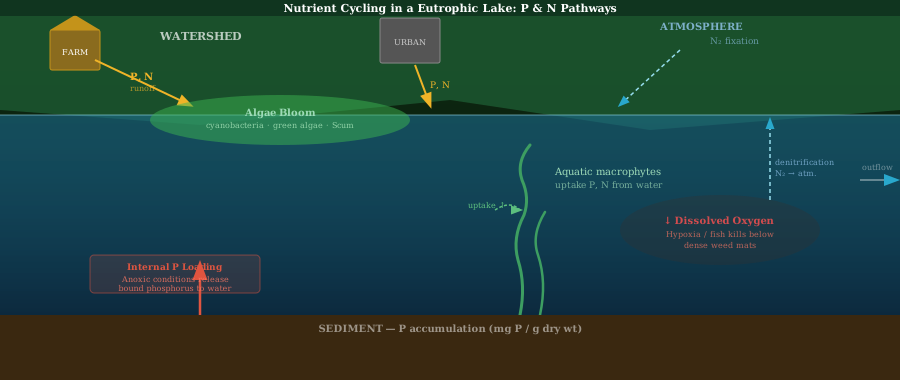
Dense invasive weed stands rapidly take up available nutrients — particularly phosphorus and nitrogen — from the water column and sediment. In high-nutrient (eutrophic) water bodies, this competitive advantage favors the fastest-growing species, which are frequently the invasive or nuisance species that have been released from the natural constraints of insect herbivory, disease, and nutrient limitation that govern them in their native range. Native plants, which evolved in lower-nutrient conditions and with slower growth rates, are competitively disadvantaged in the high-nutrient, high-growth-rate environment that eutrophication creates.
Physical Displacement and Allelopathy
Some aquatic weeds physically displace native plants through sheer biomass — dense weed mats in the littoral zone leave no physical space for native emergent or floating-leaved plants to establish. Some species also produce allelopathic compounds — chemical substances released into the water that inhibit germination or growth of competing plant species. Water hyacinth, Eurasian watermilfoil, and several other invasive aquatic plants have been documented to produce allelopathic compounds that suppress native aquatic plants in laboratory and field conditions, providing a chemical competitive advantage beyond simple resource competition.
Native Plant Community Diversity Loss
A healthy, diverse native aquatic plant community in a temperate lake or pond typically includes multiple functional groups: submerged species (pondweeds, milfoils, coontail, naiads, elodea), floating-leaved species (water lilies, spatterdock), emergent species (cattails, bulrushes, arrowheads, pickerelweed), and floating free-surface species (duckweed, water meal at low density). Each functional group provides different ecological services and occupies different habitat niches.
Invasive weed dominance progressively simplifies this community. As a single aggressive invasive species — hydrilla, water hyacinth, or Eurasian watermilfoil — comes to dominate the littoral zone, first the more light-sensitive submerged species disappear, then floating-leaved species are displaced, and finally even emergent margin vegetation may be affected as altered water chemistry, reduced light, and physical displacement eliminate the multi-layered plant structure that characterized the native community. The end state of severe, long-term infestation is often a near-monoculture of the invasive species, with perhaps a handful of the most tolerant native species persisting at very low density.
Loss of native plant diversity directly reduces the structural complexity of littoral habitat — the variety of attachment surfaces, shelter types, food sources, and microhabitat niches that support high invertebrate, fish, and waterfowl diversity. Fish and wildlife habitat effects →
Invertebrate Community Collapse
Aquatic invertebrates — insects, crustaceans, mollusks, worms, and other macroinvertebrates — depend critically on native aquatic plant communities for food (algae and plant material), attachment substrate (for feeding, pupation, and oviposition), and refuge from predators. Research consistently shows that the diversity of invertebrate communities associated with monoculture invasive weed beds is significantly lower than on diverse native plant beds, even though gross invertebrate biomass may be similar.
Hydrilla, Eurasian watermilfoil, and other non-native invasive plants have different physical structure, different surface chemistry, and different food quality than native plants. Invertebrate species that evolved to exploit native plant resources — feeding on specific plant tissues, using specific leaf surface chemistry for oviposition cues, completing metamorphosis on specific plant structures — may be unable to exploit the invasive plant in the same way. The result is a shift in invertebrate community composition, typically toward disturbance-tolerant generalist species and away from specialist species with specific native plant dependencies. Since many invertebrate species are regionally rare, endemic, or of conservation concern, this community shift can cause permanent local extinctions of rare invertebrate taxa.
Food Web Cascades
Because aquatic invertebrates are the primary food base for most fish and waterfowl species, invertebrate community collapse cascades up the food web. Juvenile fish in the first weeks and months of life depend entirely on invertebrate prey for growth and survival — reduced invertebrate diversity and density in heavily infested littoral zones translates to reduced juvenile fish survival and recruitment into adult populations. Waterfowl species that feed on aquatic invertebrates — diving ducks, dabbling ducks, shorebirds — are similarly affected. Studies on lakes converted from diverse native plant communities to invasive weed monocultures have documented reduced waterfowl species diversity and abundance, reduced fish recruitment, and altered food web structure.
The loss of native aquatic plants as direct food sources — seeds, tubers, and stems consumed by waterfowl and some fish — further reduces the productivity and diversity of the food web. Canvasback ducks, redheads, lesser scaup, and other diving ducks depend heavily on seeds and tubers of native pondweeds and other submerged plants during migration and wintering. Replacement of native pondweed communities by hydrilla or Eurasian watermilfoil monocultures reduces the nutritional resources available to these migratory species, potentially affecting population dynamics far beyond the infested water body.
Recovery and Restoration of Native Plant Communities
Native aquatic plant communities do not recover automatically after invasive weed control. Even after successful control of the invasive species, recovery of native plant diversity depends on: persistence of native plant seed banks or root crowns in the sediment (which may have been depleted over years of weed dominance); adequate water clarity for native plant establishment (which requires nutrient reduction, not just weed control); absence of secondary invasive species that colonize disturbed habitat; and sufficient time for slow-growing native species to re-establish.
Active restoration — replanting native species, seeding native plant communities, controlling invasive plants before planting natives — is often necessary to achieve recovery within a management-relevant timeframe. The most successful restoration programs combine: (1) invasive species control timed to minimize damage to native plant propagule banks; (2) nutrient management to improve water clarity and reduce competitive advantage of fast-growing invasive species; (3) active revegetation with appropriate native species for the site's depth, substrate, and regional plant community; and (4) prevention of reinvasion through boater education, equipment inspection, and monitoring.
Recovery timelines vary widely — from 2–5 years in small, well-managed water bodies to decades in large lake systems where the native seed bank has been depleted and invasive species pressure remains high. Long-term monitoring of native plant community diversity, not just absence of the target invasive, is the appropriate measure of restoration success. For guidance on managing specific invasive species affecting native communities, see the aquatic weed control methods hub.
Frequently Asked Questions
Can native aquatic plants coexist with invasive weeds?
At low invasive weed densities, native plants can persist, but as invasive weed coverage increases, competitive pressure on native species intensifies. Some native species are more tolerant of competition — coontail, water lilies with strong root systems, and robust emergent species may persist at moderate invasive weed densities. More sensitive native submerged species are typically the first to disappear. In most documented cases of severe, long-term invasive weed infestation, native plant diversity declines significantly — the community simplifies rather than 'coexisting' in any meaningful ecological sense.
Which aquatic weeds cause the most damage to native plant communities?
Hydrilla and water hyacinth cause the most severe native plant community displacement, due to hydrilla's extraordinary competitive advantages (deep light tolerance, rapid growth, tuber persistence) and water hyacinth's surface mat formation that eliminates light for all submerged species. Eurasian watermilfoil, giant salvinia, and water lettuce also cause severe displacement in their respective ranges. Dense curly-leaf pondweed infestations suppress native warm-season submersed plants through spring competitive dominance, though the effect is more seasonal than year-round.
Does controlling aquatic weeds automatically restore native plant diversity?
Not automatically. Weed control removes the competitive pressure but does not guarantee native plant recovery. If the native seed bank has been depleted, water clarity remains poor due to ongoing nutrient loading, or the water body is reinfested before native plants can establish, recovery may not occur without active intervention. Successful restoration requires combining weed control with nutrient management, monitoring, and in many cases active replanting of native species.
References
- Chambers, P.A., et al. (1999). The role of submerged aquatic plants in structuring freshwater communities. Freshwater Biology 41:409–420.
- Jeppesen, E., et al. (1998). The impact of nutrient state and lake depth on top-down control in the pelagic zone of lakes. Limnology and Oceanography 43:1317–1331.
- Langeland, K.A. (1996). Hydrilla: The perfect aquatic weed. Castanea 61(3):293–304.
- Toft, J.D., et al. (2003). The effects of introduced water hyacinth on habitat structure, invertebrate assemblages, and fish diets. Estuaries 26(3):746–758.
- Gettys, L.A., et al. (2014). Biology and Control of Aquatic Plants: A Best Management Practices Handbook, 3rd ed. Aquatic Ecosystem Restoration Foundation.