Identification Features
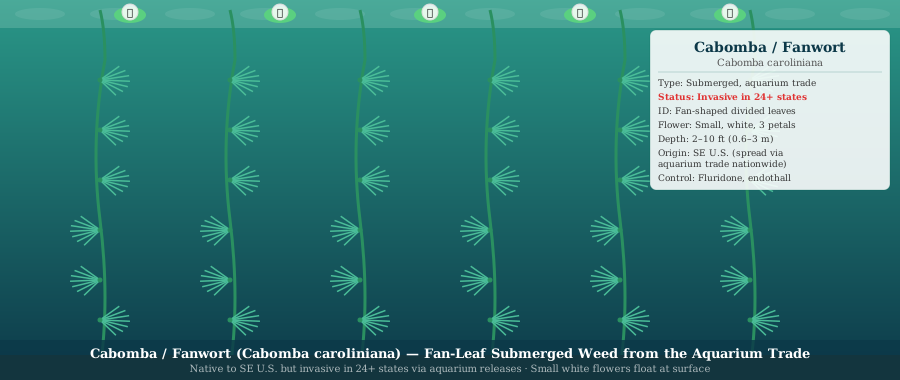
Cabomba (Cabomba caroliniana), also called fanwort, is one of the most visually striking submerged aquatic plants. The submersed leaves are fan-shaped and pinnately divided — each leaf is divided into multiple pairs of narrow, thread-like segments arranged radially, resembling a small green fan or an open hand. Leaves are arranged in opposite pairs along the stem, and the overall appearance is feathery and delicate. Stem internodes are 2–4 cm, spacing the leaf pairs along a sinuous, freely branching stem.
Cabomba also produces small floating leaves near the water surface when approaching flowering — these are oval to elongated, 1–2 cm, with a notched (peltate) base, and are quite different from the submerged leaves. This leaf heterophylly (different leaf forms above and below water) is diagnostic for cabomba among fan-leaved submerged plants. Flowers are white or pale yellow, 1–2 cm across, with 3 petals.
Cabomba is sometimes confused with coontail (both have divided, bushy leaves) but is easily distinguished: coontail's leaves are forked (dichotomous) and rigid/rough; cabomba's leaves are finely pinnately divided and soft/flexible. Coontail has no roots; cabomba is rooted in sediment. Identification guide →
Biology and Invasive Status
Cabomba is native to the southeastern United States (Florida, the Gulf Coast states, and southward) but has been introduced and become invasive throughout much of northeastern North America, several mid-Atlantic states, and internationally in Europe, Asia, and Australia. It was spread primarily through the aquarium and water garden trade — it is one of the most popular aquarium plants in the world, sold under the name "Carolina fanwort" or "green cabomba."
Cabomba spreads vegetatively: stem fragments root readily in sediment, and waterfowl and boats disperse fragments between water bodies. It is a warm-season grower, most active in summer, and goes dormant under ice in northern states. Despite dying back in winter, established populations persist through rhizomes and basal tissue and regenerate vigorously in spring.
Distribution and Invasive Range
Native range: Florida south through tropical South America. Invasive range in the U.S.: New England states (particularly Massachusetts, Connecticut, Maine), mid-Atlantic, Pacific Northwest, and parts of the Midwest. Most management-significant infestations are in New England, where it has displaced native vegetation in multiple lakes and ponds. Cabomba is listed as invasive in more than a dozen countries and is one of the world's most globally problematic aquatic invasive plants due to the aquarium trade.
Control
Cabomba management options include fluridone, endothall, and diquat, applied before peak biomass development in late spring/early summer for best results. Physical removal by harvesting provides temporary suppression but must be done carefully to avoid creating dispersible fragments. Cabomba is a priority target in New England states with active management programs. Control methods →
Management and Control Approaches
Fanwort management uses the same approaches as other fragment-invasive submerged weeds. Systemic herbicides — fluridone (whole-lake slow-release application) and endothall — provide effective control. Mechanical harvesting carries the usual fragmentation-spread risks and requires perimeter boom containment. Grass carp have limited effectiveness against fanwort due to its low palatability compared to other submerged species — carp tend to consume higher-palatability species before consuming fanwort, providing limited relief in mixed-species infestations. Herbicide options for submerged weeds →
Early detection is especially critical for fanwort because its ornamental appearance makes it likely to be misidentified as a native plant (native Cabomba caroliniana exists in the southeastern U.S., while invasive Cabomba caroliniana from South America is the problem species in most of the northern U.S.). Any suspected fanwort in a water body outside its native southeastern range should be reported to the state aquatic invasive species program for confirmation before determining management response. Identification guide →
Frequently Asked Questions
Is cabomba illegal to own in the United States?
Cabomba caroliniana is listed as a federal noxious weed in some states and is prohibited from sale, transport, or introduction into natural water bodies in several northeastern and mid-Atlantic states. At the federal level, it is not universally prohibited, but state-level regulations vary significantly. Check your state's aquatic invasive species list before purchasing cabomba for any purpose. The plant remains widely sold as an aquarium plant in some areas where state regulations have not yet caught up with its invasive status.