Overview
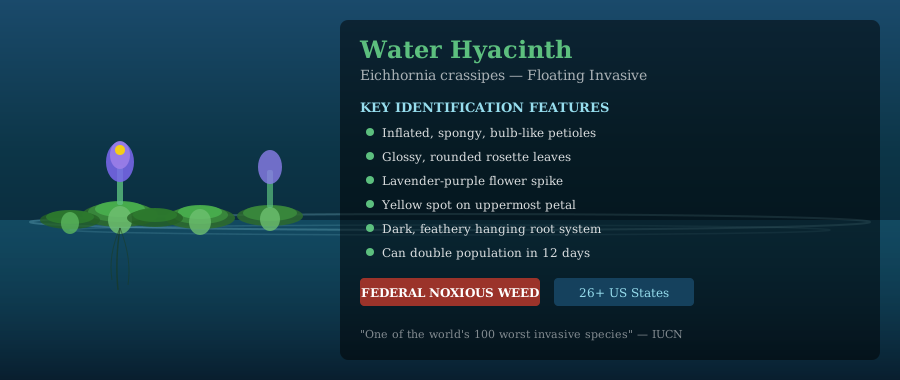
Water hyacinth is considered one of the world's worst aquatic weeds by the IUCN and is listed among the world's 100 worst invasive species. A free-floating plant native to South America, it has spread to tropical and subtropical regions worldwide. Its attractive purple flowers belie its extremely invasive nature — it can double its population in as few as 12 days under optimal conditions, covering entire water bodies with mats so dense they can support the weight of a person walking across them.
Identification Characteristics
Water hyacinth is one of the most visually distinctive aquatic plants. Its rounded, glossy, bright green leaves are arranged in rosettes and held above the water surface on uniquely inflated, spongy, bulb-like petioles that serve as natural flotation devices. This inflated petiole is the most diagnostic identification feature — no other common aquatic weed has it.
Roots are dark purple to black, feathery, and hang several inches below the plant in the water column, filtering nutrients directly from the water. The plant produces showy spikes of 8–15 lavender to violet flowers with a distinctive yellow spot surrounded by purple on the uppermost petal. Individual plants range from a few inches to over a foot in height.
In cooler or low-nutrient conditions, plants may not produce the inflated petioles, instead producing slimmer, more strap-like leaf stalks. Even in this form, the glossy rounded leaf blades and dark feathery root system remain distinctive. The plant has no roots connected to the sediment — it floats freely or is trapped in mats.
Growth Habit & Ecology
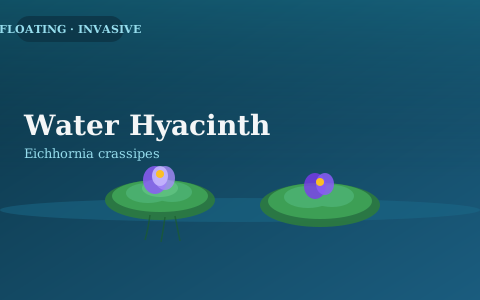
Water hyacinth reproduces primarily through vegetative means — daughter plants develop on stolons from the parent plant at extraordinary rates. Each plant can produce 70,000 plants covering half an acre in just 3 months under optimal conditions. This makes it one of the fastest-reproducing plants on Earth. Each plant can also produce thousands of seeds that remain viable in the sediment for over 20 years, creating a persistent seed bank even after surface plants are eliminated.
Growth is driven by warm temperatures (optimal: 77–86°F), high nutrient levels (particularly nitrogen and phosphorus from agricultural runoff or sewage), full sunlight, and still or slow-moving water. Under these conditions, populations double every 7–12 days. Conversely, cold water (below 50°F), low nutrients, shade, and turbulent water all limit growth.
In frost-free climates (Florida, Gulf Coast, Southern California), water hyacinth grows year-round. In areas with light frost, plants die back but may re-establish from seeds the following spring. This seasonal pattern means that cool-climate infestations can seem to disappear in winter only to re-emerge aggressively in spring.
Habitat Preferences
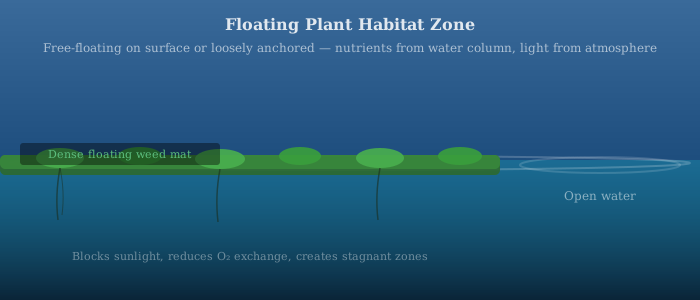
Water hyacinth thrives in warm, still to slow-moving freshwater bodies with high nutrient concentrations. It is most abundant in tropical and subtropical climates where air and water temperatures remain above 59°F for most of the year. In the United States, it forms year-round populations in Florida, Louisiana, and coastal Texas, and seasonally in other Gulf Coast states and California's Sacramento-San Joaquin Delta.
Key habitat requirements include warm water temperatures (optimal 77–86°F; growth stalls below 59°F), high nutrients — particularly nitrogen and phosphorus from agricultural runoff, livestock operations, or wastewater discharge — and calm or slow-moving water where currents do not disperse mats. It is exclusively a freshwater species, not tolerating brackish conditions above approximately 1–2 ppt salinity.
Water hyacinth thrives in slow rivers, backwaters, lakes, reservoirs, ponds, canals, bayous, and coastal impoundments. It does not establish in flowing rapids or highly exposed coastal areas. Agricultural drainage canals in the Gulf South — warm, nutrient-loaded, and slow-moving — represent ideal habitat and function as pathways connecting infested water bodies. The species is considered an ecological indicator of severely eutrophic conditions; its presence signals high nutrient loading.
Spread Mechanisms
Water hyacinth's explosive spread combines several biological and human-mediated pathways. The most important biological spread mechanism is vegetative stolons: daughter plants form on short horizontal runners from the parent, producing dense interconnected mats that expand across water surfaces at visible rates. Under ideal conditions, an initial small colony can expand to cover an acre of water surface within a growing season.
Long-lived seeds (viable in sediment for 20+ years) provide a persistent source of reinfestaton even after complete above-ground removal. Seeds are distributed by water currents, flooding events, and animals. Dense mats themselves become mobile during flood events, with entire sections breaking free and floating into downstream water bodies.
Human transport has historically driven long-distance spread: ornamental plant trade introduced water hyacinth to regions worldwide in the 19th and early 20th centuries. Despite its Federal Noxious Weed status prohibiting interstate sale, water hyacinth continues to be sold online — a contributing factor in new infestations. Waterfowl and water birds carry seeds and small plant fragments, as does boating equipment.
Preventing introduction requires vigilance: never purchase or plant water hyacinth in open water bodies; clean and dry equipment moving between water bodies; report sightings to state agricultural or natural resource agencies.
Seasonal Growth Pattern
Water hyacinth's seasonal behavior differs sharply depending on climate. In frost-free regions (Florida, Gulf Coast, Southern California), the plant grows continuously year-round and can maintain enormous surface coverage throughout winter. There is no natural seasonal control in these areas — populations must be actively managed year-round.
In areas with occasional or mild frosts, plants may die back at the surface during cold periods but re-establish from seeds and small surviving plants the following spring. The timing of spring population explosion depends heavily on when water temperatures cross approximately 60°F — in the Gulf South, this can occur as early as February or March.
In areas with sustained freezing temperatures (below 28°F for several days), above-ground plants are typically killed. However, seeds in the sediment survive and can germinate in subsequent warm growing seasons if conditions are favorable. This means that cold winters reduce but do not eliminate the long-term threat.
Summer peak (June–September across the Gulf South) represents the period of most aggressive mat development. Population doubling every 7–12 days means that a small early-summer colony can become an acre-scale infestation by August without intervention. Early-season treatment before peak growth offers the highest cost-effectiveness.
Ecological Impact
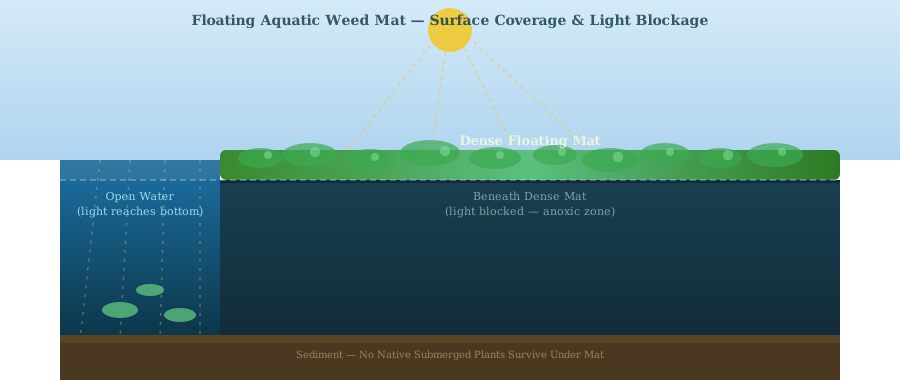
Water hyacinth's ecological and socioeconomic impacts are among the most severe of any aquatic invasive plant. Dense mats — which can exceed 100 kg of biomass per square meter — block virtually all sunlight from the water column, eliminating growth of submerged aquatic plants and triggering a cascade of ecological changes.
As submerged plant communities collapse, dissolved oxygen in the water drops dramatically from both reduced photosynthesis and the enormous oxygen demand of decomposing biomass. Fish kills are common in severely infested water bodies. Invertebrate communities shift from diverse assemblages to those tolerant of low oxygen. Native aquatic bird species that depend on open water and native vegetation lose habitat.
Economically, water hyacinth has caused humanitarian crises in Africa and Asia, blocking waterways that fishing communities depend on for subsistence. Lake Victoria in East Africa lost billions of dollars in economic productivity and suffered catastrophic fisheries collapse associated with water hyacinth invasion. In the United States, costs include lost recreational value, reduced property values, impaired irrigation and water supply intakes, and millions in annual management expenditures.
Control Methods
Water hyacinth management is inherently challenging because removal must outpace the plant's extraordinary growth rate. An integrated pest management approach combining multiple strategies is most effective for sustained control.
Mechanical removal using harvesting equipment provides immediate reduction in plant cover and is often used to open navigation channels. However, mechanical harvesting must be nearly continuous to keep pace with regrowth, and removed biomass must be transported away and disposed of properly.
Herbicide control with 2,4-D, glyphosate, or diquat provides effective knockdown. 2,4-D is the most commonly used herbicide for water hyacinth in the United States, providing systemic control. State permits and buffer zones for water use (irrigation, drinking, swimming) are required.
Biological control using the weevils Neochetina eichhorniae and N. bruchi, introduced in the 1970s, has achieved long-term suppression in some regions, particularly in warmer climates. A water hyacinth moth (Niphograpta albiguttalis) has also been introduced. Biological control is most effective when used to maintain control after initial population reduction.
Nutrient reduction — addressing the eutrophication that fuels rapid growth — is the most sustainable long-term approach, though it operates on a much longer timescale than other methods.
Important: Always obtain required permits before applying any aquatic herbicide or introducing biological control agents. Requirements vary by state. Contact your state department of natural resources or environmental protection agency for guidance.
Distribution in the United States
Water hyacinth is established throughout the Gulf Coast states (Florida, Louisiana, Texas, Mississippi, Alabama) and in California, where it forms persistent year-round infestations. It is present in at least 26 states, though populations in states with cold winters may not survive year-round without reintroduction.
Florida and Louisiana have the most significant and historically troublesome infestations. In Florida, water hyacinth was once so pervasive that it completely choked major rivers and lake basins; decades of intensive management have reduced but not eliminated infestations. Louisiana bayou systems continue to require ongoing management.
California's Sacramento-San Joaquin Delta has experienced rapidly expanding water hyacinth populations since the early 2000s, threatening the Delta's critical water supply infrastructure and ecological values. California now operates an aggressive management program. New infestations continue to appear in states further north during warm years.
Frequently Asked Questions
Why is water hyacinth so hard to control?
Its explosive growth rate (population doubles every 7–12 days under optimal conditions), multiple reproduction modes (vegetative and seed), long-lived seeds (viable 20+ years), and ability to thrive in nutrient-rich water make it extremely difficult to control. Even small fragments left behind after removal can re-establish. In warm, nutrient-rich conditions, growth rate consistently outpaces manual removal efforts.
Does water hyacinth die in winter?
In frost-free climates (Florida, Gulf Coast, Southern California), it persists year-round and grows continuously. In areas with light frosts, it dies back seasonally but may re-establish from long-lived seeds in spring. In areas with sustained freezes (below 28°F for multiple days), the above-ground plant is typically killed, though seeds may survive in the sediment for future germination.
Are there any benefits to water hyacinth?
Despite its invasive nature, water hyacinth can remove heavy metals, excess nitrogen, and phosphorus from water through phytoremediation. It has been used as livestock feed, compost, biogas feedstock, and in handicrafts in some tropical countries. However, these beneficial uses have not proven sufficient to justify its introduction or retention in invaded regions, where its harms far outweigh any benefits.
How did water hyacinth spread around the world?
Water hyacinth's spread began in the 19th century when it was introduced as an ornamental plant from South America. Its attractive flowers led to its deliberate introduction in botanical gardens and private ponds across tropical and subtropical regions worldwide. Escapes from cultivation spread into natural waterways. It is now established on every continent except Antarctica.
Is water hyacinth illegal to grow?
In the United States, water hyacinth is a Federal Noxious Weed, meaning interstate transport and sale is illegal. Most Gulf Coast states and California have state-level prohibitions on possession and sale. Despite these regulations, water hyacinth is still sold online and in some water garden stores, contributing to new infestations.
References & Further Reading
- Villamagna, A.M. & Murphy, B.R. (2010). Ecological and socio-economic impacts of invasive water hyacinth (Eichhornia crassipes): a review. Freshwater Biology 55(2):282–298.
- IUCN (2021). Eichhornia crassipes listed among the world's 100 worst invasive alien species. IUCN Invasive Species Specialist Group.
- Center, T.D., et al. (2002). The mosaic of biological control agent establishment against water hyacinth. BioControl 47:167–186.
- California Department of Food and Agriculture (2022). Water Hyacinth in the Sacramento-San Joaquin Delta: Management Approach and Status. CDFA.