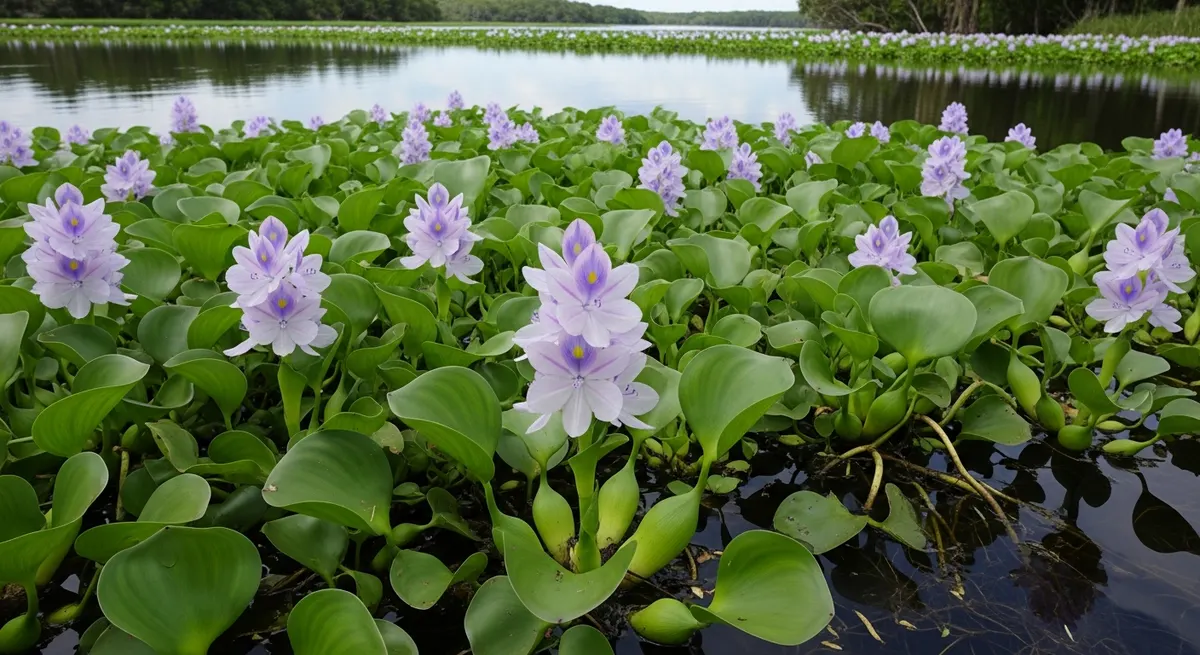
The World's Worst Aquatic Weed
Water hyacinth (Eichhornia crassipes) is considered by many ecologists to be the world's worst aquatic weed. Originally native to the Amazon basin in South America, it has spread to more than 50 countries across five continents following deliberate introduction for ornamental purposes in the 19th and early 20th centuries. In the United States, water hyacinth is established throughout the Gulf Coast states, the entire state of Florida, and much of California, where it causes enormous ecological and economic damage. In Africa and Asia, it has created humanitarian crises by blocking water transportation, destroying fisheries, and fouling drinking water sources for millions of people.
The plant is visually stunning — a rosette of glossy, rounded leaves with inflated, buoyant petioles and an erect spike of lavender-purple flowers that has earned it the nickname "water orchid." This ornamental beauty was directly responsible for its spread worldwide: it was distributed at expositions and through the water garden trade beginning in the late 1800s, planted in ponds and waterways, and inevitably released into natural water bodies where it found ideal conditions and no natural controls.
Taxonomy and Biology
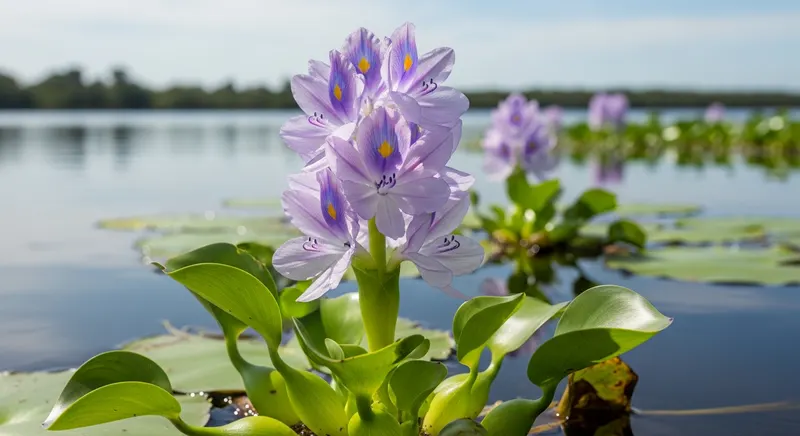
Water hyacinth belongs to the family Pontederiaceae (pickerelweed family). Eichhornia crassipes is its single species — there are no U.S. native relatives. It is a free-floating perennial herb in frost-free climates, persisting year-round in Florida and the Gulf Coast. In states with freezing winters (such as parts of California), water hyacinth behaves as an annual or facultative perennial, dying back in hard frosts but reestablishing from seeds or surviving buds in mild winters. Seeds remain viable in waterway sediments for decades.
The plant floats because of its inflated petioles — the stalks connecting leaves to the stem. These bulbous, spongy petioles are filled with aerenchyma tissue (air-filled cells) that provide buoyancy. The roots hang freely in the water, forming dense, dark purple mats of fine root hairs that are highly efficient at absorbing nutrients from the water column. This root structure is both an ecological problem (blocking water flow, creating anoxic zones) and the foundation of water hyacinth's potential use in phytoremediation — experiments have demonstrated its capacity to remove heavy metals and excess nutrients from polluted water.
Introduction to the United States
Water hyacinth arrived in the United States at the 1884 World Cotton Centennial Exposition in New Orleans, Louisiana, where plants were given away to visitors as decorative souvenirs. Within years, it had escaped into Louisiana bayous and the St. Johns River in Florida. By 1900, it was already a serious navigation problem in Florida waterways. The state of Florida began organized hyacinth control efforts in 1899 — making it the site of the first organized aquatic weed management program in the United States and one of the earliest anywhere in the world.
The plant spread westward through the Gulf Coast — Texas, Louisiana, Mississippi, Alabama — and northward along river systems. California infestations developed separately through water garden releases into irrigation canals and the Sacramento-San Joaquin Delta, where it remains a significant problem today.
Growth Rate and Competitive Biology
Water hyacinth can double its population in as little as 6–18 days under optimal conditions of warm temperature (25–30°C), high sunlight, and nutrient-rich water. This growth rate is among the fastest of any plant species on Earth. A small patch of water hyacinth can cover several acres in a single growing season under ideal conditions. Dense mats block sunlight from reaching submerged plants and algae, creating essentially dead zones beneath them. For details on growth dynamics, see the full water hyacinth growth rate guide.
Economic and Ecological Significance
In the United States, water hyacinth management costs state and federal agencies tens of millions of dollars annually. In Florida alone, the state's Exotic Pest Plant Council has tracked management expenditures exceeding $10 million per year in some years. Beyond direct management costs, water hyacinth impairs navigation (obstructing boat traffic, fouling outboard motors), reduces recreational fishing access, kills fish through oxygen depletion, and reduces waterfront property values. In developing countries, particularly in Africa, water hyacinth has caused catastrophic impacts on subsistence fishing communities by covering entire lakes and river deltas, making net fishing impossible and eliminating access to water for drinking and irrigation.
For ecological impacts in U.S. waters, see water hyacinth ecological impact. For control options, see water hyacinth control methods.
References
- Holm, L., et al. (1977). The World's Worst Weeds. University Press of Hawaii.
- Gettys, L.A., et al. (2014). Biology and Control of Aquatic Plants. Aquatic Ecosystem Restoration Foundation.
- UF/IFAS Center for Aquatic and Invasive Plants. Eichhornia crassipes. plants.ifas.ufl.edu
Whole-Lake Hydrilla Management: Lake Tohopekaliga, FL
Lake Tohopekaliga ("Lake Toho"), a 22,700-acre Central Florida lake, has sustained one of the most intensively managed hydrilla programs in the U.S. since the 1990s. Annual fluridone treatments combined with targeted mechanical harvesting in high-use recreational areas have maintained hydrilla coverage below nuisance thresholds while preserving native submersed vegetation communities in designated littoral zones.
Key outcome: Multi-decade integrated program demonstrates that hydrilla can be managed at acceptable levels in large water bodies, but requires sustained annual investment and coordinated agency cooperation across FDEP, SFWMD, and local fisheries managers.
The species identification guides on AquaticWeed.org are the most accurate I've used in 18 years of lake management. I now send all my new clients here first before we discuss treatment options.
Robert Harmon Certified Lake Manager, FL · Lake Okeechobee regionWe referenced the biological control pages extensively when evaluating our grass carp stocking proposal. The detail on stocking rates and target species specificity helped us present a credible case to our board.
Karen Ostrowski HOA Lake Committee Chair, MN · Lake Minnetonka association