Currently Available: Web Content
The primary access format for AquaticWeed.org information is our structured web content — 241 pages covering species identification, biology, ecology, distribution, management, and supporting educational topics. All web content is:
- Freely accessible: No login, subscription, or payment required. All 241 pages are publicly accessible at all times.
- Structurally organized: Content is organized into topic clusters (species profiles, identification, biology, ecology, management, distribution, questions) with consistent URL structure that reflects content hierarchy. Species pages follow the pattern
/species/[slug]/and sub-pages follow/species/[slug]/[subtopic]/, making content location predictable and linkable. - Machine-readable: All pages include structured data markup (JSON-LD Schema.org) for Article, FAQPage, BreadcrumbList, Organization, and WebSite schema types, enabling search engines and data consumers to extract structured information directly from the HTML.
- Citable: Each species page, management page, and supporting article is individually addressable by URL and includes the primary sources it is based on, enabling citation of both AquaticWeed.org content and its underlying sources.
- Linkable and embeddable: All AquaticWeed.org content is freely linkable. Educational organizations, state agencies, and researchers may link directly to specific pages, species profiles, or sections without restriction.
Web Content Structure by Topic
Understanding the URL structure makes it easier to navigate directly to the content you need:
- Species authority pages:
/species/[slug]/— comprehensive profiles for hydrilla, water-hyacinth, duckweed, eurasian-watermilfoil, pondweed, coontail, alligator-weed, elodea, and chara - Species sub-pages:
/species/[slug]/[subtopic]/— identification guides, ecology pages, control methods, FAQ, distribution, and what-is pages for each species - Growth category hubs:
/floating-aquatic-weeds/,/submerged-aquatic-weeds/,/emergent-aquatic-weeds/ - Management cluster:
/aquatic-weed-control-methods/,/aquatic-weed-management-planning/, and sub-pages - Biology and ecology:
/aquatic-weed-biology/,/ecological-impact-of-aquatic-weeds/, and sub-pages - Distribution:
/aquatic-weed-distribution-united-states/and regional sub-pages - Questions and answers:
/questions/hub and 30 individual question pages at/questions/[slug]/
A complete list of all 241 pages is available on our site map.
Structured Data and Schema Markup

Every page on AquaticWeed.org includes JSON-LD structured data in the page head. This enables automated extraction of page metadata, entity relationships, and FAQ content by search engines and data consumers. The schema types implemented include:
- Article: Applied to all educational content pages — species profiles, management guides, biology articles. Includes headline, description, author organization, and publisher information.
- FAQPage: Applied to all pages with FAQ sections — species profiles, management pages, and question-and-answer pages. Each FAQ is marked up with Question and Answer entities, enabling direct display in search results.
- BreadcrumbList: Applied to all pages — enables search engines to display page hierarchy in results and facilitates navigation understanding.
- Organization and WebSite: Sitewide schemas in the page head of every page, providing publisher identity and site-level metadata.
Developers and data engineers who want to extract structured data from AquaticWeed.org can use standard HTML parsing and JSON-LD extraction from the <script type="application/ld+json"> tags present on every page.
Coming Soon: Downloadable Species Reports (PDF)
We are developing formatted two-page PDF reference sheets for each of the 9 authority species. Each report will include a standardized template covering: common name and scientific name, federal and state regulatory status, primary identification characteristics with diagnostic features, distribution map (state-level presence/absence), primary management methods, key management considerations, and primary source citations.
These reports are designed for field use — printable, clearly formatted, and containing the core identification and management information a practitioner needs in a non-internet-connected setting such as a field survey or management planning meeting. They are also suitable for educational distribution by lake associations, extension services, and agency programs.
Target availability: 2026. Contact us at [email protected] if you have specific formatting requirements for your program.
Coming Soon: Interactive Distribution Maps
Our distribution map development project will produce interactive, state-level presence/absence maps for all 9 authority species and for major management-relevant species in the floating, submerged, and emergent categories. Maps will be updated on the same schedule as our distribution content (see update frequency) and sourced from the USGS Nonindigenous Aquatic Species (NAS) database, USDA PLANTS database, and state agency records.
Map features in development include: state-level presence/absence with confidence rating; year of first detection for each state; indication of eradication vs. established status where known; zoom capability to county level for states with high-resolution occurrence records; and export of map views as images for use in reports and presentations. Target availability: 2025–2026. Learn more about our distribution data →
Future: CSV Dataset Downloads
We plan to make tabular datasets available for download in CSV format for the following data categories:
- Species distribution records: State-by-state presence/absence for all covered species, with source attribution and confidence ratings, suitable for import into GIS and data analysis tools
- Management method comparison: Tabular comparison of management approaches by species, cost range, effectiveness rating, and permit requirement level, for use in management planning analysis
- Reference bibliography: Complete list of primary sources cited on AquaticWeed.org in CSV format, including journal, year, author(s), title, and DOI where available, for use in research literature review workflows
CSV datasets will be made available under an open data license with attribution requirement. Target availability: 2026. To register interest or request a specific dataset, contact [email protected].
Future: API Access
A read-only API for programmatic access to AquaticWeed.org species data, distribution records, and management information is on our long-term development roadmap. The API would enable developers, researchers, and state agency systems to query our data directly — for example, to integrate aquatic weed species information into agency GIS systems, embed species-specific management guidance in extension service portals, or pull distribution data into conservation planning tools.
API development is contingent on demonstrated demand. If API access would be valuable for your organization or research program, please contact us at [email protected] with a description of your use case. We are tracking demand to prioritize this development investment appropriately.
See also our distribution data page, update frequency page, and search and browse features.
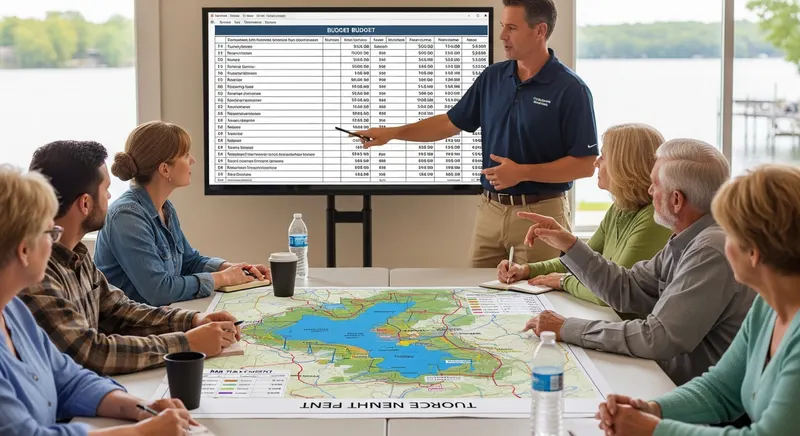
Ten-Year Lake Management Plan: Lake Wingra, WI
Lake Wingra, a 342-acre urban lake in Madison, WI, developed a comprehensive 10-year management plan coordinating the City of Madison, University of Wisconsin, and adjacent neighborhood associations. The plan addressed Eurasian watermilfoil, curly-leaf pondweed, and purple loosestrife through an integrated approach including targeted herbicide treatment, mechanical harvesting, native plant restoration, and public education.
Key outcome: The structured multi-agency planning process secured consistent funding across multiple budget cycles, a key advantage over ad hoc management. Native plant restoration efforts showed measurable progress in designated restoration zones within three years of initiation.
The seasonal timing guidance has been invaluable. Treating at the right growth stage cut our herbicide costs by nearly 30% without sacrificing efficacy on our county-managed reservoir.
Dale Buchanan County Parks Director, MI · Kalamazoo CountyRunning a golf course with three retention ponds means constant weed pressure. The prevention and best management practices guide gave us a systematic approach that replaced our reactive spray schedule.
Paul Esteban Golf Course Superintendent, SC · Myrtle Beach area