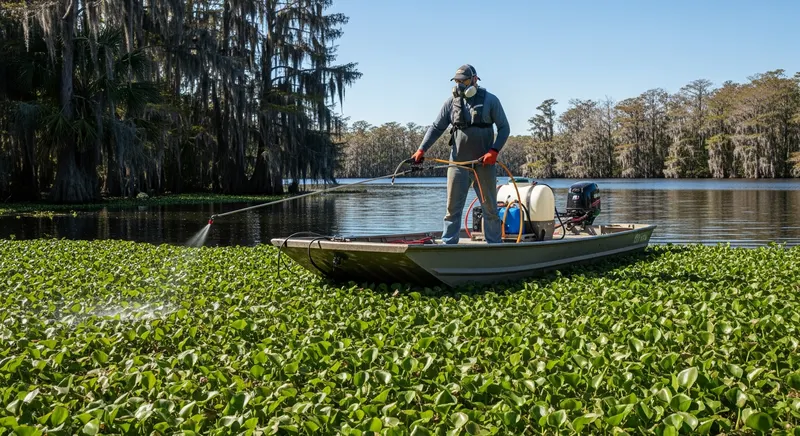
EPA-registered aquatic herbicides have been rigorously tested for safety to humans, aquatic organisms, and the broader environment when used according to label directions. They are not unconditionally safe — they require licensed applicators, state permits, and strict adherence to water use restrictions. When properly used, they are among the most environmentally selective tools available for invasive aquatic weed management.
- EPA-registered aquatic herbicides are approved only after rigorous safety testing for human health and aquatic ecosystems.
- All aquatic herbicides carry water-use restrictions (swimming, irrigation, livestock watering) that must be followed.
- Professional, licensed applicators are required by most states to apply herbicides to public water bodies.
- Product selection, timing, and dosing must match the target species and water conditions to be effective and safe.
- Herbicide labels are legal documents — following them completely is both required and the best safety guarantee.
The Regulatory Framework for Aquatic Herbicides
Aquatic herbicides used in U.S. waterways are regulated at multiple levels. The EPA evaluates each product through the Federal Insecticide, Fungicide, and Rodenticide Act (FIFRA) process, which requires extensive safety testing for human health, aquatic organism toxicity, sediment behavior, degradation pathways, and environmental fate before registration. Only products that meet EPA safety standards can be legally sold and used.
At the state level, each state's department of environmental protection or natural resources regulates aquatic herbicide applications through permit systems. Permit requirements typically specify which products can be used, in what water body types, at what concentrations, during what seasons, and with what notification and posting requirements. This dual federal-state regulatory system provides substantial safety oversight.
How Aquatic Herbicides Work
Different aquatic herbicides work through different mechanisms of action, each with different selectivity and environmental behavior profiles.
Systemic Herbicides
Fluridone interferes with carotenoid synthesis (a plant-specific process with no mammalian equivalent), causing plants to bleach and die over 30–90 days. It is highly selective for vascular plants, minimally toxic to fish and invertebrates at treatment concentrations, and degrades photolytically in sunlit water. Its slow action allows fish and invertebrates to relocate as treated plants die gradually, reducing oxygen depletion risk.
Contact Herbicides
Endothall disrupts cellular membranes in plant tissue on contact, providing rapid results (7–14 days) with shorter water use restriction periods. It degrades rapidly in water through microbial activity. Copper-based algaecides, while technically not herbicides, work by contact mechanism against algae and are among the most commonly used treatments for algae and chara.
Water Use Restrictions Explained
Water use restrictions (WURs) are legally required waiting periods between herbicide application and resumption of specific water uses. They are based on the rate at which the herbicide dissipates to safe concentrations for each use type. Restrictions are typically most conservative for potable water use (irrigation of food crops, livestock watering, drinking water intake), followed by swimming/recreation, then fishing. Your applicator is legally required to notify you of all WURs before treatment and must post notices at all water access points. Never use treated water for any restricted purpose during the WUR period. Full chemical control guide →
Sources & Scientific References
- USEPA. Aquatic pesticide registrations and water quality. Office of Pesticide Programs.
- Getsinger, K.D. (1998). Aquatic herbicide selectivity and efficacy. ERDC/EL Technical Note.
- Sprecher, S.L. & Getsinger, K.D. (2000). Zebra mussel chemical control guide. ERDC/EL SR-00-1.
Frequently Asked Questions
Are aquatic herbicides safe for fish?
EPA-registered aquatic herbicides used at label rates are generally safe for fish. The primary fish risk from herbicide treatment is not direct toxicity but indirect: oxygen depletion caused by the decomposition of treated plant biomass. This is why professional applicators treat sections sequentially over multiple years rather than treating entire water bodies at once. Some products have fish toxicity at concentrations far higher than those used for weed control.
Can you swim after aquatic herbicide treatment?
Each aquatic herbicide product has specific water use restrictions (WURs) that include minimum waiting periods before swimming, fishing, drinking water use, and irrigation use. Swimming restrictions range from 0 days (some contact herbicides) to several days (some systemic products). These restrictions are on the product label and must be followed by law. Your applicator is required to notify you of these restrictions before treatment.
Do aquatic herbicides require a permit?
Yes. In all U.S. states, the application of aquatic herbicides requires a state permit (typically from the department of environmental protection or natural resources), in addition to a federal NPDES permit in most circumstances. Permit applications require applicant identification, water body information, species to be treated, products to be used, and often a management plan. Applications must be made by or under supervision of a licensed pesticide applicator.
What is the safest aquatic herbicide?
Safety depends on the specific application context. Fluridone is considered highly selective and low-risk for non-target aquatic plants and animals. Endothall at low rates is a rapid-acting option with short water use restrictions. Triclopyr is selective for broadleaf plants and leaves grasses/sedges largely unaffected. No single product is universally 'safest' — product selection requires matching the product to the target species, water body characteristics, and desired selectivity level.
Key Takeaways
- EPA-registered aquatic herbicides are approved only after rigorous safety testing for human health and aquatic ecosystems.
- All aquatic herbicides carry water-use restrictions (swimming, irrigation, livestock watering) that must be followed.
- Professional, licensed applicators are required by most states to apply herbicides to public water bodies.
- Product selection, timing, and dosing must match the target species and water conditions to be effective and safe.
- Herbicide labels are legal documents — following them completely is both required and the best safety guarantee.
Ten-Year Lake Management Plan: Lake Wingra, WI
Lake Wingra, a 342-acre urban lake in Madison, WI, developed a comprehensive 10-year management plan coordinating the City of Madison, University of Wisconsin, and adjacent neighborhood associations. The plan addressed Eurasian watermilfoil, curly-leaf pondweed, and purple loosestrife through an integrated approach including targeted herbicide treatment, mechanical harvesting, native plant restoration, and public education.
Key outcome: The structured multi-agency planning process secured consistent funding across multiple budget cycles, a key advantage over ad hoc management. Native plant restoration efforts showed measurable progress in designated restoration zones within three years of initiation.
The ecological impact section helped our team explain to county commissioners why early intervention matters. The oxygen depletion data alone secured funding for our early-detection monitoring program.
Donna Whitfield State Wildlife Biologist, GA · Okefenokee regionWe used the integrated management framework from this site to structure our Eurasian watermilfoil control program. After three seasons we've reduced lake-wide coverage by 78% on our 340-acre water body.
Susan Thibodeau Lake District Manager, MN · Crow Wing County