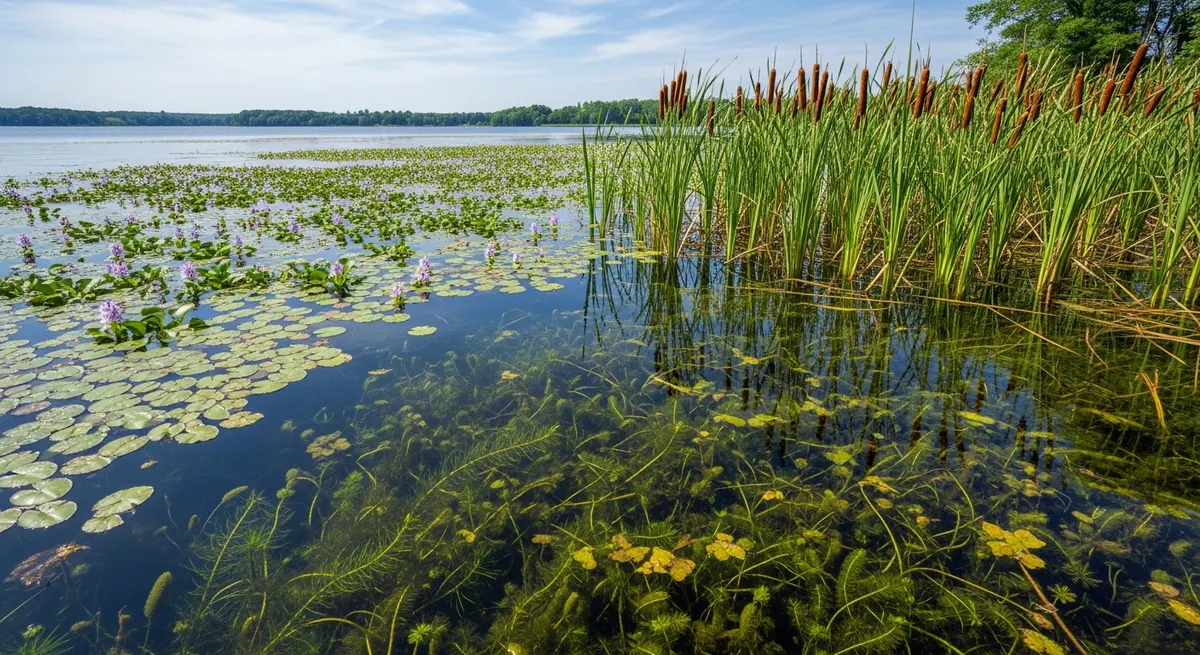
Invasive aquatic weeds displace native aquatic plant communities through three primary mechanisms: competitive exclusion (superior resource acquisition that outcompetes native species), shading (dense canopies that reduce light available to underlying native plants), and physical suppression (growth that overrides and smothers slower-growing native plants). The loss of native aquatic plant diversity has cascading effects throughout the food web — affecting invertebrates, fish, waterfowl, and the fundamental ecological functions that healthy plant communities provide.
- Invasive aquatic weeds displace native plant communities through competitive exclusion, shading, and physical suppression.
- Native aquatic plant diversity is closely correlated with animal biodiversity — losing plant diversity causes cascading losses.
- Hydrilla forms dense canopies that shade out native submerged plants, reducing native species richness by 50–90% in infested water bodies.
- Restoring native plant communities requires removing invasives first — re-seeding alone fails without prior weed suppression.
- Healthy native plant communities are the most durable long-term defense against invasive aquatic plant establishment.
How Competitive Exclusion Works in Aquatic Systems
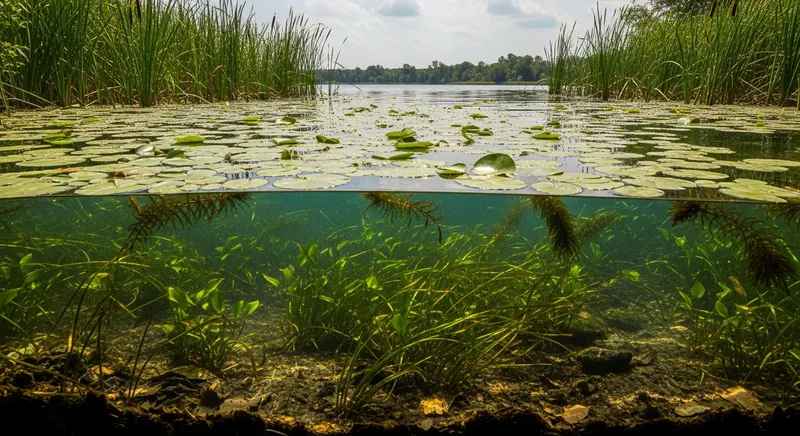
Competitive exclusion — the displacement of one species by another through resource competition — is the primary mechanism by which invasive aquatic plants reduce native plant diversity. The key resource being competed for is light. Most aquatic plants grow toward the surface to maximize light capture, and the species that forms the densest canopy at the surface shades out everything below it. Invasive species like hydrilla, Eurasian watermilfoil, and Brazilian elodea — all fast-growing submerged plants that reach the water surface and form dense mats — reduce light availability in the water column to levels below the minimum required for the survival of slower-growing, less competitive native plants beneath them.
The phenological aspect of this competition is particularly important. In temperate lakes, aquatic plant growth begins in early spring as water temperatures rise and day length increases. Species that emerge earliest — particularly curly-leaf pondweed, which grows in cold water before most native plants emerge — gain a resource preemption advantage that allows them to dominate before competition begins. By the time native species are growing actively, the invasive may already have formed a surface canopy that prevents native plants from establishing. What drives aquatic weed growth →
Cascading Effects of Native Plant Loss
The loss of native aquatic plant diversity is not an isolated ecological impact — it triggers cascading effects throughout the food web and broader ecosystem. Native aquatic plant communities support specialized invertebrate communities (insects, crustaceans, mollusks) that depend on specific plant structures for food and habitat. These invertebrates are critical food sources for juvenile fish, breeding waterfowl, and other wildlife. When invasive monocultures displace the native plant community and its associated invertebrate diversity, the food web loses critical energy pathways.
Fish communities are particularly affected. Many fish species — including game fish like largemouth bass, bluegill, and yellow perch — depend on native plant structural complexity for spawning substrate, juvenile habitat, and foraging. Invasive monocultures that create uniformly dense, species-poor environments provide less suitable habitat than diverse native communities, even when they support higher total plant biomass. Studies have documented reduced fish species richness, juvenile fish abundance, and game fish condition in heavily invaded water bodies compared to those with intact native plant communities. Fish population impacts →
Restoration of Native Plant Communities
Restoring native aquatic plant communities after invasive species suppression requires both weed control and active plant restoration in most cases. The invasive species must be reduced to low density — not necessarily eradicated — to relieve competitive suppression. Active native plant establishment (seeding or transplanting of locally appropriate native species) then creates a native community that can compete with remaining invasive plants and resist reinvasion. Key elements of successful native plant restoration include: appropriate species selection for the depth, substrate, and water quality of the target site; adequate density of plantings to establish competitive cover; and monitoring and follow-up weed treatment to prevent invasive regrowth before native plants are established. The ecological value of aquatic vegetation →
Sources & Scientific References
- Nichols, S.A. & Shaw, B.H. (1986). Ecological life histories of three aquatic nuisance plants: Myriophyllum spicatum, Potamogeton crispus, and Elodea canadensis. Hydrobiologia, 131(1), 3–21.
- Valley, R.D. & Newman, R.M. (1998). Competitive interactions between Eurasian watermilfoil and native aquatic macrophytes. Journal of Aquatic Plant Management, 36, 85–88.
- Thiébaut, G. (2007). Does competition for phosphate supply explain the invasion success of Elodea species? Biological Invasions, 9(2), 219–231.
Frequently Asked Questions
Why are native aquatic plants important?
Native aquatic plant communities provide essential ecological services that invasive monocultures do not replicate: food web support (native plant seeds, tubers, and invertebrate communities associated with diverse plant beds are critical food resources for fish, waterfowl, and wildlife); structural habitat complexity (diverse plant assemblages create varied microhabitats that support greater biodiversity than monocultures); water quality function (native plants stabilize sediment, take up nutrients, oxygenate the water column, and buffer against nutrient pulses); and shoreline protection (native emergent plants dissipate wave energy and prevent erosion better than either bare substrate or invasive monocultures).
How do invasive weeds outcompete native plants?
Invasive aquatic plants exploit several competitive advantages over native species: rapid growth rate — many invasives grow significantly faster than native species, reaching the surface and forming dense canopies before native plants emerge in spring; resource acquisition — some invasives are adapted to efficiently acquire phosphorus and other nutrients at low concentrations, enabling them to thrive in conditions where native plants cannot; phenological advantage — curly-leaf pondweed, for example, grows in cold water before native plants emerge, gaining dominance before competition is possible; and release from natural control — invasives lack the herbivores, pathogens, and competitors that regulate their growth in their native range.
How much native plant diversity is lost to aquatic invasions?
Quantitative studies of Eurasian watermilfoil, hydrilla, and Phragmites invasions consistently document dramatic reductions in native plant species richness and abundance. Studies of hydrilla-invaded water bodies have found native submergent species richness reduced by 50–90% compared to uninvaded reference sites. Eurasian watermilfoil invasions are associated with 30–70% reductions in native submergent plant cover in affected areas. Purple loosestrife monocultures in wetlands have been found to reduce plant species richness by 50% or more compared to native plant communities.
Can native aquatic plants recover after invasive removal?
Recovery depends on the species removed, the duration of the invasion, and the management approach used. For some invasive species removed early in the invasion (before native seed banks are depleted), native plant recovery can occur naturally within 2–5 years. For long-established, dense invasions — particularly Phragmites monocultures — native plant recolonization is slow and often fails without active restoration. Residual seed banks, altered soil chemistry, and physical legacy effects of the invasive can all impede native plant recovery even after the invasive is suppressed. Active native plant seeding or transplanting accelerates and improves recovery outcomes in most cases.
Are there native aquatic plants that resist invasive species?
A healthy, diverse native plant community is the most effective natural resistance to invasive species. Water bodies with intact, diverse native plant communities show substantially lower invasive species colonization rates than those with sparse or degraded native communities. Among individual species, some native plants are more competitive against invasives than others — wild celery (Vallisneria americana) and native pondweeds (Stuckenia, Potamogeton) have shown competitive ability against Eurasian watermilfoil in some studies. However, no native species provides complete protection, and native plant community health is the most reliable predictor of invasion resistance.
Key Takeaways
- Invasive aquatic weeds displace native plant communities through competitive exclusion, shading, and physical suppression.
- Native aquatic plant diversity is closely correlated with animal biodiversity — losing plant diversity causes cascading losses.
- Hydrilla forms dense canopies that shade out native submerged plants, reducing native species richness by 50–90% in infested water bodies.
- Restoring native plant communities requires removing invasives first — re-seeding alone fails without prior weed suppression.
- Healthy native plant communities are the most durable long-term defense against invasive aquatic plant establishment.
Ten-Year Lake Management Plan: Lake Wingra, WI
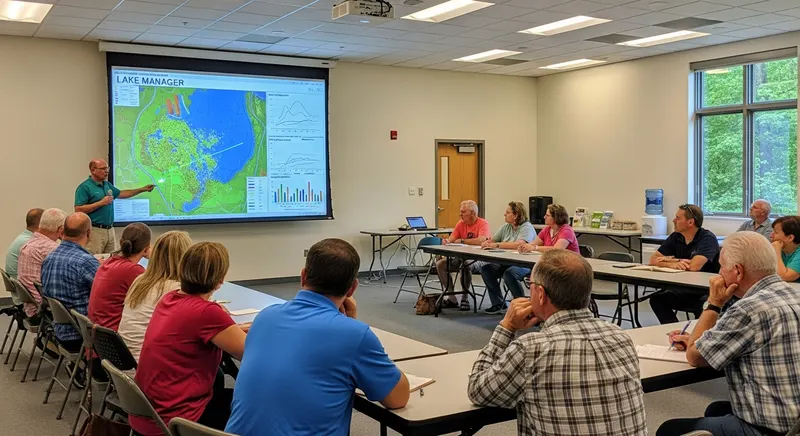
Lake Wingra, a 342-acre urban lake in Madison, WI, developed a comprehensive 10-year management plan coordinating the City of Madison, University of Wisconsin, and adjacent neighborhood associations. The plan addressed Eurasian watermilfoil, curly-leaf pondweed, and purple loosestrife through an integrated approach including targeted herbicide treatment, mechanical harvesting, native plant restoration, and public education.
Key outcome: The structured multi-agency planning process secured consistent funding across multiple budget cycles, a key advantage over ad hoc management. Native plant restoration efforts showed measurable progress in designated restoration zones within three years of initiation.
I've managed aquatic vegetation on Texas reservoirs for 15 years. The water hyacinth control content here is the most up-to-date, practical guidance I've found anywhere online.
Travis McKinley Commercial Fishing Guide, TX · Lake Travis / Lake AustinThe species identification guides on AquaticWeed.org are the most accurate I've used in 18 years of lake management. I now send all my new clients here first before we discuss treatment options.
Robert Harmon Certified Lake Manager, FL · Lake Okeechobee region