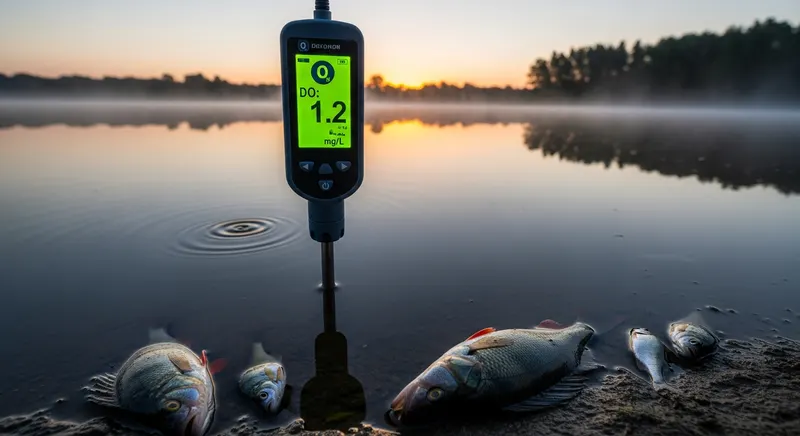
DO is tightly coupled with aquatic plant cycles, thermal stratification, and eutrophication — and most fish kills, fish habitat loss, and water-quality complaints in lakes can be traced back to a DO problem.
How Oxygen Enters and Leaves Lake Water
Dissolved oxygen enters lake water from two sources: atmospheric diffusion at the air–water interface (enhanced by wind, waves, and turbulence) and photosynthesis by aquatic plants and algae (which produces oxygen as a byproduct in daylight). Oxygen leaves the water through respiration by all aquatic organisms (continuous, day and night), microbial decomposition of organic matter (consumes oxygen as bacteria break down dead plant and algal material), and chemical oxidation of reduced compounds in the sediment.
The cold-water saturation concentration of dissolved oxygen is higher than warm-water saturation — cold water at 5°C holds about 12.8 mg/L at saturation, while warm water at 30°C holds only 7.6 mg/L. This temperature dependency is a primary reason summer dissolved oxygen problems are more severe and more common than winter problems in most U.S. lakes.
The Diel and Seasonal Oxygen Cycle

In productive lakes, dissolved oxygen follows a strong daily (diel) cycle driven by photosynthesis vs respiration balance. Daytime photosynthesis can supersaturate surface water (DO > 12 mg/L common in plant beds at midafternoon). Nighttime respiration consumes oxygen continuously while no photosynthesis offsets it, producing minimum DO in the predawn hours (commonly 3–5 mg/L in plant beds, occasionally < 2 mg/L). Fish stress and mortality occur at DO < 4 mg/L for warmwater species and < 6 mg/L for coldwater species like trout — predawn oxygen sags are therefore the most common direct cause of summer fish kills.
Seasonally, oxygen distribution is controlled by thermal stratification. From late spring through fall in temperate stratified lakes, the bottom layer (hypolimnion) is isolated from atmospheric reaeration. Continuous oxygen consumption by sediment microbes depletes hypolimnetic DO progressively through summer — many eutrophic lakes show complete hypolimnetic anoxia (DO ≈ 0 mg/L) by August. The anoxic hypolimnion releases dissolved phosphorus and ammonia from the sediment via "internal loading," fueling subsequent algal blooms and creating a positive feedback loop that worsens eutrophication. See the oxygen depletion guide for direct ecological impacts.
How Aquatic Weeds Drive DO Problems
Dense aquatic weed beds are paradoxically associated with both extremely high daytime DO (from intense photosynthesis) and extremely low nighttime DO (from intense respiration plus restricted surface exchange beneath canopy mats). The diel swing in heavily infested coves can exceed 8 mg/L from peak afternoon to predawn minimum — a stress level few fish species can tolerate over multiple consecutive nights.
Weed senescence at end of growing season is the highest-risk DO period in most managed lakes. When large quantities of plant biomass die simultaneously, microbial decomposition consumes oxygen far faster than reaeration can replenish it — particularly under the calm warm conditions that often coincide with senescence. Major fish kills in hydrilla- and milfoil-infested water bodies frequently coincide with herbicide-triggered or natural senescence events. Best-practice management spreads treatments across multiple smaller applications to avoid massive synchronous die-offs.
Measuring and Managing DO
Dissolved oxygen is measured with electrochemical (membrane) probes or optical sensors deployed at multiple depths. Continuous monitoring sondes deployed for 24–72 hours capture the full diel cycle and identify the predawn minimum that single midday measurements miss. State lake management programs increasingly require DO profiling as part of lake monitoring protocols. Aeration, destratification, and hypolimnetic oxygenation can ameliorate DO problems in critical lakes, but like other in-lake treatments, durable improvement requires controlling the underlying nutrient loading.
Frequently Asked Questions
What dissolved oxygen level is needed for healthy fish?
Most warmwater fish species (bass, bluegill, catfish) require dissolved oxygen above 4 mg/L for survival and above 5 mg/L for healthy growth. Coldwater species (trout, salmon) require above 6 mg/L. Acute mortality occurs at sustained DO below 2 mg/L. Trout in waters that briefly drop below 6 mg/L will experience stress and reduced growth even without acute kills.
Why do fish kills happen in summer?
Summer fish kills usually result from one of three causes: predawn dissolved oxygen depletion under hot, calm conditions; sudden anoxic water rising to surface during partial mixing events; or oxygen consumption by massive plant or algal die-offs. All three are aggravated by elevated nutrient loading and dense aquatic weed beds.
How does aquatic weed treatment cause fish kills?
Herbicide treatments kill plants, which then decompose. Microbial decomposition consumes oxygen — large simultaneous die-offs can deplete dissolved oxygen below survival thresholds within days. Best practice is to treat in sections of no more than 25–40% of the water body at a time, allowing decomposition to spread over weeks rather than days. Permits typically require this.
What is hypoxia?
Hypoxia is the condition of dissolved oxygen below approximately 2 mg/L, the threshold at which most aquatic life cannot survive long-term. Anoxia is the complete absence of dissolved oxygen (0 mg/L), at which only specialized anaerobic microbes can function. The hypolimnion of many eutrophic lakes becomes anoxic during summer stratification.
Does aeration solve aquatic weed problems?
Aeration directly raises dissolved oxygen and can reduce internal phosphorus loading, but it does not directly reduce aquatic weed biomass. Aeration is most useful as part of an integrated program addressing both nutrient sources and in-lake symptoms. Aeration alone in a heavily eutrophic, weed-infested lake typically does not produce lasting recovery.
Can dissolved oxygen be too high?
Yes — supersaturated dissolved oxygen (greater than 100% of saturation, commonly 110–150% in productive plant beds at midafternoon) can cause gas bubble disease in fish, particularly trout. Sustained supersaturation is uncommon outside of intensive aquaculture; in natural lakes the supersaturated daytime peaks are short-lived and rarely cause direct fish harm.
References
- Wetzel, R.G. (2001). Limnology: Lake and River Ecosystems, 3rd ed. Academic Press, San Diego.
- Diaz, R.J. & Rosenberg, R. (2008). Spreading dead zones and consequences for marine ecosystems. Science, 321(5891), 926–929.
- Nürnberg, G.K. (1995). Quantifying anoxia in lakes. Limnology and Oceanography, 40(6), 1100–1111.
- U.S. EPA (1986). Quality Criteria for Water. EPA 440/5-86-001.
- Cooke, G.D., et al. (2005). Restoration and Management of Lakes and Reservoirs, 3rd ed. Taylor & Francis.
Ten-Year Lake Management Plan: Lake Wingra, WI
Lake Wingra, a 342-acre urban lake in Madison, WI, developed a comprehensive 10-year management plan coordinating the City of Madison, University of Wisconsin, and adjacent neighborhood associations. The plan addressed Eurasian watermilfoil, curly-leaf pondweed, and purple loosestrife through an integrated approach including targeted herbicide treatment, mechanical harvesting, native plant restoration, and public education.
Key outcome: The structured multi-agency planning process secured consistent funding across multiple budget cycles, a key advantage over ad hoc management. Native plant restoration efforts showed measurable progress in designated restoration zones within three years of initiation.
We referenced the biological control pages extensively when evaluating our grass carp stocking proposal. The detail on stocking rates and target species specificity helped us present a credible case to our board.
Karen Ostrowski HOA Lake Committee Chair, MN · Lake Minnetonka associationThe ecological impact section helped our team explain to county commissioners why early intervention matters. The oxygen depletion data alone secured funding for our early-detection monitoring program.
Donna Whitfield State Wildlife Biologist, GA · Okefenokee region