Authority Species Profiles
The species below represent the most ecologically damaging, economically costly, and management-challenging aquatic plants in the United States. Each profile is built on a foundation of peer-reviewed research and provides the depth of information needed by lake managers, researchers, property owners, and natural resource professionals making real management decisions.
Hydrilla — Hydrilla verticillata
Category: Submerged Invasive | Status: Federal Noxious Weed
The most aggressive submerged invasive plant in the United States. Hydrilla can grow one inch per day, tolerates near-total darkness, and reproduces via four mechanisms including tubers that survive in sediment for over a decade. Established in 30+ states. Annual management costs run into the tens of millions of dollars in Florida alone.
Water Hyacinth — Eichhornia crassipes
Category: Floating Invasive | Status: Federal Noxious Weed
Considered the world's worst aquatic weed, water hyacinth can double its population in 12 days and form floating mats that cover entire lakes. Introduced from South America as an ornamental in 1884, it has since spread throughout the Southeast and warm-climate states. Dense mats eliminate light, deplete oxygen, block navigation, and cause fish kills.
Eurasian Watermilfoil — Myriophyllum spicatum
Category: Submerged Invasive | Status: Highly Invasive
The most widely distributed invasive submerged plant in North America, established in 45+ states. Its feathery leaves form dense canopies that shade out native vegetation. The species spreads primarily through fragmentation on boats and watercraft — a single stem fragment with one node can establish a new population. Native-invasive hybrid forms show increased herbicide tolerance.
Curly-leaf Pondweed — Potamogeton crispus
Category: Submerged Invasive | Status: Invasive
A European invasive that uniquely grows in cool water — appearing in spring before native aquatics emerge and dying back in early summer, leaving behind massive decaying biomass that depletes oxygen and releases nutrients that fuel algal blooms. Widespread throughout the northern United States and Canada. Its early growth gives it a competitive advantage over native aquatic plants.
Alligator Weed — Alternanthera philoxeroides
Category: Emergent Invasive | Status: Federal Noxious Weed
Native to South America, alligator weed grows in emergent mats along shorelines and in the water column, forming dense floating colonies that block waterways and crowd out native vegetation. One of the most successful biological control targets — three insect agents are approved for release, including the alligator weed flea beetle, which provides significant suppression in the Gulf Coast states.
Duckweed — Lemna minor and related species
Category: Floating | Status: Native / Nuisance
The world's smallest flowering plants, duckweed species are native to North America but can become major nuisances in nutrient-enriched water bodies. A single frond can become a pond-covering mat within weeks under favorable conditions. Unlike invasive species, duckweed responds primarily to nutrient inputs — reducing nitrogen and phosphorus is the most effective long-term management strategy.
Coontail — Ceratophyllum demersum
Category: Submerged | Status: Native / Nuisance
Coontail is a native, rootless submerged plant that provides valuable fish habitat in natural densities but can form disruptive dense beds in nutrient-enriched water bodies, impeding navigation and recreation. It lacks true roots, anchoring loosely in sediment or floating freely. Dense coontail beds are a sign of eutrophication rather than an invasive threat.
Elodea (Common Waterweed) — Elodea canadensis
Category: Submerged | Status: Native / Nuisance
Elodea is a native submerged plant with whorled leaves that is frequently confused with the invasive hydrilla — making accurate identification critically important before any management action. In natural densities, elodea is an ecologically valuable component of native plant communities. It can become nuisance-dense in high-nutrient water bodies but does not have the aggressive spread or ecological damage profile of true invasives.
Chara (Muskgrass) — Chara vulgaris and related species
Category: Submerged | Status: Native / Beneficial
Chara is a macroalgae — not a true plant — that is frequently confused with submerged aquatic plants. It is a native, ecologically beneficial species that indicates good water quality and is associated with clear, healthy lakes. Chara is not a weed in the management sense; it provides habitat, stabilizes sediment, and competes effectively with true invasive species. Management is rarely warranted and may be counterproductive.
Invasive vs. Native Nuisance Species: A Critical Distinction
The 9 species profiled here include both true non-native invasive species and native plants that become problematic in disturbed or nutrient-enriched water bodies. This distinction matters enormously for management planning:
- True invasive species (hydrilla, water hyacinth, Eurasian watermilfoil, curly-leaf pondweed, alligator weed) are non-native species that have been introduced to North American waterways and cause ecological harm disproportionate to their density. They are listed as Federal or state noxious weeds, and management typically requires state permits. The management goal is suppression or, in newly introduced populations, eradication. Interstate transport and sale are prohibited for Federal noxious weed species.
- Native nuisance species (duckweed, coontail, elodea) are native plants that grow out of balance in nutrient-enriched or otherwise disturbed water bodies. Their proliferation is typically a symptom of underlying water quality problems — elevated nitrogen and phosphorus inputs from agricultural runoff, lawn fertilizers, septic systems, or other sources. Effective long-term management of native nuisance species requires addressing the nutrient source, not just removing the plant. Chemical treatment provides temporary relief but will not prevent recurrence without nutrient management.
- Native beneficial species (chara) provide ecological services and should generally not be managed. Misidentification of chara as a weed and treating it can remove beneficial native vegetation and worsen water quality.
Accurate species identification is the essential first step in any management program. See our identification hub for tools and guidance, and our aquatic weeds vs. beneficial plants guide for help distinguishing problem species from ecological assets.
Species by Growth Category
Aquatic weed growth habit determines how the plant establishes, spreads, and affects the water body — and directly influences what management strategies are effective:
- Submerged species (hydrilla, Eurasian watermilfoil, coontail, elodea, curly-leaf pondweed, chara) grow beneath the surface. They affect light penetration, dissolved oxygen, and fish habitat most directly. Mechanical harvesting, aquatic herbicides, and biological agents are primary management approaches. See the submerged species hub →
- Floating species (water hyacinth, duckweed) grow at the water surface. They block light, deplete oxygen, and can cover entire water bodies rapidly. They are often the most visually dramatic aquatic weed problems. See the floating species hub →
- Emergent species (alligator weed) grow along shorelines and in shallow water with stems extending above the surface. They form dense mats at the water's edge that block shoreline access and displace native wetland vegetation. See the emergent species hub →
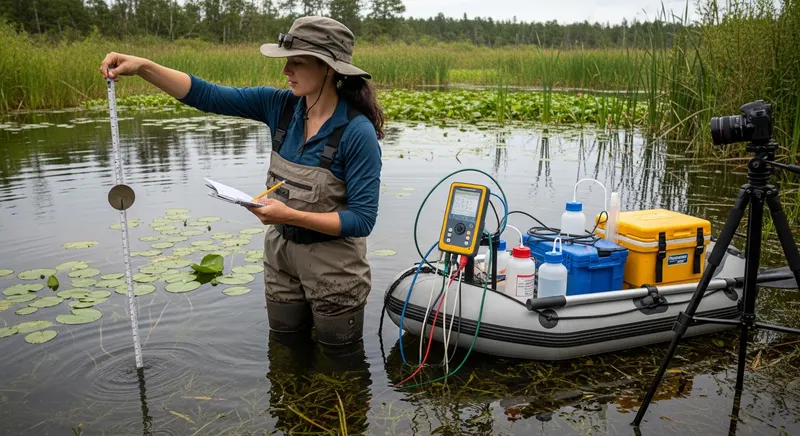
Whole-Lake Hydrilla Management: Lake Tohopekaliga, FL
Lake Tohopekaliga ("Lake Toho"), a 22,700-acre Central Florida lake, has sustained one of the most intensively managed hydrilla programs in the U.S. since the 1990s. Annual fluridone treatments combined with targeted mechanical harvesting in high-use recreational areas have maintained hydrilla coverage below nuisance thresholds while preserving native submersed vegetation communities in designated littoral zones.
Key outcome: Multi-decade integrated program demonstrates that hydrilla can be managed at acceptable levels in large water bodies, but requires sustained annual investment and coordinated agency cooperation across FDEP, SFWMD, and local fisheries managers.
The ecological impact section helped our team explain to county commissioners why early intervention matters. The oxygen depletion data alone secured funding for our early-detection monitoring program.
Donna Whitfield State Wildlife Biologist, GA · Okefenokee regionWe used the integrated management framework from this site to structure our Eurasian watermilfoil control program. After three seasons we've reduced lake-wide coverage by 78% on our 340-acre water body.
Susan Thibodeau Lake District Manager, MN · Crow Wing County