Update Philosophy
AquaticWeed.org updates content when substantive changes in the underlying science, regulatory landscape, or distribution records warrant revision — not on a fixed calendar schedule that would produce superficial revisions without informational improvement. Our update triggers are evidence-based: a significant new research finding that changes a management recommendation; a regulatory change that affects permit requirements for a control method; a new species detection that expands a distribution record; or an identified factual error that requires correction.
Content that accurately represents the current scientific consensus is not revised to appear fresh. Our readers are making real management decisions with our information, and superficial revisions that don't improve accuracy or completeness would undermine the editorial quality we maintain.
Update Schedule by Content Type
Regulatory Information — Annually or Upon Change
Regulatory content — including federal noxious weed listings, state noxious weed lists, aquatic herbicide permit requirements, licensed applicator requirements, and specific product use restrictions — is verified against authoritative primary sources (USDA APHIS, EPA pesticide registration database, and state agency websites) at least annually, typically in the first quarter of each calendar year. Significant mid-year regulatory changes are incorporated promptly upon identification.
Regulatory information is the highest-priority category for currency because errors or outdated content could cause users to act on incorrect permit requirements — a compliance risk with real financial and legal consequences. We encourage users relying on regulatory information for permit applications to verify current requirements directly with the relevant state agency regardless of the review date of our content.
Distribution Data — Semi-Annually
Species distribution information — state-level presence/absence records and range expansion updates — is reviewed against USGS Nonindigenous Aquatic Species (NAS) database records and major state agency databases twice per year, in spring (April) and fall (October), to capture early-season detection reports and end-of-season confirmation records. Significant new detections (particularly first-state records for major invasive species) are incorporated promptly when identified.
Distribution data has an inherent lag between actual species occurrence and database recording, as new detections must be verified, vouchered, and submitted to databases before they appear in records. Our distribution content reflects current database records, not necessarily real-time field conditions.
Management Guidance — Upon Significant Research Publication
Management efficacy content — including herbicide efficacy, biological control program status, mechanical management methods, and integrated management recommendations — is reviewed when significant new research is published in the Journal of Aquatic Plant Management, ERDC technical reports, or other primary sources, and when management consensus changes based on the accumulating research base. This is not on a fixed schedule but is driven by the research publication cycle.
We maintain literature alerts for all 9 authority species and major management method categories. When new research that materially changes a management recommendation is published, we update the affected content within 60–90 days of the publication date.
Species Biology Content — Periodically as Research Advances
Species biology content — life history, growth rates, reproduction mechanisms, physiological tolerances, and biotype information — changes more slowly than management guidance and is typically updated when significant genetic or ecological research changes the understanding of a species. For most well-studied species (hydrilla, water hyacinth, Eurasian watermilfoil), the fundamental biology is well-established and changes incrementally. New biotype research (such as herbicide-tolerant hybrid milfoil populations) triggers expedited review and update.
Educational and Contextual Content — As Needed
Background educational content — including general ecology, identification techniques, and explanatory articles — is updated when our team identifies clarity improvements, when user feedback identifies confusing sections, or when structural content improvements are needed. This content is reviewed in full at least every two years.
Data Sources That Drive Updates

The following are the primary information sources we monitor for content-triggering developments:
- USGS Nonindigenous Aquatic Species (NAS) database: Monitored for new state-level occurrence records for all 9 authority species and other significant invasives. nas.er.usgs.gov
- Journal of Aquatic Plant Management: The primary applied management research journal — every issue is reviewed for management-relevant findings. apms.org/japm
- EPA pesticide registration database: Monitored for new aquatic herbicide registrations, label amendments, and cancellations relevant to management guidance. epa.gov/pesticide-registration
- USDA APHIS noxious weed listings: Monitored for changes to the Federal Noxious Weed list and related regulatory actions. aphis.usda.gov
- U.S. Army Corps of Engineers ERDC publications: Monitored for new technical notes on aquatic herbicide efficacy and management program results from the Aquatic Plant Control Research Program.
- State aquatic invasive species program bulletins: We follow state agency communications for first-detection reports and management program updates from high-priority states.
How to Verify Information Currency
For any time-sensitive management decision — particularly those involving regulatory compliance, permit applications, or chemical control of regulated species — we recommend verifying current information directly with the primary source regardless of the review date on our content. Specifically:
- Current permit requirements: Contact your state DNR, DEQ, or equivalent agency directly
- Current species regulatory status: Check USDA PLANTS database and USDA APHIS for federal listings; your state agency for state listings
- Current herbicide registrations: Check EPA pesticide registration records and your state's pesticide registration database
- Current distribution records: Check the USGS NAS database directly for the most current occurrence records
To report outdated content on AquaticWeed.org, please contact us at [email protected] with the page URL and the specific information you believe requires updating. We investigate all content currency reports promptly. See our editorial policy for our full corrections and currency policy.
Ten-Year Lake Management Plan: Lake Wingra, WI
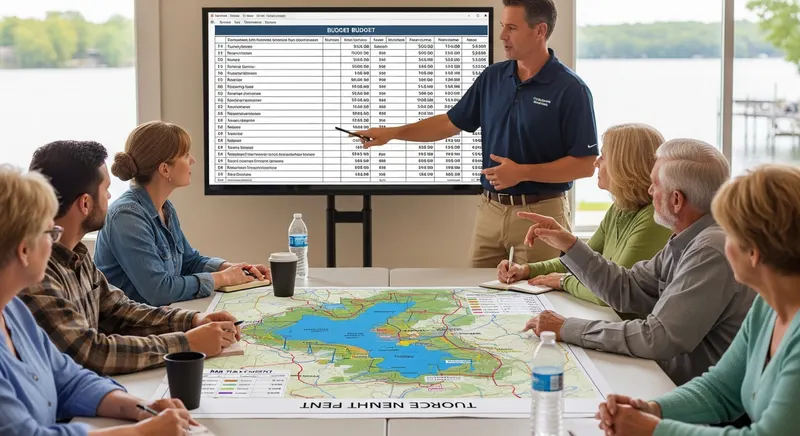
Lake Wingra, a 342-acre urban lake in Madison, WI, developed a comprehensive 10-year management plan coordinating the City of Madison, University of Wisconsin, and adjacent neighborhood associations. The plan addressed Eurasian watermilfoil, curly-leaf pondweed, and purple loosestrife through an integrated approach including targeted herbicide treatment, mechanical harvesting, native plant restoration, and public education.
Key outcome: The structured multi-agency planning process secured consistent funding across multiple budget cycles, a key advantage over ad hoc management. Native plant restoration efforts showed measurable progress in designated restoration zones within three years of initiation.
Running a golf course with three retention ponds means constant weed pressure. The prevention and best management practices guide gave us a systematic approach that replaced our reactive spray schedule.
Paul Esteban Golf Course Superintendent, SC · Myrtle Beach areaAs a lakefront property owner I was completely lost until I found AquaticWeed.org. The permit guidance alone saved me from making costly, potentially illegal treatment mistakes.
Gerald Renfrew Lakefront Landowner, WI · Vilas County