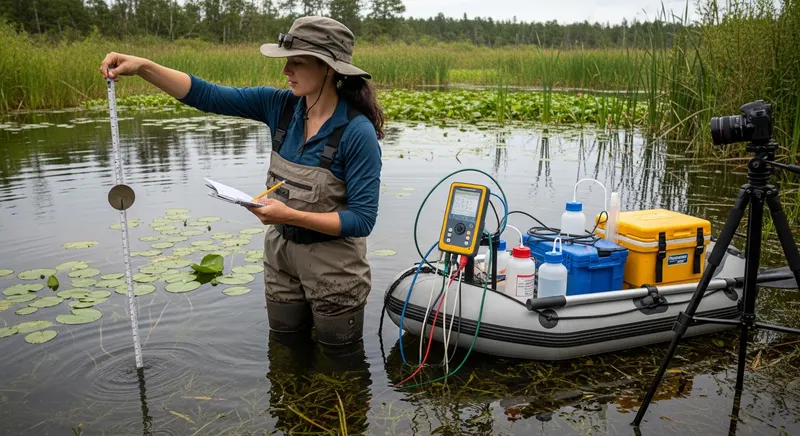
Our Editorial Philosophy

Every contributor to AquaticWeed.org is selected for their demonstrated expertise in aquatic plant science, ecology, or management — and for their commitment to translating complex scientific knowledge into clear, accurate, and practically useful educational content. We hold our content to the same standards as the peer-reviewed literature we draw from.
Dr. Margaret "Meg" Callahan, Ph.D.
Education: Ph.D. in Freshwater Ecology, University of Minnesota — Twin Cities (2006); B.S. in Biology, University of Wisconsin-Stevens Point (2001)
Experience: Dr. Callahan brings 17 years of applied freshwater ecology research to AquaticWeed.org. Her doctoral work focused on the propagule ecology of invasive submerged plants, specifically the role of hydrilla turions and Eurasian watermilfoil fragments in colonization dynamics. Following her doctorate, she spent eight years as a research scientist at a Midwest regional limnological institute, publishing more than 20 peer-reviewed papers on invasive macrophyte biology, management efficacy, and lake restoration. She has conducted field surveys on more than 150 lakes across the Upper Midwest and Great Lakes region.
Specialties: Invasive aquatic plant biology and propagule ecology; hydrilla and Eurasian watermilfoil management; integrated management program design; lake restoration; field survey methods
Contributes to: Species profiles, identification guides, biology and ecology content, management planning guidance
James R. Whitmore, M.S.
Education: M.S. in Environmental Management, Florida State University (2003); B.S. in Environmental Science, University of Florida (2001)
Experience: James Whitmore spent 12 years as program coordinator for a major state aquatic invasive species management program, overseeing annual management contracts totaling over $15 million on more than 80 water bodies. In this role, he developed deep expertise in aquatic herbicide selection and application, NPDES and state permit navigation, contractor oversight, monitoring protocol design, and stakeholder communication. He has managed programs targeting water hyacinth, hydrilla, giant salvinia, Eurasian watermilfoil, and Phragmites across a range of water body types from small agricultural ponds to large public reservoirs. He subsequently moved to independent consulting, providing aquatic management planning services to lake associations, municipalities, and water utilities.
Specialties: Aquatic herbicide efficacy and application; permit compliance (NPDES, state aquatic pesticide permits, Section 404); large-scale program administration; water hyacinth and giant salvinia management in southeastern waterways; stakeholder communication
Contributes to: Control methods content, regulatory and permit guidance, cost analysis, case studies
Dr. Anita Patel, Ph.D.
Education: Ph.D. in Limnology, University of Wisconsin-Madison (2000); M.S. in Water Resources Management, University of Wisconsin-Madison (1997); B.S. in Environmental Biology, Cornell University (1994)
Experience: Dr. Patel has 22 years of lake management consulting experience, working with lake associations, municipal governments, and conservation organizations across the Midwest, Great Lakes states, and Mid-Atlantic region. Her work focuses on the full spectrum of lake management — from nutrient budget analysis and watershed assessment through integrated aquatic weed management program design, biological control program implementation, native plant restoration, and long-term monitoring. She has developed and overseen management plans for over 60 lakes ranging from small private ponds to large public reservoirs, and is a recognized expert in the economics of lake management and the quantitative relationship between aquatic vegetation management and property values.
Specialties: Integrated lake management planning; nutrient management and eutrophication; biological control programs; native plant restoration; lake economics and property value research; long-term monitoring design
Contributes to: Management planning, ecology and water quality content, nutrient loading guidance, economic analysis, biological control
Content Review Process
All content published on AquaticWeed.org is reviewed by at least one team member with direct expertise in the subject area before publication. Species profiles are reviewed by Dr. Callahan for biological accuracy. Management guidance is reviewed by Mr. Whitmore for regulatory accuracy and field applicability. Lake management planning content is reviewed by Dr. Patel for ecological and economic accuracy. Content that spans multiple domains may be reviewed by all three contributors.
We additionally solicit review of major content updates from external experts at state cooperative extension services and university aquatic science programs when content involves species or management approaches outside our primary expertise areas. Learn about our full research methodology →
Professional Memberships and Affiliations
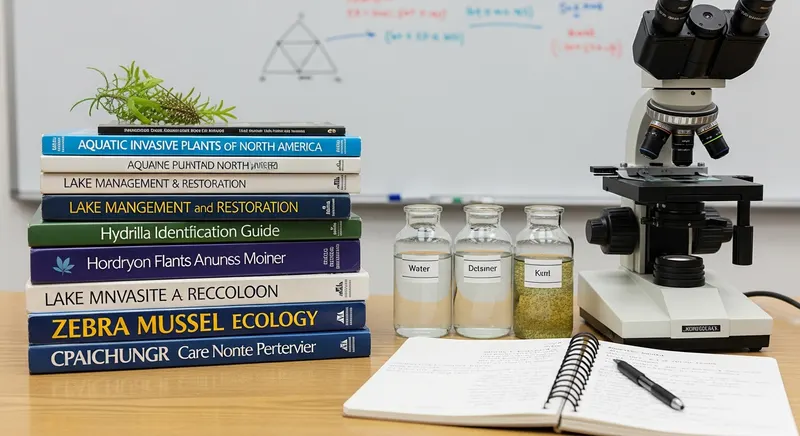
Members of the AquaticWeed.org editorial team maintain active professional affiliations with the leading organizations in aquatic science and lake management. These memberships ensure our team remains current with emerging research, regulatory developments, and evolving best practices in the field.
Aquatic Plant Management Society (APMS)
The primary North American professional organization for aquatic plant management professionals. Team members hold active APMS membership and follow the Journal of Aquatic Plant Management — the field's peer-reviewed primary research journal.
North American Lake Management Society (NALMS)
The leading professional organization for lake managers, publishing Lake and Reservoir Management and setting best-practice standards for lake management planning, monitoring, and restoration across North America.
Association for the Sciences of Limnology and Oceanography (ASLO)
The major international society for freshwater and marine scientists. ASLO membership keeps the team connected to the broader freshwater ecology research community and the latest findings in lake ecology and aquatic invasive species science.
Society of Wetland Scientists (SWS)
The premier professional organization focused on wetland science. Relevant to AquaticWeed.org's coverage of emergent wetland invasives including Phragmites australis and purple loosestrife, and the broader ecological context of wetland aquatic plant management.
Advisory Relationships with External Experts
Beyond the three-member editorial core, AquaticWeed.org engages with a network of external experts for content review, specialist consultation, and verification of content in specialized domains. These relationships are advisory — external experts do not endorse the site as a whole, but provide subject-matter review of specific content areas where their expertise is particularly relevant.
External reviewers have included: aquatic botanists at state cooperative extension services who review species identification content for regional accuracy; state agency invasive species program biologists who verify current management recommendations and regulatory requirements; university limnologists who review ecological impact content for accuracy against the current research literature; and licensed aquatic plant management professionals who verify the practical applicability of management guidance. We do not identify external reviewers publicly without their consent, but we thank them for the substantial value their input adds to our content.
Corrections and Feedback
We encourage readers to contact us with questions, corrections, or feedback. Factual errors identified by readers are taken seriously, investigated promptly, and corrected transparently. To reach the editorial team: [email protected]
Ten-Year Lake Management Plan: Lake Wingra, WI
Lake Wingra, a 342-acre urban lake in Madison, WI, developed a comprehensive 10-year management plan coordinating the City of Madison, University of Wisconsin, and adjacent neighborhood associations. The plan addressed Eurasian watermilfoil, curly-leaf pondweed, and purple loosestrife through an integrated approach including targeted herbicide treatment, mechanical harvesting, native plant restoration, and public education.
Key outcome: The structured multi-agency planning process secured consistent funding across multiple budget cycles, a key advantage over ad hoc management. Native plant restoration efforts showed measurable progress in designated restoration zones within three years of initiation.
We referenced the biological control pages extensively when evaluating our grass carp stocking proposal. The detail on stocking rates and target species specificity helped us present a credible case to our board.
Karen Ostrowski HOA Lake Committee Chair, MN · Lake Minnetonka associationThe ecological impact section helped our team explain to county commissioners why early intervention matters. The oxygen depletion data alone secured funding for our early-detection monitoring program.
Donna Whitfield State Wildlife Biologist, GA · Okefenokee region