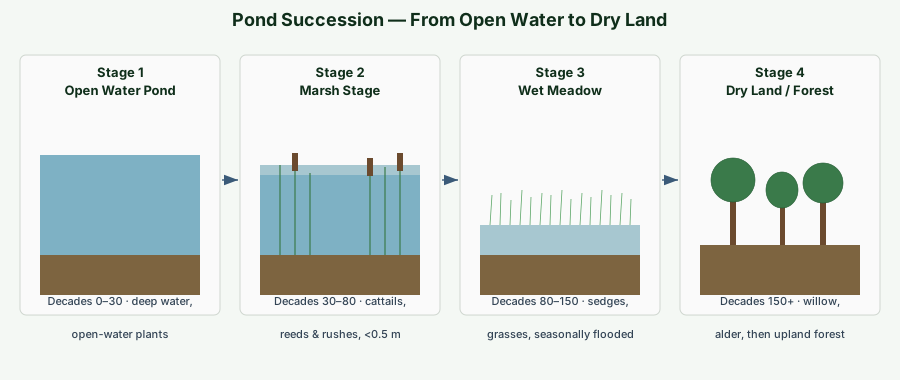
Direct answer: Pond succession is the natural, predictable process by which an open-water pond gradually fills in with sediment and aquatic vegetation, transitions through marsh and wet meadow stages, and ultimately becomes dry land. The process typically spans decades to centuries, but is dramatically accelerated by nutrient enrichment and invasive aquatic plant establishment.
The Classic Pond Succession Sequence
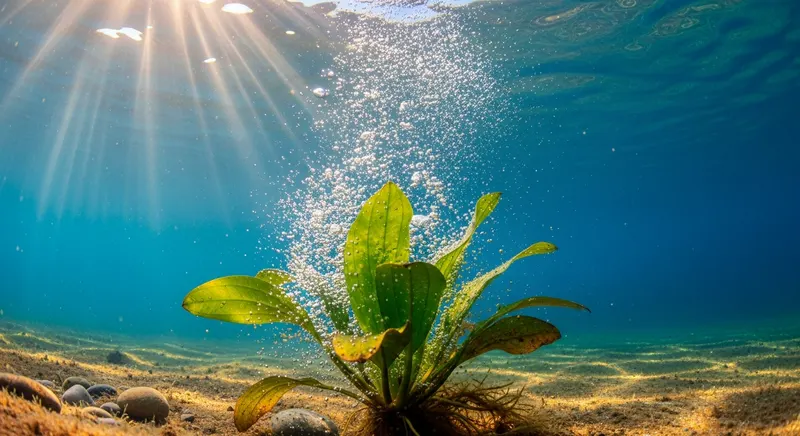
Ecologists describe pond succession as a sequence of five overlapping stages. Stage 1 (open water) features clear water, sparse submerged vegetation, and minimal organic sediment. Stage 2 (submerged plant) sees colonization of the littoral zone by rooted submerged plants like pondweeds and coontail, accelerating sediment deposition. Stage 3 (floating-leaf) brings water lilies and lotus, casting shade and reducing submerged plant cover near shore. Stage 4 (emergent marsh) features cattails, bulrush, and sedges colonizing the shallowest zones as accumulated sediment raises the bottom. Stage 5 (wet meadow and shrub carr) transitions to terrestrial vegetation as the basin fills completely.
The driving mechanism throughout is sediment accumulation: each year, dead plant material, eroded watershed soil, and dust contribute a thin organic-mineral layer to the pond bottom. Annual accumulation rates of 1–10 mm are typical for small ponds. Over decades the cumulative deposit raises the lake floor, reduces depth, and shifts vegetation zonation shoreward.
Why Succession Accelerates Under Eutrophication
Natural pond succession in a low-nutrient setting can take 500–2,000 years to fill a 2-meter-deep pond. Under modern eutrophication pressure — elevated phosphorus and nitrogen from watershed sources — the same pond may complete the sequence in 30–80 years. The acceleration occurs because enriched water supports dense annual aquatic plant biomass, which dies, decomposes incompletely under low-oxygen sediment conditions, and adds far more organic matter per year than oligotrophic ponds. See watershed nutrient loading for the upstream source-control imperative.
Invasive aquatic plants further accelerate the process. Hydrilla and Eurasian watermilfoil can produce 5–10 times the annual biomass of the native plants they displace, depositing correspondingly more organic matter. Studies on Wisconsin and Minnesota lakes infested with milfoil have documented measurable acceleration of the sedimentation rate within a decade of invasion (see water quality degradation guide).
Identifying the Successional Stage of a Pond
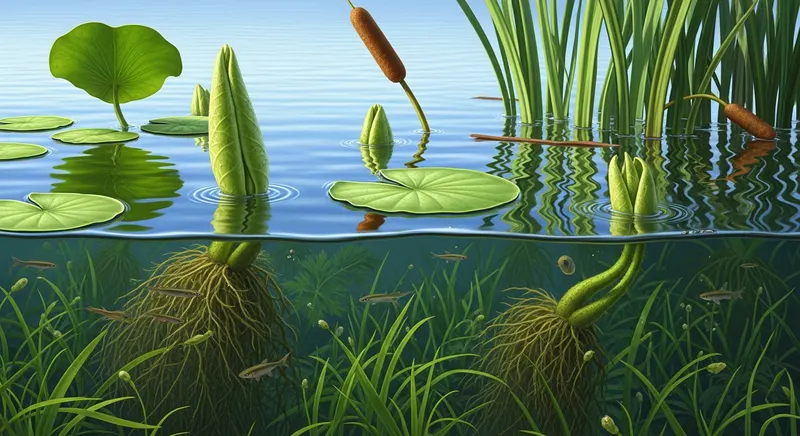
Field practitioners diagnose successional stage from three simple indicators. Open water fraction: ponds in Stage 1–2 retain >60% open water at midsummer; Stage 3 ponds show 30–60%; Stage 4 ponds show <30%. Dominant vegetation: submerged plants dominate Stage 2; floating-leaved plants in Stage 3; cattails and bulrush in Stage 4. Sediment thickness: probing the bottom reveals soft organic deposits ranging from a few centimeters (Stage 1) to over a meter (late Stage 4). See monitoring and survey methods for standardized assessment protocols.
Managing for or Against Succession
Pond owners face a fundamental choice: accept and manage for the natural successional trajectory (eventually accepting wetland or terrestrial habitat) or actively counteract succession to preserve open water. Counteracting succession requires three sustained interventions: (1) watershed nutrient control to slow biomass accumulation; (2) aquatic plant management targeting both invasive and native species in late-stage succession; and (3) periodic sediment removal (mechanical dredging) to restore depth. Dredging is expensive ($15–$60 per cubic yard typical for small ponds) but is the only intervention that resets successional clock to early stages — see the pond management planning guide for cost–benefit framing.
For lake associations and stormwater pond operators, accepting wetland succession is sometimes the ecologically and economically optimal choice. Wetland-stage ponds provide superior water quality treatment, wildlife habitat, and flood storage compared with deep open-water designs — particularly for stormwater detention and retention basins where ecological function matters more than aesthetic open water.
Frequently Asked Questions
How long does it take for a pond to fill in?
Under natural, low-nutrient conditions a 2-meter-deep pond may take 500–2,000 years to fill via succession. Under modern eutrophication pressure with elevated nutrient loading and invasive aquatic plants, the same pond may fill within 30–80 years — a 10–25× acceleration.
Can I stop pond succession?
Succession can be slowed and locally reversed but cannot be permanently stopped without continuous intervention. The three effective interventions are watershed nutrient control, ongoing aquatic plant management, and periodic mechanical dredging to remove accumulated sediment. Sustained effort produces sustained results; interruption restarts the trajectory.
Is pond succession a bad thing?
Not inherently. Succession is a natural ecological process, and late-successional wetlands provide valuable ecosystem services including water quality treatment, wildlife habitat, and flood storage. Whether to actively counteract succession depends on the pond's intended function — recreational deep-water ponds require active management, while stormwater treatment ponds may benefit from accepting wetland succession.
Do invasive aquatic weeds speed up pond succession?
Yes, significantly. Invasive species like hydrilla and Eurasian watermilfoil produce far more annual biomass than the native species they displace, depositing correspondingly more organic matter on the pond bottom. Documented field studies show measurable acceleration of sedimentation rates within a decade of invasive establishment.
What is the difference between pond succession and eutrophication?
Eutrophication describes the increase in nutrient concentrations in a water body, while pond succession describes the long-term physical transition from open water to wetland to land. Eutrophication is one of the principal drivers that accelerates succession, but they are conceptually distinct processes.
How does dredging fit into succession management?
Dredging physically removes accumulated sediment, effectively resetting the successional clock to an earlier stage. It is the only intervention that can restore lost depth. Costs are substantial ($15–$60 per cubic yard for small ponds, much higher for large lakes), so dredging is typically a once-every-20-to-50-year intervention combined with ongoing source-control and vegetation management.
References
- Mitsch, W.J. & Gosselink, J.G. (2015). Wetlands, 5th ed. John Wiley & Sons, Hoboken, NJ.
- Walker, K.F. (1972). The vertical distribution of zooplankton in a small lake. Australian Journal of Marine and Freshwater Research, 23(2), 153–174.
- Wetzel, R.G. (2001). Limnology: Lake and River Ecosystems, 3rd ed. Academic Press.
- Cooke, G.D., et al. (2005). Restoration and Management of Lakes and Reservoirs, 3rd ed. Taylor & Francis.
- Smith, V.H. & Schindler, D.W. (2009). Eutrophication science: where do we go from here? Trends in Ecology & Evolution, 24(4), 201–207.
Ten-Year Lake Management Plan: Lake Wingra, WI
Lake Wingra, a 342-acre urban lake in Madison, WI, developed a comprehensive 10-year management plan coordinating the City of Madison, University of Wisconsin, and adjacent neighborhood associations. The plan addressed Eurasian watermilfoil, curly-leaf pondweed, and purple loosestrife through an integrated approach including targeted herbicide treatment, mechanical harvesting, native plant restoration, and public education.
Key outcome: The structured multi-agency planning process secured consistent funding across multiple budget cycles, a key advantage over ad hoc management. Native plant restoration efforts showed measurable progress in designated restoration zones within three years of initiation.
The seasonal timing guidance has been invaluable. Treating at the right growth stage cut our herbicide costs by nearly 30% without sacrificing efficacy on our county-managed reservoir.
Dale Buchanan County Parks Director, MI · Kalamazoo CountyRunning a golf course with three retention ponds means constant weed pressure. The prevention and best management practices guide gave us a systematic approach that replaced our reactive spray schedule.
Paul Esteban Golf Course Superintendent, SC · Myrtle Beach area