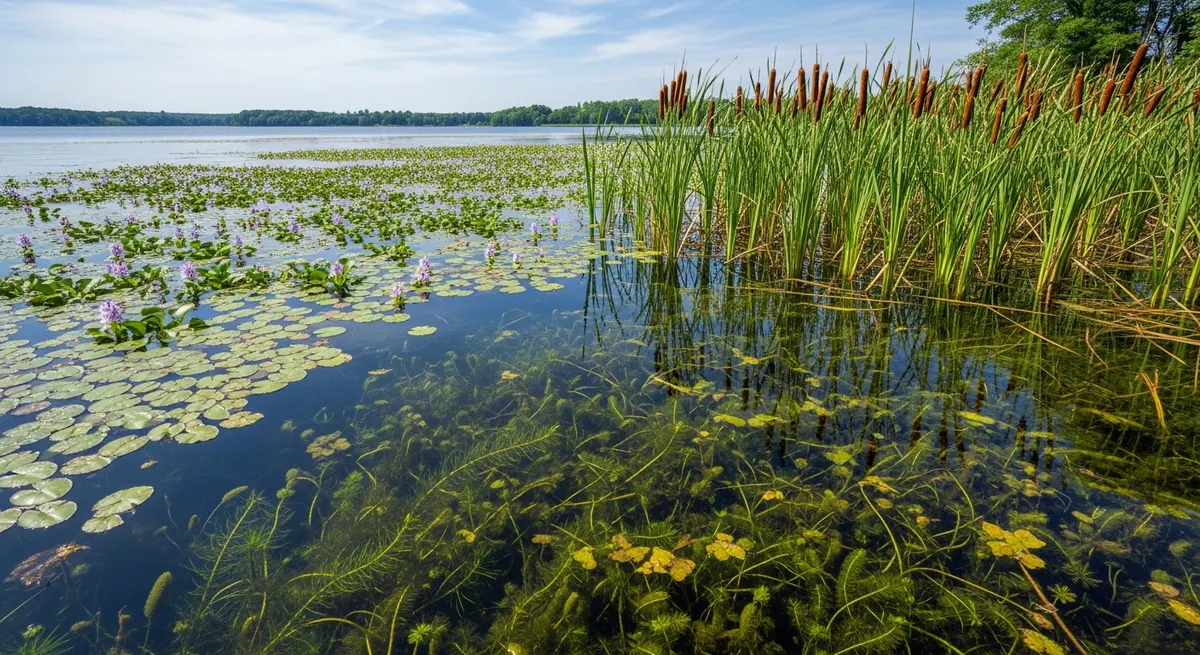
Invasive aquatic weeds are among the most significant drivers of wetland degradation in the United States. By displacing native plant communities, altering hydrology, and reducing structural habitat complexity, invasive wetland plants degrade the ecological functions that make wetlands the most productive ecosystems on the planet — and the most cost-effective natural water quality treatment systems available.
- Invasive aquatic weeds displace native wetland plant communities, reducing biodiversity and ecological function.
- Phragmites australis (common reed) is the dominant invasive threat to wetlands in the Northeast and Great Lakes — forming vast monocultures.
- Dense invasive vegetation reduces habitat quality for waterfowl, shorebirds, amphibians, and macroinvertebrates.
- Invasive wetland plants alter hydrology by trapping sediment, accelerating the filling of wetland basins.
- Wetland restoration requires removing invasive species before native communities can recolonize — management is prerequisite to restoration.
Why Wetlands Are So Vulnerable to Invasive Plants
Wetlands — marshes, fens, bogs, swamps, and riparian zones — are among the most biologically diverse and ecologically productive habitats on Earth. They provide critical functions: water quality treatment (filtering nutrients and sediment), flood storage and attenuation, groundwater recharge, carbon sequestration, and habitat for a disproportionate share of the nation's biodiversity. They are also among the most vulnerable ecosystems to invasion by non-native plants.
Several characteristics make wetlands invasion-prone: high nutrient availability (especially in agricultural landscapes), frequent disturbance from flooding and human activity, and edge habitats where terrestrial and aquatic environments meet. Non-native plants adapted to similar or identical conditions in their native range — reeds, loosestrife, knotweeds — find these conditions ideal and, lacking their native community of competitors and herbivores, can grow at rates impossible in their native range. Ecological impact hub →
Priority Invasive Species in Wetlands
Phragmites australis (Common Reed)
An introduced genotype of Phragmites australis — taller, more aggressive, and less palatable to wildlife than the native genotype — has invaded coastal and inland wetlands throughout the eastern and midwestern US and into California and the Pacific Northwest. It forms dense, nearly impenetrable stands 10–18 feet tall, eliminating open water, suppressing native plants, and providing poor-quality habitat for virtually all wildlife. Millions of acres of formerly productive coastal marsh, Great Lakes wetland, and interior freshwater marsh have been transformed. Management requires a combination of herbicide treatment (primarily glyphosate, imazapyr, or their combinations), mowing or burning to remove standing dead stems, and follow-up treatment for resprouts over 3–5 years. Emergent aquatic weeds hub →
Purple Loosestrife (Lythrum salicaria)
Purple loosestrife, a European wetland plant introduced through the ornamental plant trade and early agriculture, has invaded sedge meadows, wet prairies, and emergent marshes throughout the northern US and Canada. A single plant produces over a million seeds annually and can spread rapidly across a wetland. Classical biological control using host-specific beetles (Galerucella calmariensis and G. pusilla) has provided significant population suppression at landscape scales across the Great Lakes and Northeast, reducing its management burden substantially since the 1990s. Targeted herbicide treatment remains necessary for high-priority sites.
Wetland Restoration After Invasive Plant Removal
Removing invasive plants from a wetland is necessary but not sufficient for restoration. The persistent seed bank of invasive species — particularly Phragmites and purple loosestrife — can regenerate dense infestations within 2–3 years if control efforts stop prematurely. Successful restoration follows a three-phase approach: (1) repeated treatment to suppress the invasive population to very low levels over 3–5 years; (2) active native plant establishment through seeding or transplanting of locally appropriate native species; (3) management of site hydrology to maintain conditions favorable to native species and unfavorable to invasive reinvasion. Partnerships with state and federal wetland restoration programs can provide both technical and financial support for comprehensive restoration projects. Native plant community impacts →
Sources & Scientific References
- Meyerson, L.A. et al. (2000). A comparison of Phragmites australis populations in southeastern New England and the Chesapeake Bay. Biological Invasions, 2(1), 1–5.
- Blossey, B. et al. (2001). Impact and management of purple loosestrife in North America. Biodiversity & Conservation, 10(10), 1787–1807.
- Mitsch, W.J. & Gosselink, J.G. (2015). Wetlands. 5th ed. Wiley.
Frequently Asked Questions
What is the biggest threat to wetlands from aquatic invasive plants?
Phragmites australis (common reed) and purple loosestrife (Lythrum salicaria) are the two most significant invasive plant threats to freshwater wetlands in the northern US and Great Lakes region. Phragmites forms dense, tall monocultures that exclude virtually all other vegetation, eliminate open water, and reduce wildlife habitat value dramatically. Purple loosestrife invades sedge meadows and cattail marshes, displacing native plant diversity. In the South, water hyacinth and alligator weed significantly degrade marsh and floodplain wetland habitats.
How do invasive plants change wetland hydrology?
Dense invasive wetland vegetation — particularly Phragmites — traps sediment at an accelerated rate, raising the elevation of the wetland substrate over time. This process, called terrestrialization, converts open-water wetlands and emergent marshes into shrub-dominated uplands over decades. Additionally, high-transpiration invasive plants (especially Phragmites) remove substantial water from wetland soils, reducing soil moisture levels and altering the seasonal hydroperiod that defines wetland character. These hydrological changes make restoration more difficult, even after invasive species are removed.
Do invasive aquatic weeds reduce wetland wildlife habitat?
Yes, significantly. Native wetland plant community diversity is closely correlated with wildlife diversity. Dense invasive monocultures eliminate the structural heterogeneity — mixtures of open water, floating vegetation, emergent plants at different heights, and shrub edges — that maximizes habitat value for birds, mammals, amphibians, reptiles, and invertebrates. Studies have documented dramatic declines in breeding bird species richness, amphibian populations, and invertebrate diversity in heavily invaded wetlands compared to native-plant-dominated reference sites.
Can wetlands recover after invasive plant removal?
Wetlands can recover after invasive plant removal, but recovery is rarely automatic. In many cases, invasive plants leave a persistent seed bank and altered soil chemistry that makes native plant recolonization slow and unreliable. Successful restoration typically involves a combination of invasive plant removal (often requiring multiple treatments over several years), followed by active native plant restoration (seeding or transplanting) to outcompete remaining invasive propagules. Hydrological restoration — ensuring appropriate water level management — is often also required.
Is there biological control for invasive wetland plants?
Yes. Classical biological control has been used for purple loosestrife (using Galerucella beetles and Hylobius weevils) and water hyacinth (using Neochetina weevils). The purple loosestrife biological control program is considered one of the most successful classical biocontrol programs in North American history — Galerucella beetles have provided meaningful suppression of purple loosestrife at landscape scales in many regions. Phragmites biological control is under active research and development but has not yet yielded approved agents for field release in the US.
Key Takeaways
- Invasive aquatic weeds displace native wetland plant communities, reducing biodiversity and ecological function.
- Phragmites australis (common reed) is the dominant invasive threat to wetlands in the Northeast and Great Lakes — forming vast monocultures.
- Dense invasive vegetation reduces habitat quality for waterfowl, shorebirds, amphibians, and macroinvertebrates.
- Invasive wetland plants alter hydrology by trapping sediment, accelerating the filling of wetland basins.
- Wetland restoration requires removing invasive species before native communities can recolonize — management is prerequisite to restoration.
Ten-Year Lake Management Plan: Lake Wingra, WI
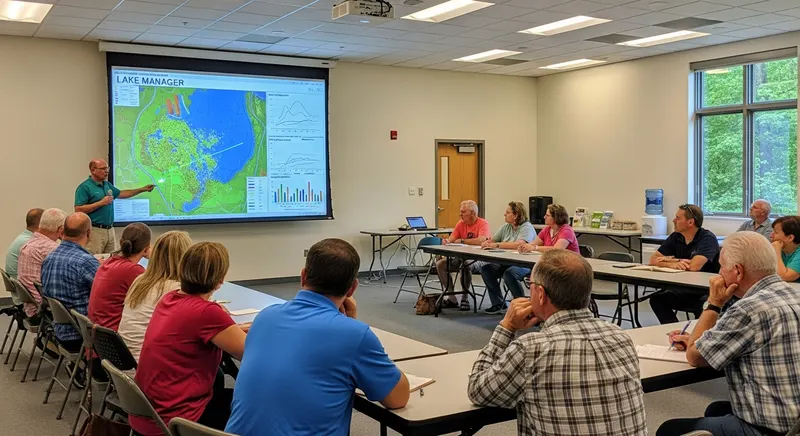
Lake Wingra, a 342-acre urban lake in Madison, WI, developed a comprehensive 10-year management plan coordinating the City of Madison, University of Wisconsin, and adjacent neighborhood associations. The plan addressed Eurasian watermilfoil, curly-leaf pondweed, and purple loosestrife through an integrated approach including targeted herbicide treatment, mechanical harvesting, native plant restoration, and public education.
Key outcome: The structured multi-agency planning process secured consistent funding across multiple budget cycles, a key advantage over ad hoc management. Native plant restoration efforts showed measurable progress in designated restoration zones within three years of initiation.
We referenced the biological control pages extensively when evaluating our grass carp stocking proposal. The detail on stocking rates and target species specificity helped us present a credible case to our board.
Karen Ostrowski HOA Lake Committee Chair, MN · Lake Minnetonka associationThe ecological impact section helped our team explain to county commissioners why early intervention matters. The oxygen depletion data alone secured funding for our early-detection monitoring program.
Donna Whitfield State Wildlife Biologist, GA · Okefenokee region