The Great Lakes basin — encompassing eight US states, two Canadian provinces, and the world's largest system of freshwater lakes — faces persistent aquatic weed challenges shaped by its unique ecology, shipping history, and regional governance structure. Eurasian watermilfoil, curly-leaf pondweed, and purple loosestrife are the three highest-priority aquatic invasives in the region, managed through a combination of state programs, the Great Lakes Restoration Initiative (GLRI), and bilateral US-Canada coordination.
- The Great Lakes basin — shared by eight states and two Canadian provinces — is managed under coordinated regional compacts.
- Eurasian watermilfoil, curly-leaf pondweed, and purple loosestrife are the three highest-priority aquatic invasives in the region.
- The Great Lakes Restoration Initiative provides hundreds of millions of dollars for invasive species control, including aquatic weeds.
- Shipping ballast water was the primary historical introduction pathway for aquatic invasives in the Great Lakes.
- Michigan, Wisconsin, Minnesota, and Ohio have among the most comprehensive state aquatic invasive species programs in the US.
The Great Lakes Aquatic Weed Situation
The Great Lakes basin is one of the most intensively studied aquatic environments in the world — and one of the most heavily invaded. Decades of commercial shipping, recreational boating, and ornamental plant introduction have established dozens of non-native aquatic plant species, of which three represent the most significant ongoing management challenge: Eurasian watermilfoil, curly-leaf pondweed, and purple loosestrife.
Unlike the South, where warm temperatures allow year-round growth of aggressive tropical invasives, the Great Lakes region's cold winters provide natural biomass knockdown — though they do not eliminate established populations. Cold tolerance is actually an advantage for some invasives: curly-leaf pondweed, uniquely, grows most aggressively in cool water (10–15°C) and completes its life cycle in late spring, before native plants emerge from winter dormancy. This phenological advantage gives it a head start that native species struggle to overcome. National invasive species overview →
Priority Species in the Great Lakes
Eurasian Watermilfoil (Myriophyllum spicatum)
Eurasian watermilfoil is present in every contiguous US state — but it reached some of its highest densities in the Great Lakes basin, where it has transformed the ecology of thousands of inland lakes. It forms dense surface canopies that shade native submerged plants, reduces fishing access, impairs boating, and creates anoxic conditions on the bottom. Herbicide treatment (primarily with triclopyr and 2,4-D), mechanical harvesting, and biological control (milfoil weevils) are all used in the region. Long-term, integrated management programs produce better outcomes than single-method approaches.
Curly-Leaf Pondweed (Potamogeton crispus)
Curly-leaf pondweed completes its life cycle earlier than most native plants, forming dense beds in spring and producing durable propagules (turions) that persist in sediment for years. Die-offs in late spring release large nutrient pulses that frequently trigger algal blooms. Fluridone (applied early, before turion formation) and mechanical harvesting early in the season are the most effective management approaches. Minnesota's Curly-leaf Pondweed Management Program is the most extensive regional initiative targeting this species.
Purple Loosestrife and Phragmites
While not submerged or floating aquatic weeds in the traditional sense, purple loosestrife and common reed (Phragmites australis) have transformed coastal and inland wetlands throughout the Great Lakes basin, displacing native plant communities and reducing habitat quality for waterfowl, fish, and other wildlife. Classical biological control using host-specific weevils (Galerucella spp.) has achieved significant purple loosestrife suppression across the region. Phragmites remains a challenging management target.
The Great Lakes Restoration Initiative
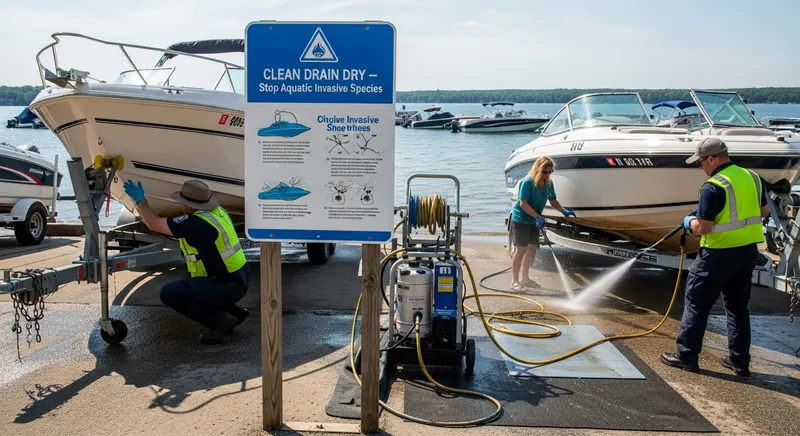
The Great Lakes Restoration Initiative (GLRI), funded at approximately $300 million per year, is the most significant federal investment in Great Lakes restoration since the Clean Water Act. Within the GLRI, the Invasive Species focus area funds: watercraft inspection and decontamination stations at high-risk boat launches; early detection and rapid response for new invasive species introductions; management of established populations of priority species; biological control research and implementation; and public education programs. GLRI grants are administered through the US EPA Great Lakes National Program Office and are available to states, tribes, local governments, universities, and nonprofits. Government grants guide →
Sources & Scientific References
- US EPA Great Lakes National Program Office. (2023). Great Lakes Restoration Initiative Action Plan III. Chicago: US EPA.
- Madsen, J.D. et al. (1991). The biomass, distribution, and ecological status of Eurasian watermilfoil in Lake Minnetonka. Journal of Aquatic Plant Management, 29, 82–87.
- Great Lakes Panel on Aquatic Nuisance Species. (2022). Annual Report on Aquatic Invasive Species in the Great Lakes Basin.
Frequently Asked Questions
What aquatic weeds are the biggest problem in the Great Lakes?
Eurasian watermilfoil is the most widespread submerged aquatic invasive in the Great Lakes basin, present in all five Great Lakes and the majority of inland lakes in the region. Curly-leaf pondweed is the second most significant submerged invasive. Purple loosestrife — technically an emergent wetland invasive — has transformed hundreds of thousands of acres of Great Lakes coastal and inland wetlands. Phragmites (common reed) is also a critical invasive in coastal wetland habitats.
What is the Great Lakes Restoration Initiative?
The Great Lakes Restoration Initiative (GLRI) is a federal program providing approximately $300 million per year for restoration and protection of the Great Lakes ecosystem. A significant portion of GLRI funding targets aquatic invasive species, including early detection programs, management of established populations, prevention (boat ramp inspection stations), and research. GLRI grants are distributed through the US EPA to state agencies, tribes, local governments, and nonprofits.
How did aquatic weeds enter the Great Lakes?
The primary historical pathway for aquatic invasive species in the Great Lakes is shipping ballast water — vessels taking on water in one port and discharging it with contained organisms in another. Eurasian watermilfoil is believed to have been introduced through early recreational boating and the aquarium trade in the mid-20th century. Curly-leaf pondweed was introduced from Europe in the 19th century. Recreational boating and the aquarium/water garden trade remain the dominant vectors for new introductions today.
Which Great Lakes states have the best aquatic weed programs?
Michigan, Wisconsin, and Minnesota are generally considered to have among the most comprehensive aquatic invasive species programs in the Great Lakes region, with significant state funding, mandatory permit systems, and extensive public outreach. All eight Great Lakes states participate in the Great Lakes Panel on Aquatic Nuisance Species, which coordinates policy and management across the basin. Wisconsin's Aquatic Invasive Species Program — supported by a dedicated boating fund — is often cited as a national model for state-level invasive species management.
Can I treat aquatic weeds in a Great Lakes state without a permit?
No. All eight Great Lakes states require permits for aquatic herbicide use. Most also regulate mechanical removal methods in public waters. Permit requirements vary by state — some require the property owner to hold the permit directly, while others require a licensed applicator to hold the permit. In general, treatment near Great Lakes shorelines or tributaries involves additional regulatory review. Contact your state's DNR or equivalent agency for current permit requirements.
Key Takeaways
- The Great Lakes basin — shared by eight states and two Canadian provinces — is managed under coordinated regional compacts.
- Eurasian watermilfoil, curly-leaf pondweed, and purple loosestrife are the three highest-priority aquatic invasives in the region.
- The Great Lakes Restoration Initiative provides hundreds of millions of dollars for invasive species control, including aquatic weeds.
- Shipping ballast water was the primary historical introduction pathway for aquatic invasives in the Great Lakes.
- Michigan, Wisconsin, Minnesota, and Ohio have among the most comprehensive state aquatic invasive species programs in the US.
Ten-Year Lake Management Plan: Lake Wingra, WI
Lake Wingra, a 342-acre urban lake in Madison, WI, developed a comprehensive 10-year management plan coordinating the City of Madison, University of Wisconsin, and adjacent neighborhood associations. The plan addressed Eurasian watermilfoil, curly-leaf pondweed, and purple loosestrife through an integrated approach including targeted herbicide treatment, mechanical harvesting, native plant restoration, and public education.
Key outcome: The structured multi-agency planning process secured consistent funding across multiple budget cycles, a key advantage over ad hoc management. Native plant restoration efforts showed measurable progress in designated restoration zones within three years of initiation.
We used the integrated management framework from this site to structure our Eurasian watermilfoil control program. After three seasons we've reduced lake-wide coverage by 78% on our 340-acre water body.
Susan Thibodeau Lake District Manager, MN · Crow Wing CountyThe seasonal timing guidance has been invaluable. Treating at the right growth stage cut our herbicide costs by nearly 30% without sacrificing efficacy on our county-managed reservoir.
Dale Buchanan County Parks Director, MI · Kalamazoo County