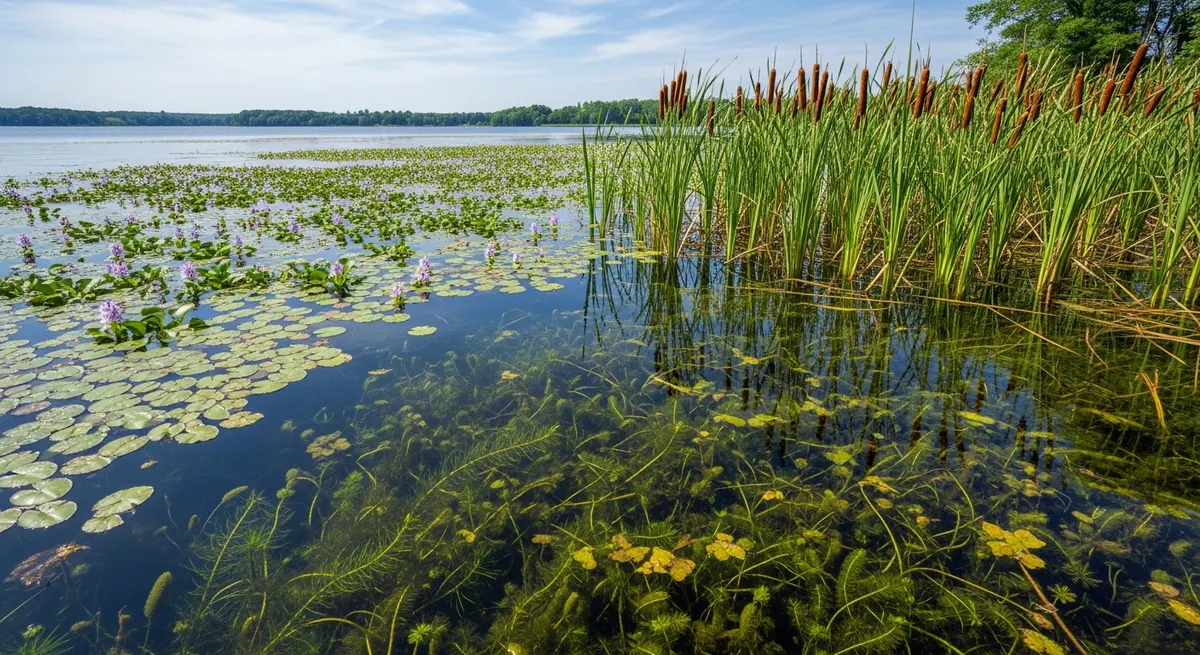
The relationship between aquatic vegetation and waterfowl is complex: native aquatic plant communities are critical waterfowl habitat, while invasive monocultures can initially attract some species but ultimately degrade habitat quality and reduce avian diversity. Dense floating mats eliminate the open water that diving ducks require. Hydrilla infestations have been directly linked to avian vacuolar myelinopathy (AVM), a fatal neurological disease that has killed thousands of birds including bald eagles.
- Native aquatic vegetation is critical habitat for waterfowl — nesting, brood-rearing, and foraging all depend on diverse plant communities.
- Invasive monocultures (hydrilla, giant salvinia) can initially attract dabbling ducks but ultimately degrade habitat quality.
- Dense invasive floating mats eliminate the open water that diving ducks and diving birds require for foraging.
- Avian vacuolar myelinopathy (AVM), linked to hydrilla-associated cyanobacteria, has killed thousands of birds and bald eagles.
- Wetland restoration focused on invasive plant removal consistently improves waterfowl abundance and diversity.
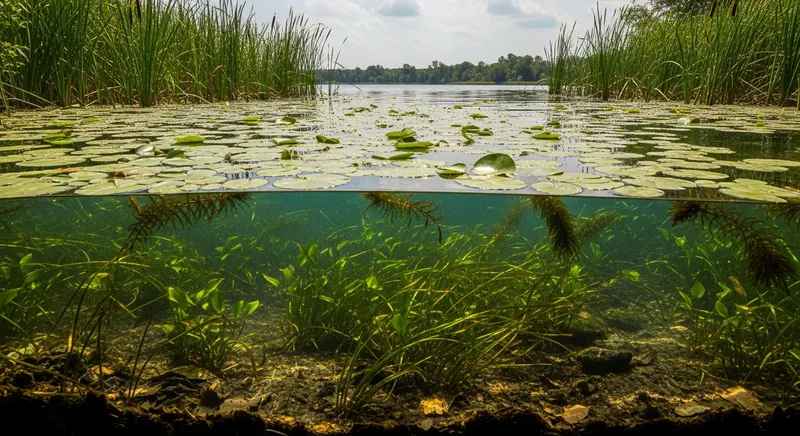
Native Aquatic Vegetation as Waterfowl Habitat
Waterfowl depend on aquatic vegetation for food, nesting cover, and brood-rearing habitat throughout their life cycles. Native submergent plants — pondweeds, wild celery (Vallisneria), wigeon grass, coontail — produce seeds, tubers, and vegetative parts that are directly consumed by dabbling ducks, diving ducks, and geese. These plant beds also support abundant invertebrate communities — aquatic insects, crustaceans, mollusks — that provide high-protein food for breeding ducks and their ducklings. Emergent vegetation — native cattails, bulrushes, sedges — provides nesting structure for mallards, teal, redheads, and marsh-nesting songbirds. A diverse, structurally complex native plant community maximizes both food availability and nesting opportunity. The role of aquatic plants in ecology →
The AVM Crisis: Hydrilla and Bald Eagles
One of the most dramatic wildlife impacts of aquatic invasive plants is avian vacuolar myelinopathy (AVM) — a fatal neurological disease linked to a cyanobacterium that colonizes hydrilla surfaces. AVM causes progressive brain lesions that result in loss of coordination, inability to fly, and death. The disease was first recognized in the mid-1990s when bald eagles and American coots began dying at Southeastern US reservoirs.
Research published between 2002 and 2021 traced the disease pathway: the cyanobacterium Aetokthonos hydrillicola grows on hydrilla leaf surfaces and produces a brominated toxin that causes AVM. Coots and other waterfowl feeding on hydrilla-colonized cyanobacteria acquire the toxin. Disoriented, easily captured coots become prey for bald eagles, which then develop AVM from consuming the toxin-laden waterfowl. AVM outbreaks have been documented at multiple reservoirs in North Carolina, Georgia, Alabama, Arkansas, Texas, and Maryland, killing thousands of birds. Full hydrilla guide →
Invasive Floating Plants and Habitat Loss
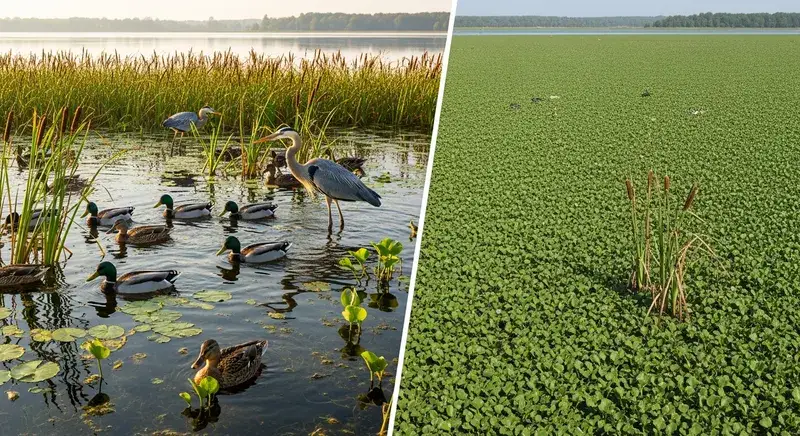
Water hyacinth and giant salvinia represent the most acute threat to waterfowl habitat because they can rapidly develop complete surface coverage that eliminates all open water over large areas. Diving ducks — scaup, canvasbacks, ring-necks — require open water to dive for food and to take flight. Complete surface coverage by floating mats makes a water body functionally inaccessible to these species. Dabbling ducks can navigate more marginal open water areas, but dense floating mats reduce overall habitat quality even for these adaptable species. In Florida's heavily water hyacinth-impacted water bodies, waterfowl use has been documented to decline significantly during peak infestation periods.
Managing Aquatic Weeds for Waterfowl
Waterfowl habitat management and aquatic weed control are aligned goals when management focuses on reducing invasive monocultures and promoting native plant diversity rather than eliminating all vegetation. Best practices for waterfowl-friendly aquatic plant management include: targeted treatment of invasive species while protecting native plant beds; maintaining 50–70% open water through selective weed management in high-use foraging areas; timing treatments to avoid peak breeding season (April–July); restoring native submergent plant communities after invasive removal; and managing emergent vegetation to maintain nesting structure. Wetland ecosystem impacts →
Sources & Scientific References
- Birrenkott, A.H. et al. (2004). Evidence for a dietary link between fish and American coots to avian vacuolar myelinopathy in a Georgia reservoir. Journal of Wildlife Diseases, 40(3), 412–419.
- Brakhage, D.H. & Dey, K. (2002). Impact of aquatic invasive plants on waterfowl habitat. Ducks Unlimited Technical Report.
- Haynie, R.S. et al. (2013). Avian vacuolar myelinopathy: a review of its diagnosis, etiology, and epidemiology. Journal of Wildlife Diseases, 49(1), 1–11.
Frequently Asked Questions
Is some aquatic vegetation good for waterfowl?
Yes. Native aquatic plant communities are essential waterfowl habitat. Submergent plants provide food (seeds, tubers, invertebrates in plant beds) for diving ducks and dabbling ducks. Emergent plants provide nesting cover for mallards, teal, and other marsh-nesting species. Floating-leaved plants provide brood-rearing cover. The ideal waterfowl habitat is a mosaic of open water interspersed with varied native aquatic vegetation — not weed-free water and not dense weed monoculture. 20–40% plant coverage is generally associated with the highest waterfowl use.
How do invasive weed monocultures harm waterfowl?
Invasive monocultures — particularly floating species like water hyacinth and giant salvinia — eliminate the open water that diving ducks, coots, grebes, and other species require for foraging. Dense submerged weed canopies alter the structural complexity of aquatic habitats, reducing the invertebrate diversity that supports energy-intensive breeding and migration. Monotypic plant stands provide fewer food species than diverse native communities. Additionally, loss of native plant communities reduces the structural diversity of emergent vegetation — reducing nesting site availability and quality for marsh-nesting species.
What is avian vacuolar myelinopathy and how is it related to aquatic weeds?
Avian vacuolar myelinopathy (AVM) is a neurological disease of birds characterized by lesions in brain white matter that cause progressive disorientation, loss of flight ability, and death. It was first described in the 1990s in bald eagles dying at Southeastern US reservoirs. Research has linked AVM to a specific cyanobacterium (Aetokthonos hydrillicola) that grows on the surfaces of hydrilla plants. Herbivorous waterfowl feeding on hydrilla-colonized cyanobacteria acquire the AVM-causing toxin and become prey for bald eagles, transferring the toxin up the food chain. AVM has killed thousands of birds — including coots, ducks, and eagles — at hydrilla-infested reservoirs.
Do aquatic weed management programs benefit waterfowl?
It depends on the management approach and the condition being treated. Management that reduces invasive monocultures and promotes native aquatic plant diversity is beneficial for waterfowl. Aggressive whole-lake herbicide treatment that eliminates all aquatic vegetation, including native species, can temporarily reduce waterfowl use. Best management practices for waterfowl habitat combine targeted treatment of invasive species with active restoration of native aquatic plant communities and maintenance of open water areas in the 50–70% range.
What invasive plants most threaten waterfowl habitat?
Water hyacinth and giant salvinia are the most damaging invasive plants for waterfowl habitat because they form complete surface coverage that eliminates open water across entire water bodies. Phragmites monocultures in coastal and inland marshes eliminate the structural diversity of emergent plant communities needed for breeding marsh birds. Hydrilla, while providing some short-term foraging value for diving ducks, is associated with AVM and degrades water quality in ways that reduce overall waterfowl habitat quality in the long term.
Key Takeaways
- Native aquatic vegetation is critical habitat for waterfowl — nesting, brood-rearing, and foraging all depend on diverse plant communities.
- Invasive monocultures (hydrilla, giant salvinia) can initially attract dabbling ducks but ultimately degrade habitat quality.
- Dense invasive floating mats eliminate the open water that diving ducks and diving birds require for foraging.
- Avian vacuolar myelinopathy (AVM), linked to hydrilla-associated cyanobacteria, has killed thousands of birds and bald eagles.
- Wetland restoration focused on invasive plant removal consistently improves waterfowl abundance and diversity.
Ten-Year Lake Management Plan: Lake Wingra, WI
Lake Wingra, a 342-acre urban lake in Madison, WI, developed a comprehensive 10-year management plan coordinating the City of Madison, University of Wisconsin, and adjacent neighborhood associations. The plan addressed Eurasian watermilfoil, curly-leaf pondweed, and purple loosestrife through an integrated approach including targeted herbicide treatment, mechanical harvesting, native plant restoration, and public education.
Key outcome: The structured multi-agency planning process secured consistent funding across multiple budget cycles, a key advantage over ad hoc management. Native plant restoration efforts showed measurable progress in designated restoration zones within three years of initiation.
The seasonal timing guidance has been invaluable. Treating at the right growth stage cut our herbicide costs by nearly 30% without sacrificing efficacy on our county-managed reservoir.
Dale Buchanan County Parks Director, MI · Kalamazoo CountyRunning a golf course with three retention ponds means constant weed pressure. The prevention and best management practices guide gave us a systematic approach that replaced our reactive spray schedule.
Paul Esteban Golf Course Superintendent, SC · Myrtle Beach area