Two Major Invasives — Different in Every Key Way
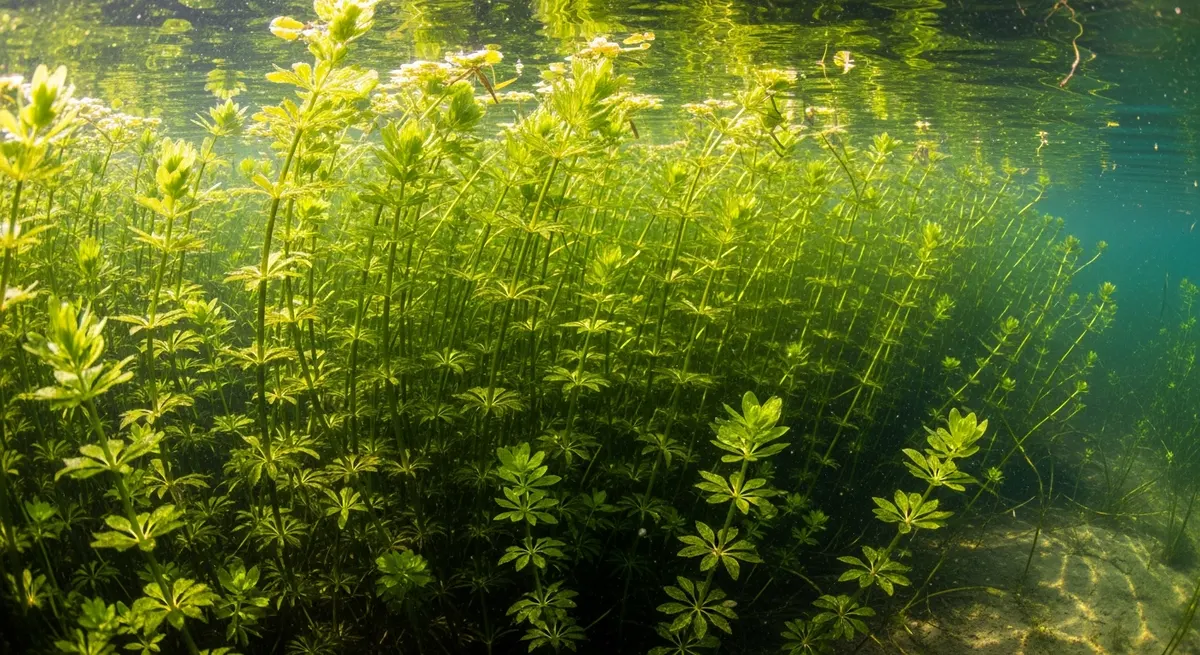
Hydrilla (Hydrilla verticillata) and Eurasian watermilfoil (Myriophyllum spicatum) are two of the most destructive aquatic invasive plants in North America, and they frequently co-occur in the same lakes and river systems. Despite causing similar ecological damage — dense canopy formation, native plant displacement, oxygen depletion, navigation obstruction — they are botanically very different and respond differently to management strategies. Understanding which species is present (or whether both are) is essential for selecting the right herbicides and control approaches.
Visual Identification: Leaves
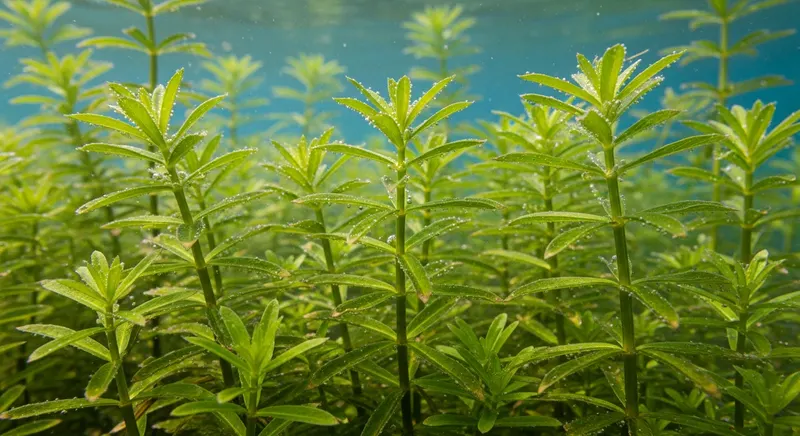
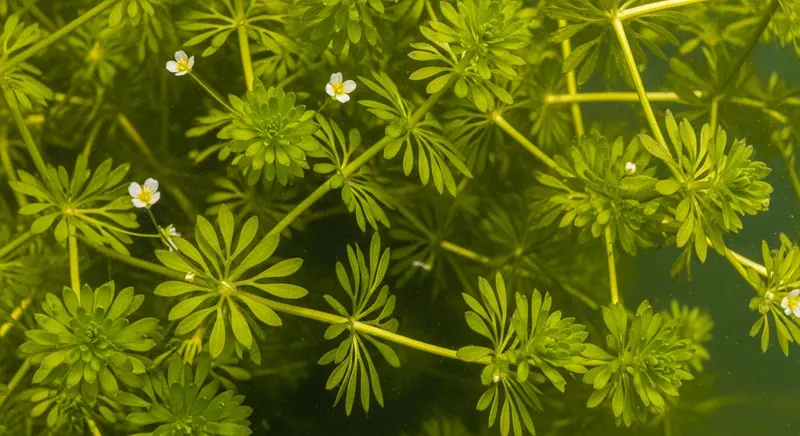
The simplest distinction is leaf structure. Hydrilla has simple, undivided leaves — small, lance-shaped blades, 6–20 mm long, arranged in whorls of 4–8 around the stem. The leaves are solid, not divided or compound. Eurasian watermilfoil has pinnately compound (feathery) leaves — each leaf is divided into many pairs of thread-like leaflets (usually 14–24 pairs per leaf). The overall appearance is feathery or fern-like, not leaf-shaped. This single distinction eliminates confusion in most cases: a plant with undivided whorled leaves is hydrilla (or elodea/coontail); a plant with feathery divided whorled leaves is a milfoil species.
Leaf Arrangement
Both plants have leaves arranged in whorls around the stem, but the whorl structure differs: Hydrilla whorls contain 4–8 leaves. Eurasian watermilfoil whorls almost always contain exactly 4 leaves. This difference is consistent and reliable once you know what to look for.
Diagnostic Tests
The Leaflet Count Test for Milfoil
For Eurasian watermilfoil vs. native milfoils: count the pairs of leaflets on a mid-stem leaf from the upper portion of the plant. Eurasian watermilfoil typically has 14–24 leaflet pairs. Northern watermilfoil (Myriophyllum sibiricum), the most common native milfoil, typically has 5–12 leaflet pairs. Intermediate counts (9–13 pairs) may indicate the Eurasian × Northern hybrid (M. spicatum × sibiricum), which is increasingly common and presents its own management complexities.
The Midrib Tooth Test for Hydrilla
Run your fingernail along the underside of a hydrilla leaf from tip to base — you will feel a raised tooth on the midrib. This feature is absent in milfoil (milfoil leaves are feathery, not blade-like). If you have a blade-like leaf that scratches on the underside midrib, it's likely hydrilla.
Growth Pattern and Ecology
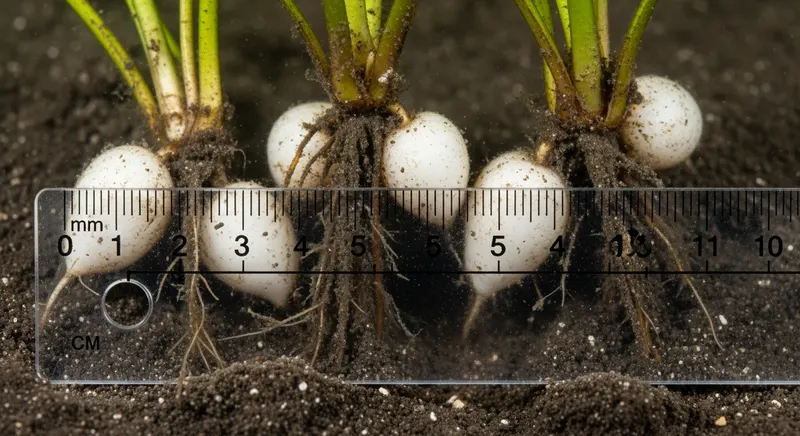
Both species form dense canopies that reach the surface, but their growth patterns differ. Hydrilla typically emerges from tubers in late spring, grows rapidly from sediment to surface, and reaches peak biomass in July–August in most of the U.S. It can maintain surface mats into October. Eurasian watermilfoil typically reaches its surface canopy in May–June in northern states — earlier than hydrilla in many locations — and begins dying back in late summer as stem tips break off and fragment. Milfoil's earlier canopy formation gives it a competitive advantage over native submersed plants that emerge later in spring.
Management Differences
The management implications of correct identification are significant. Several aquatic herbicides are more effective on one species than the other:
- Fluridone (Sonar) is effective against both hydrilla and Eurasian watermilfoil at appropriate concentrations maintained over 60–90 days, but resistance has been documented in some hydrilla populations. Milfoil does not share this resistance.
- Triclopyr (Renovate) is highly effective against Eurasian watermilfoil and native broadleaf aquatic plants but is less effective against hydrilla and grasses.
- Endothall is used against both but requires precise concentration and contact time.
- ProcellaCOR (florpyrauxifen-benzyl) is highly effective against hydrilla, milfoil, and several other submerged weeds at very low concentrations, and has become an increasingly important tool in resistant-hydrilla management.
The milfoil weevil (Euhrychiopsis lecontei), a native North American weevil, is an effective biological control agent for Eurasian watermilfoil but has no effect on hydrilla. Grass carp are used for hydrilla control but have limited effectiveness against milfoil, which they eat less readily.
When Both Are Present
Co-infestations of hydrilla and Eurasian watermilfoil are common in large lakes in the southeastern and mid-Atlantic U.S. In these situations, broad-spectrum herbicide treatments (fluridone or ProcellaCOR) that target both species simultaneously are typically preferred. Management planning should clearly identify which species are present and their relative abundance before treatment selection. For a comprehensive guide to hydrilla control options, see hydrilla control methods. For milfoil management, see Eurasian watermilfoil control methods.
References
- Madsen, J.D. (1997). Seasonal Biomass and Carbohydrate Allocation in Eurasian Watermilfoil. Journal of Aquatic Plant Management 35:15–21.
- Langeland, K.A. (1996). Hydrilla verticillata. Castanea 61(3):293–304.
- Minnesota Department of Natural Resources. Eurasian Watermilfoil vs. Native Milfoil. dnr.mn.us
Whole-Lake Hydrilla Management: Lake Tohopekaliga, FL
Lake Tohopekaliga ("Lake Toho"), a 22,700-acre Central Florida lake, has sustained one of the most intensively managed hydrilla programs in the U.S. since the 1990s. Annual fluridone treatments combined with targeted mechanical harvesting in high-use recreational areas have maintained hydrilla coverage below nuisance thresholds while preserving native submersed vegetation communities in designated littoral zones.
Key outcome: Multi-decade integrated program demonstrates that hydrilla can be managed at acceptable levels in large water bodies, but requires sustained annual investment and coordinated agency cooperation across FDEP, SFWMD, and local fisheries managers.
Running a golf course with three retention ponds means constant weed pressure. The prevention and best management practices guide gave us a systematic approach that replaced our reactive spray schedule.
Paul Esteban Golf Course Superintendent, SC · Myrtle Beach areaAs a lakefront property owner I was completely lost until I found AquaticWeed.org. The permit guidance alone saved me from making costly, potentially illegal treatment mistakes.
Gerald Renfrew Lakefront Landowner, WI · Vilas County