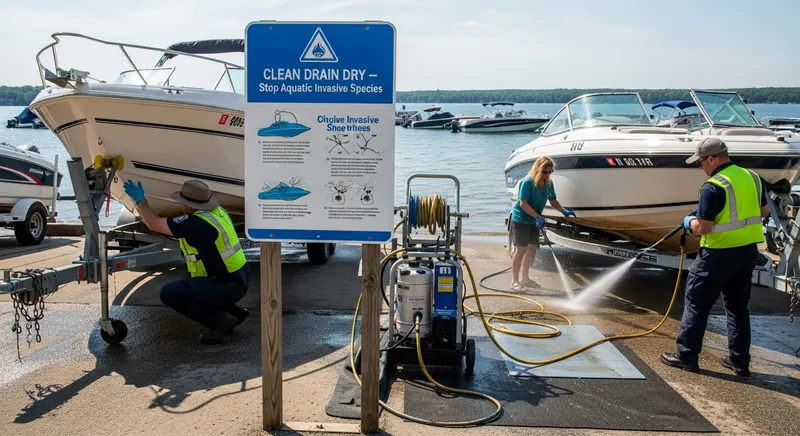
Clean, Drain, Dry (CDD) is a three-step watercraft decontamination protocol designed to prevent the transport of aquatic invasive species — including aquatic weeds, invertebrates, and fish — from infested water bodies to uninfested ones. Studies show that consistent CDD compliance reduces the probability of transporting viable aquatic plant fragments by 80–95%. It is now required at many public boat launches across the US and is recognized as the most cost-effective tool for slowing aquatic weed spread.
- Clean, Drain, Dry (CDD) is a three-step decontamination protocol for watercraft and equipment used across multiple water bodies.
- Studies confirm that consistent CDD compliance reduces the probability of transporting viable aquatic plant fragments by 80–95%.
- The protocol is now required at many public boat launches in states with active aquatic invasive species programs.
- Hot water rinsing (above 60°C) or pressure washing are the most effective Clean step methods for removing plant fragments.
- Drying time of 5–10 days (depending on climate and species) ensures remaining fragments and eggs are no longer viable.
Why CDD Matters: The Scale of the Problem
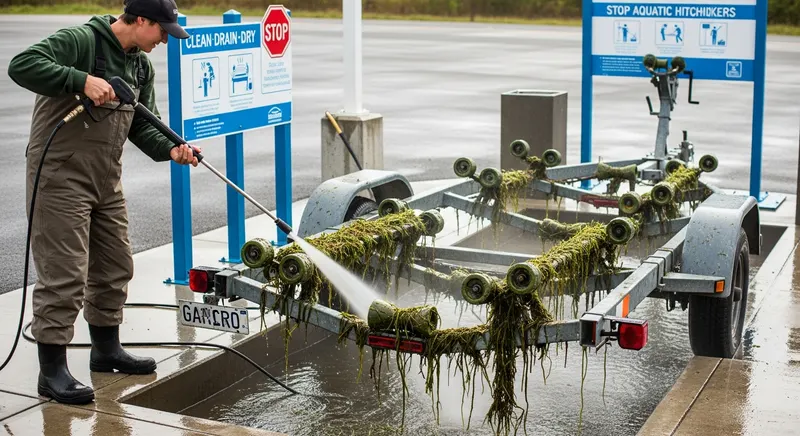
Recreational watercraft are the dominant pathway for long-distance spread of aquatic invasive species, including aquatic weeds, between water bodies. A boat used in a hydrilla-infested lake in the morning and launched in a clean lake that afternoon can transport hundreds of plant fragments — each capable of establishing a new infestation — without the boat owner ever noticing. USGS studies of boats leaving known invasive-species-infested water bodies found aquatic plant material on 30–50% of sampled vessels. Clean, Drain, Dry interrupts this pathway.
The economic case for CDD is compelling: the cost of compliance (time, access to a wash station) is trivial compared to the cost of managing established infestations. A new hydrilla introduction detected when the population is still under 0.5 acres can be eradicated for $10,000–$50,000. A landscape-scale hydrilla infestation requires ongoing annual management spending of hundreds of thousands to millions of dollars with no prospect of eradication. CDD is the bridge between these two outcomes. Pathways of aquatic weed spread →
How CDD Works: The Science
The Clean Step
The most important step in CDD is removing visible plant material. Research shows that most viable aquatic weed propagules transported on boats are large enough to be visible — stem fragments, leaf clusters, and root material that lodges in propeller cavities, trailer rollers, bunk supports, and live well intakes. A thorough visual inspection and manual removal of all plant material reduces the viable fragment load by 60–70%. This step should be done at the water access point before leaving — not at home, where transport to a new water body may already have occurred.
The Drain Step
Draining all water from the vessel eliminates water-borne propagules — seeds, spores, very small plant fragments, and aquatic invertebrates — that remain viable in standing water. Live wells, bilge compartments, cooling water systems, and bait buckets should all be drained before leaving a launch site. Most states that have mandatory CDD requirements include specific requirements for draining live wells and bilge water on site.
The Dry Step
Drying kills remaining plant material and other organisms that survived the Clean and Drain steps. The critical drying times — 5 days in warm weather (above 70°F), up to 18 days in cool weather (below 50°F) — are based on survival studies of specific aquatic invasive species. For boaters who want faster decontamination, hot water spraying (above 120°F, ideally 140°F) for 30–60 seconds effectively kills plant fragments and most other invasives. Many boat wash stations provide hot water decontamination capability. Full prevention guide →
Mandatory Inspection Programs
Studies comparing voluntary and mandatory CDD compliance have consistently found that mandatory programs — where trained inspectors check boats at launches and require decontamination of contaminated vessels — reduce new invasion rates by 40–70% compared to voluntary-only approaches. States with the most robust aquatic invasive species programs (Wisconsin, Michigan, Minnesota, Washington, California) all have mandatory or enforced CDD requirements at high-risk boat launches. Contact your state's department of natural resources to find launches with mandatory inspection requirements and decontamination facilities.
Sources & Scientific References
- Rothlisberger, J.D. et al. (2010). Aquatic invasive species transport by national park visitors. Frontiers in Ecology and the Environment, 8(5), 255–261.
- Picard, C.R. et al. (2012). An evaluation of partial compliance with complex invasive species regulations. Biological Invasions, 14(9), 1795–1805.
- Anderson, L.W.J. et al. (2015). The effectiveness of mandatory watercraft inspection programs for preventing aquatic invasive plant spread. Lake and Reservoir Management, 31(2), 158–167.
Frequently Asked Questions
What are the three steps of Clean, Drain, Dry?
Clean: Remove all visible plant material, mud, and debris from boats, motors, propellers, trailers, and all equipment — including live wells, bilge, bait buckets, and anchors — before leaving a water body. Drain: Empty all water from the vessel, including live wells, bilge compartments, motors, and bait containers. Dry: Allow all equipment to dry completely before using it in another water body — the recommended drying time is 5 days in warm weather and 18 days in cool weather, though hot water rinsing can accelerate decontamination.
Does Clean Drain Dry actually prevent the spread of aquatic weeds?
Yes, when practiced consistently. Research consistently shows that CDD significantly reduces the probability of transporting viable plant fragments. A study of Eurasian watermilfoil fragments found that complete removal of plant material (the Clean step) reduced viable fragment load by 60–70%; draining eliminated water-borne propagules; and drying for 5+ days killed virtually all remaining plant material. Consistent compliance is the key challenge — studies show that a meaningful percentage of boaters who support CDD do not consistently practice it correctly, underscoring the value of mandatory inspection programs at high-risk launches.
Is Clean Drain Dry required by law?
CDD requirements vary by state. Several states — including Wisconsin, Michigan, Minnesota, and states in the western US — have mandatory CDD requirements at certain boat launches or in designated invasive species management zones. Many states operate voluntary CDD programs with enforcement at high-risk launches. Some states authorize conservation officers to inspect boats and require decontamination before launch if aquatic plant material is detected. When required, failure to comply can result in fines. Check your state's AIS regulations for current requirements.
How should I decontaminate a boat that was in a hydrilla-infested lake?
For boats used in known hydrilla-infested water bodies: immediately upon leaving the water, remove all visible plant material from the boat, motor, propeller, trailer, and any equipment that contacted the water; drain all water from live wells, bilge, and any compartments; if available, use a boat wash station or a high-pressure spray to rinse the hull, trailer, and engine thoroughly; allow complete drying for at least 5 days (18 days in temperatures below 50°F); or apply hot water (above 140°F) spray as an alternative to extended drying. Even a single hydrilla fragment can establish a new infestation, so thoroughness matters.
Where can I find a boat wash station?
Many state parks, boat launches, and marinas now have dedicated boat wash stations — high-pressure rinse facilities with water collection and treatment systems to prevent wash water from entering local water bodies. Your state's department of natural resources often maintains a map of boat wash station locations. The national 'Stop Aquatic Hitchhikers' campaign (launched by the US Fish and Wildlife Service and partners) maintains resources for locating decontamination facilities.
Key Takeaways
- Clean, Drain, Dry (CDD) is a three-step decontamination protocol for watercraft and equipment used across multiple water bodies.
- Studies confirm that consistent CDD compliance reduces the probability of transporting viable aquatic plant fragments by 80–95%.
- The protocol is now required at many public boat launches in states with active aquatic invasive species programs.
- Hot water rinsing (above 60°C) or pressure washing are the most effective Clean step methods for removing plant fragments.
- Drying time of 5–10 days (depending on climate and species) ensures remaining fragments and eggs are no longer viable.
Ten-Year Lake Management Plan: Lake Wingra, WI
Lake Wingra, a 342-acre urban lake in Madison, WI, developed a comprehensive 10-year management plan coordinating the City of Madison, University of Wisconsin, and adjacent neighborhood associations. The plan addressed Eurasian watermilfoil, curly-leaf pondweed, and purple loosestrife through an integrated approach including targeted herbicide treatment, mechanical harvesting, native plant restoration, and public education.
Key outcome: The structured multi-agency planning process secured consistent funding across multiple budget cycles, a key advantage over ad hoc management. Native plant restoration efforts showed measurable progress in designated restoration zones within three years of initiation.
The species identification guides on AquaticWeed.org are the most accurate I've used in 18 years of lake management. I now send all my new clients here first before we discuss treatment options.
Robert Harmon Certified Lake Manager, FL · Lake Okeechobee regionWe referenced the biological control pages extensively when evaluating our grass carp stocking proposal. The detail on stocking rates and target species specificity helped us present a credible case to our board.
Karen Ostrowski HOA Lake Committee Chair, MN · Lake Minnetonka association