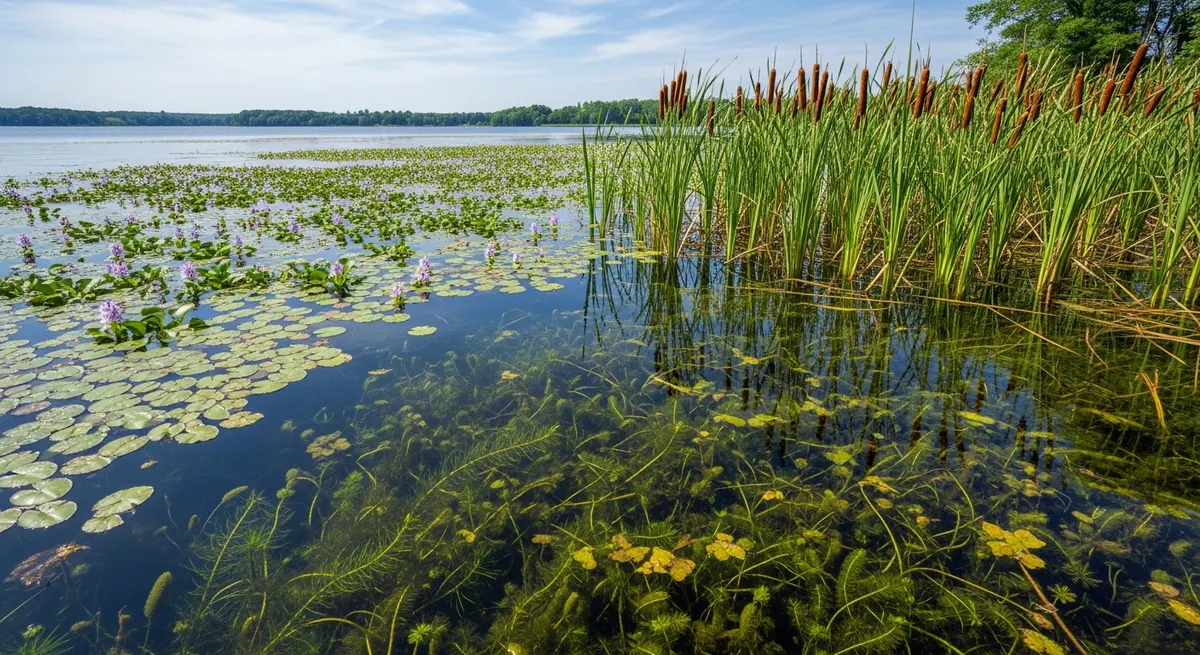
Native aquatic plants — often called aquatic weeds when they become overabundant — are ecologically essential in appropriate densities. They provide oxygen, fish habitat, shoreline stabilization, water filtration, and food for waterfowl. The 'weed' designation applies to inappropriate abundance or location, not to the species itself. Even some invasive species are studied for limited beneficial uses, though none outweigh their ecological damage.
- Native aquatic vegetation at natural densities is ecologically essential — providing habitat, oxygen, and food web support.
- Native plants outcompete invasive species when healthy and intact — they are the first line of biological defense.
- Aquatic vegetation filters excess nutrients, stabilizes sediment, and supports shoreline integrity.
- 20–30% native plant coverage is typically associated with the highest fish and wildlife diversity.
- Complete removal of all aquatic vegetation causes its own ecological damage — the goal is management, not eradication.
The Genuine Ecological Value of Aquatic Plants
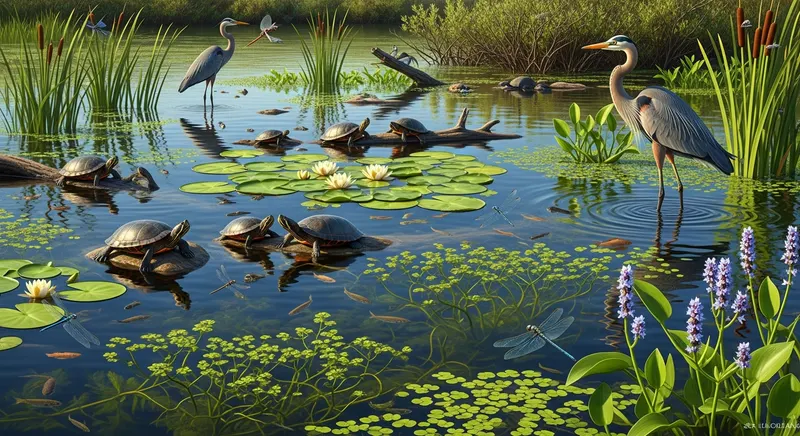
Before addressing benefits, it is important to clarify what "aquatic weed" means. Most ecologists and lake managers distinguish between native aquatic plants (which provide genuine ecological value), native species that become overabundant due to nutrient enrichment (context-dependent problems), and non-native invasive species (fundamentally problematic in their introduced range). The benefits described in this section primarily apply to native species at appropriate densities.
Native aquatic plants form the structural and productive foundation of aquatic ecosystems. They are not optional decorative features — they are the physical habitat, food source, oxygen supply, and water quality infrastructure that the entire aquatic community depends on. Lakes with intact, diverse native aquatic plant communities consistently support more species of fish, invertebrates, amphibians, and waterfowl than degraded systems with sparse or invasive-dominated vegetation.
Water Quality Benefits
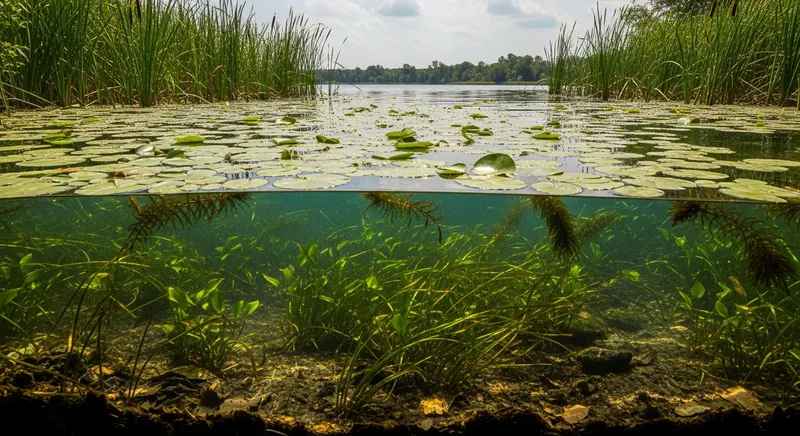
Native aquatic plants at appropriate densities provide measurable water quality services. Their roots absorb phosphorus and nitrogen from sediment and water, reducing the nutrient availability that fuels algal blooms — a process sometimes called "vegetative water treatment." Dense native plant communities reduce wave action and shoreline erosion, trapping fine sediment that would otherwise increase turbidity. Submerged plants during the day oxygenate the water column, supporting invertebrates and fish in areas that would otherwise be hypoxic. Native plants in the littoral (shoreline) zone act as biological filters, processing nutrients from surface runoff before they reach open water.
Wildlife Habitat Benefits
Diverse aquatic vegetation supports the invertebrate communities — mayflies, caddisflies, midges, amphipods, snails, and others — that are the primary food source for fish, waterfowl, and amphibians. The structural complexity of mixed aquatic plant communities — different species at different depths, with varying stem and leaf forms — creates the diversity of microhabitats that supports high biodiversity. Uniform invasive monocultures provide far less habitat diversity than the complex, multi-species native communities they displace. Biodiversity and native plants →
Practical Benefits
Moderate aquatic vegetation along shorelines reduces wave energy, protecting shores from erosion and reducing the turbidity that degrades water clarity over time. Native emergent vegetation along shorelines stabilizes sediment with roots, slowing the gradual conversion of open water to terrestrial habitat. These "ecosystem services" have quantifiable economic value in reduced shoreline protection costs and maintained water clarity — the latter being a key determinant of lakefront property values. Weeds vs. beneficial native plants →
Sources & Scientific References
- Carpenter, S.R. & Lodge, D.M. (1986). Effects of submersed macrophytes on ecosystem processes. Aquatic Botany, 26, 341–370.
- Wetzel, R.G. (2001). Limnology: Lake and River Ecosystems. Academic Press.
- Barko, J.W. & Smart, R.M. (1986). Sediment-related mechanisms of growth limitation in submersed macrophytes. Ecology, 67(5), 1328–1340.
Frequently Asked Questions
Are all aquatic weeds harmful?
No. The term 'aquatic weed' describes any aquatic plant causing management problems — but the same species at lower densities in undisturbed habitat may be highly valuable. Native aquatic plants are ecologically essential. Even invasive species have been studied for potential uses (water hyacinth as biomass, biogas production), though these beneficial applications are vastly outweighed by the ecological and economic damage these species cause.
Do aquatic weeds improve water quality?
At moderate densities, native aquatic plants do improve water quality: they absorb excess nutrients (reducing algal blooms), trap fine sediment (improving clarity), oxygenate the water during daylight, provide habitat complexity that supports diverse invertebrate communities, and stabilize shorelines. At high densities, these benefits reverse: excessive plant biomass causes oxygen crashes, the plants release stored nutrients when they die, and the system shifts toward simplified, degraded ecology.
Is water hyacinth useful for anything?
Water hyacinth has been studied for biomass energy production, wastewater treatment (its rapid nutrient uptake makes it effective at removing excess nitrogen and phosphorus from sewage effluent), composting, and artisanal craft use (woven mats and baskets in some developing countries). However, these applications are far too small in scale to make meaningful reductions in problem infestations, and the environmental and economic damage water hyacinth causes vastly outweighs any beneficial use currently available.
Do ducks benefit from aquatic weeds?
Yes. Waterfowl — ducks, geese, and swans — benefit from certain aquatic plants for food and nesting material. Duckweed, in particular, is a high-protein food source for many duck species. Seeds of pondweeds, arrowhead, and other aquatic plants are important waterfowl foods. However, extremely dense invasive monocultures of water hyacinth, giant salvinia, or Phragmites can actually reduce waterfowl habitat by eliminating the diverse native plant and invertebrate communities that provide better food and cover.
Key Takeaways
- Native aquatic vegetation at natural densities is ecologically essential — providing habitat, oxygen, and food web support.
- Native plants outcompete invasive species when healthy and intact — they are the first line of biological defense.
- Aquatic vegetation filters excess nutrients, stabilizes sediment, and supports shoreline integrity.
- 20–30% native plant coverage is typically associated with the highest fish and wildlife diversity.
- Complete removal of all aquatic vegetation causes its own ecological damage — the goal is management, not eradication.
Ten-Year Lake Management Plan: Lake Wingra, WI
Lake Wingra, a 342-acre urban lake in Madison, WI, developed a comprehensive 10-year management plan coordinating the City of Madison, University of Wisconsin, and adjacent neighborhood associations. The plan addressed Eurasian watermilfoil, curly-leaf pondweed, and purple loosestrife through an integrated approach including targeted herbicide treatment, mechanical harvesting, native plant restoration, and public education.
Key outcome: The structured multi-agency planning process secured consistent funding across multiple budget cycles, a key advantage over ad hoc management. Native plant restoration efforts showed measurable progress in designated restoration zones within three years of initiation.
We used the integrated management framework from this site to structure our Eurasian watermilfoil control program. After three seasons we've reduced lake-wide coverage by 78% on our 340-acre water body.
Susan Thibodeau Lake District Manager, MN · Crow Wing CountyThe seasonal timing guidance has been invaluable. Treating at the right growth stage cut our herbicide costs by nearly 30% without sacrificing efficacy on our county-managed reservoir.
Dale Buchanan County Parks Director, MI · Kalamazoo County