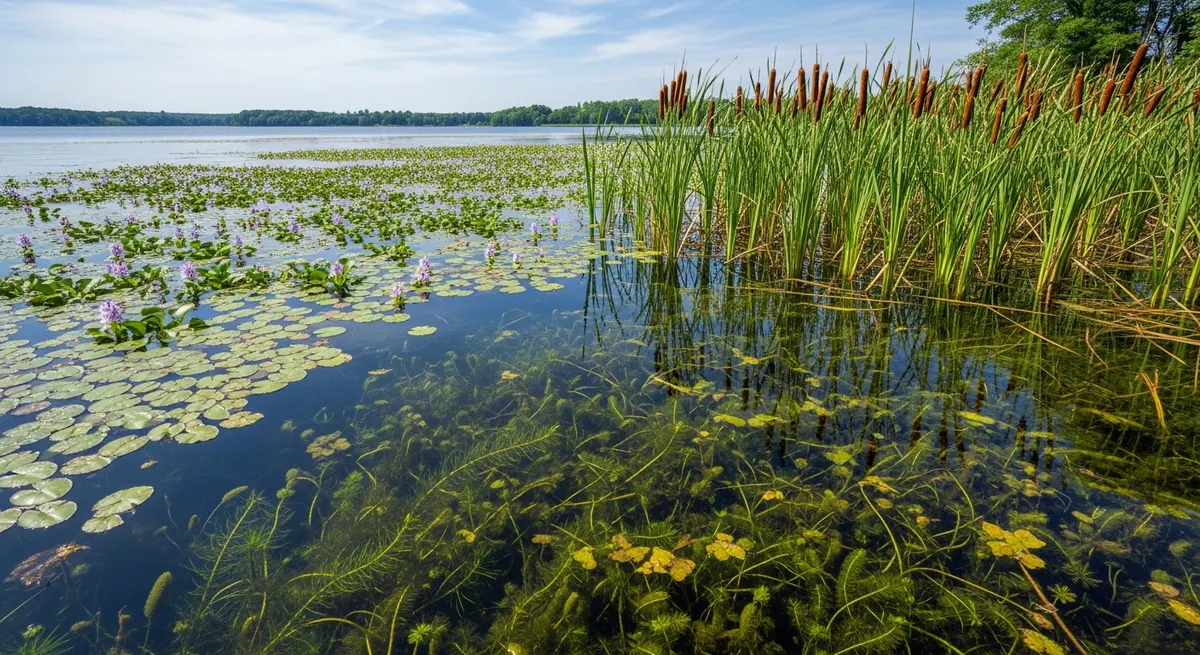
Floating, submerged, and emergent aquatic weeds occupy different zones of the water body and have fundamentally different ecologies, impacts, and management needs. Floating weeds grow on or at the water surface; submerged weeds grow entirely below the surface anchored to sediment; emergent weeds are rooted in shallow water with stems extending above the surface.
- Floating weeds capture sunlight at the surface and block light to all submerged plants and fish habitat below.
- Submerged weeds form below-surface canopies that entangle propellers, disrupt fisheries, and crash oxygen at night.
- Emergent weeds root in shallow water with stems above the surface — they drive shoreline encroachment over time.
- Each growth form requires different herbicides, application timing, and treatment equipment.
- Multiple growth forms can co-occur in the same water body, requiring integrated management strategies.
Floating Aquatic Weeds
Floating aquatic weeds occupy the air-water interface and intercept sunlight before it reaches the water column. Free-floating species — those with no root connection to sediment — are often the most ecologically disruptive because they can colonize an entire water body regardless of depth or bottom composition. Their growth is limited primarily by water temperature, nutrient availability, and space.
Water hyacinth, considered the world's most problematic aquatic plant, can double its population every two weeks and cover entire lake surfaces in warm weather. Giant salvinia can double in 2–4 days. Duckweed, while typically less dense than these species, can carpet shallow ponds and agricultural water bodies within days. All form surface mats that block light to underwater communities, reduce oxygen exchange, and provide habitat for mosquito breeding.
Rooted-floating species like water lilies present different management considerations. Their roots are anchored in sediment, making them less mobile but also harder to physically remove. Many rooted-floating species are native and ecologically valuable; management typically targets non-native or overabundant populations. Floating aquatic weeds hub →
Submerged Aquatic Weeds
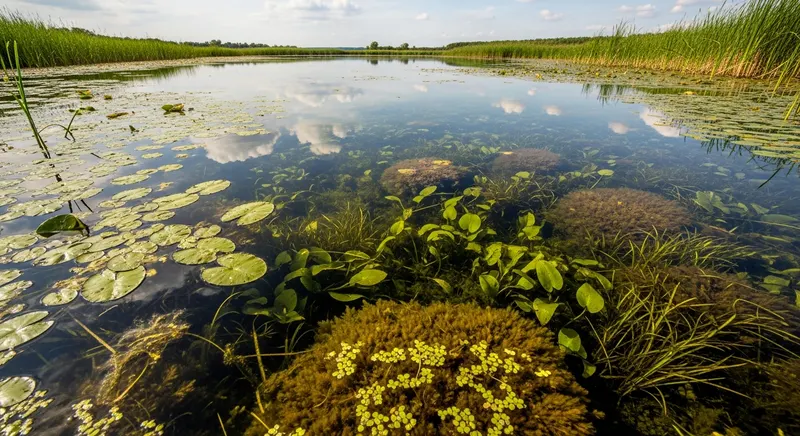
Submerged aquatic weeds are the most diverse group and include many of the most problematic invasive species in U.S. waterways. They are not visible from the water surface until they become dense enough to form surface mats or otherwise disrupt boating, swimming, and fishing. This makes them difficult to detect early, allowing infestations to develop to high densities before they are noticed.
The depth range of submerged weed colonization is determined by light penetration — in clear water, species like hydrilla and milfoil can establish to depths of 10–20 feet, covering the entire bottom of shallow to medium-depth lakes. As infestations develop, the competition and shading from dense beds eliminates native submerged plant diversity, a community that is much slower to recover than the invasive monoculture that displaced it.
The ecological impacts of dense submerged weed beds include dramatic daily dissolved oxygen swings (high during the day due to photosynthesis; very low at night due to respiration), water temperature stratification, pH fluctuations, and the physical entrapment of debris and sediment. Fish kills following summer die-offs of dense submerged beds are a documented regular occurrence in heavily infested systems. Submerged aquatic weeds hub →
Emergent Aquatic Weeds
Emergent aquatic weeds grow at the dynamic interface between aquatic and terrestrial environments. Because they extend above the water surface, they are typically the most visible category of aquatic weed problem and often the first to attract management attention.
The primary long-term impact of emergent weeds is shoreline encroachment — the conversion of open water to dense emergent vegetation over years and decades. Phragmites (invasive common reed) is the most aggressive encroacher in the eastern U.S., capable of establishing single-species monocultures many feet thick along entire lake shorelines, substantially reducing open water area and eliminating the diverse wetland community it replaces. Cattails, while native, can similarly overwhelm wetland areas when given access to elevated nutrients. Emergent aquatic weeds hub →
Management Differs by Growth Form
Because the three growth forms occupy different ecological niches and have different growth mechanics, management approaches differ significantly. Floating weeds are typically managed with mechanical harvesting (skimmer boats), herbicide application to the water surface, or biological control (where available). Submerged weeds require herbicides with good water-column penetration or contact application, or mechanical harvesting with fragment containment. Emergent weeds typically require foliar herbicide application to stems and leaves, or physical removal of root systems. In all cases, addressing the underlying nutrient and habitat conditions is essential for long-term management success. Integrated control methods →
Sources & Scientific References
- Sculthorpe, C.D. (1967). The Biology of Aquatic Vascular Plants. Edward Arnold.
- Chambers, P.A. et al. (1999). Macrophyte growth and sediment conditions. Freshwater Biology, 41, 491–502.
- USACE (2000). Submersed Aquatic Vegetation: Biology, Ecology, and Management. US Army Engineer Research and Development Center.
Frequently Asked Questions
What are floating aquatic weeds?
Floating aquatic weeds grow on or near the water surface. Free-floating species (water hyacinth, duckweed, giant salvinia) have no root connection to the sediment and move freely with wind and current. Rooted-floating species (water lilies, watershield) are anchored in sediment but have leaves that float on the surface. Both types block light to the water below and form mats that impede navigation and recreation.
What are submerged aquatic weeds?
Submerged aquatic weeds grow entirely or primarily below the water surface, rooted in the sediment. Examples include hydrilla, Eurasian watermilfoil, elodea, coontail, and pondweeds. They photosynthesize using light that penetrates the water column and can form dense beds across the entire bottom of shallow water bodies. Dense canopy-forming species like hydrilla and milfoil can grow up to the surface and form surface mats.
What are emergent aquatic weeds?
Emergent aquatic weeds are rooted in shallow water or saturated shoreline soil with stems and leaves that extend above the water surface. Common examples include cattails, Phragmites (common reed), bulrush, and water primrose. They grow at the land-water interface and are a primary driver of shoreline encroachment — the progressive conversion of open water to dense emergent vegetation over time.
Which type of aquatic weed is hardest to control?
Each category presents distinct challenges. Free-floating weeds like water hyacinth and giant salvinia can regrow from very small fragments and spread extremely rapidly. Submerged weeds like hydrilla produce persistent underground tubers that survive herbicide treatment. Emergent weeds like Phragmites develop extensive rhizome networks that require multi-year management programs. In general, any weed treated without addressing the underlying cause (excess nutrients, disturbed habitat) will regrow regardless of growth form.
Key Takeaways
- Floating weeds capture sunlight at the surface and block light to all submerged plants and fish habitat below.
- Submerged weeds form below-surface canopies that entangle propellers, disrupt fisheries, and crash oxygen at night.
- Emergent weeds root in shallow water with stems above the surface — they drive shoreline encroachment over time.
- Each growth form requires different herbicides, application timing, and treatment equipment.
- Multiple growth forms can co-occur in the same water body, requiring integrated management strategies.
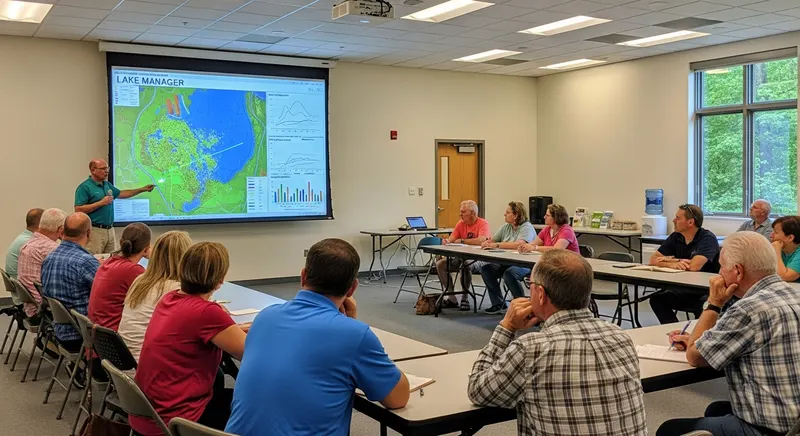
Ten-Year Lake Management Plan: Lake Wingra, WI
Lake Wingra, a 342-acre urban lake in Madison, WI, developed a comprehensive 10-year management plan coordinating the City of Madison, University of Wisconsin, and adjacent neighborhood associations. The plan addressed Eurasian watermilfoil, curly-leaf pondweed, and purple loosestrife through an integrated approach including targeted herbicide treatment, mechanical harvesting, native plant restoration, and public education.
Key outcome: The structured multi-agency planning process secured consistent funding across multiple budget cycles, a key advantage over ad hoc management. Native plant restoration efforts showed measurable progress in designated restoration zones within three years of initiation.
The species identification guides on AquaticWeed.org are the most accurate I've used in 18 years of lake management. I now send all my new clients here first before we discuss treatment options.
Robert Harmon Certified Lake Manager, FL · Lake Okeechobee regionWe referenced the biological control pages extensively when evaluating our grass carp stocking proposal. The detail on stocking rates and target species specificity helped us present a credible case to our board.
Karen Ostrowski HOA Lake Committee Chair, MN · Lake Minnetonka association