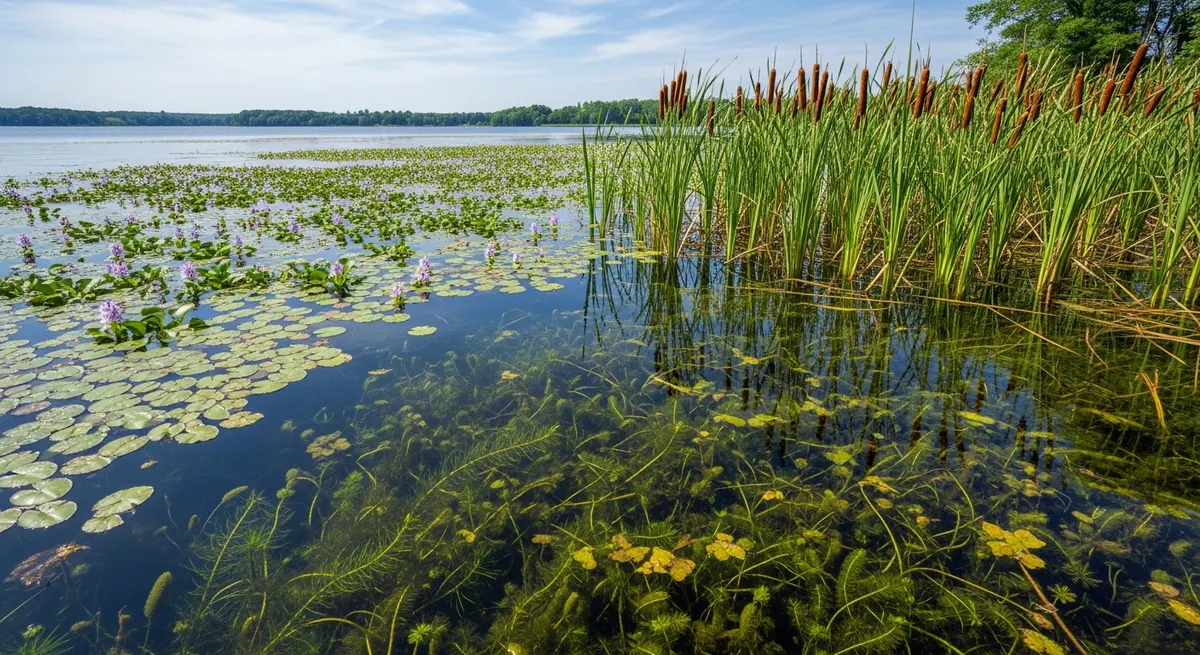
Aquatic weed removal in most U.S. states requires permits from the state department of environmental quality or natural resources. Herbicide application additionally requires federal NPDES permit coverage in most circumstances and must be conducted by or under the direct supervision of a licensed pesticide applicator. Mechanical removal may require permits in some states, particularly for work in navigable waters or wetlands.
- Chemical herbicide application to any natural water body requires a permit in most U.S. states.
- Most states require a certified aquatic pesticide applicator license to apply herbicides to water.
- Mechanical removal may also require permits for public waters — check with your state agency first.
- Permit applications typically take 2–8 weeks; plan treatment 6–8 weeks ahead to avoid season delays.
- Fines for unpermitted treatment can exceed the cost of the treatment itself — always obtain permits first.
Federal Permit Requirements
NPDES Permits
The National Pollution Discharge Elimination System (NPDES) permit program, administered under the Clean Water Act, requires permit coverage for aquatic pesticide applications to waters of the United States. In most states, this is accomplished through a state-issued general permit that applicators obtain annually or per-project. The 2009 U.S. Supreme Court decision in Headwaters Inc. v. Talent Irrigation District and subsequent Clean Water Act rulemakings confirmed that aquatic pesticide applications are "discharges" subject to NPDES coverage requirements. Working with a state-licensed aquatic applicator ensures NPDES compliance is addressed as part of the service.
Section 404 Permits
Mechanical work in navigable waters, wetlands, or other waters subject to U.S. Army Corps of Engineers jurisdiction may require a Section 404 permit under the Clean Water Act. Section 10 of the Rivers and Harbors Act may apply to work in navigable rivers. For most routine aquatic weed management that does not involve dredging, filling, or significant physical alteration of the water body, Section 404 coverage is typically available under nationwide permits for aquatic vegetation management. Projects that disturb significant sediment or alter water body morphology require individual permit review.
State Permit Frameworks
State permit requirements for aquatic weed management are administered through a variety of agencies: department of environmental quality (DEQ), department of natural resources (DNR), fish and wildlife agency, or department of environmental conservation (DEC), depending on state. Most states require either a per-project permit or enrollment in a general permit program for aquatic pesticide use. Key elements typically required in state permit applications include:
- Identification of the applicant and licensed applicator
- Water body description, location, and size
- Target species and infestation description
- Proposed pesticide product(s), rate(s), and application method
- Water use information (drinking water intakes, irrigation, recreation)
- Adjacent landowner notification requirements
Permit fees vary from zero (general permit enrollment) to several hundred dollars for individual permits. Processing times range from 2 weeks to several months depending on state workload and application complexity. Full permits guide →
Sources & Scientific References
- USEPA (2011). NPDES General Permit for Discharges from the Application of Pesticides. EPA HQ-OW-2010-0257.
- U.S. Army Corps of Engineers. Nationwide Permit Program — NWP 27 (Aquatic Habitat Restoration, Establishment, and Enhancement Activities).
- Clean Water Act, 33 U.S.C. §1251 et seq.
Frequently Asked Questions
Do you need a permit to use herbicides on aquatic weeds?
Yes. In all U.S. states, aquatic herbicide application requires: (1) a state aquatic pesticide or lake management permit from the state department of environmental quality or natural resources, (2) application by or under supervision of a licensed commercial pesticide applicator, and (3) compliance with the NPDES general permit for aquatic pesticide applications (administered by state environmental agencies). Application without required permits is a violation of federal and state environmental law.
Do you need a permit to mechanically remove aquatic weeds?
Permit requirements for mechanical aquatic weed removal vary by state and by water body type. In navigable waters (those subject to federal jurisdiction under the Clean Water Act and Rivers and Harbors Act), mechanical work may require a Section 404 permit from the U.S. Army Corps of Engineers, particularly if sediment is disturbed. Most states also have their own permit requirements for mechanical work in waters of the state, especially in wetlands or waters with sensitive habitat. Contact your state's department of environmental quality before beginning mechanical removal.
How long does it take to get an aquatic weed control permit?
Processing times vary significantly by state. Many states offer a streamlined general permit for routine aquatic herbicide applications that can be processed in 2–6 weeks. Complex situations (large water bodies, sensitive habitats, multiple agencies) may require individual permits that take 3–6 months. Planning ahead and submitting permit applications well before the desired treatment window is essential — spring permit applications often face backlogs from high application volume.
Can a homeowner apply aquatic herbicides without a license?
Most states allow property owners to apply herbicides to small private ponds on their own property without a pesticide applicator license, provided the water body is entirely within their property and does not discharge to waters of the state. However, the specific restrictions, water body size limits, and product requirements vary by state. Check with your state's department of agriculture and environmental quality for the rules applicable to your specific situation before purchasing or applying any aquatic herbicide.
Key Takeaways
- Chemical herbicide application to any natural water body requires a permit in most U.S. states.
- Most states require a certified aquatic pesticide applicator license to apply herbicides to water.
- Mechanical removal may also require permits for public waters — check with your state agency first.
- Permit applications typically take 2–8 weeks; plan treatment 6–8 weeks ahead to avoid season delays.
- Fines for unpermitted treatment can exceed the cost of the treatment itself — always obtain permits first.
Ten-Year Lake Management Plan: Lake Wingra, WI
Lake Wingra, a 342-acre urban lake in Madison, WI, developed a comprehensive 10-year management plan coordinating the City of Madison, University of Wisconsin, and adjacent neighborhood associations. The plan addressed Eurasian watermilfoil, curly-leaf pondweed, and purple loosestrife through an integrated approach including targeted herbicide treatment, mechanical harvesting, native plant restoration, and public education.
Key outcome: The structured multi-agency planning process secured consistent funding across multiple budget cycles, a key advantage over ad hoc management. Native plant restoration efforts showed measurable progress in designated restoration zones within three years of initiation.
The ecological impact section helped our team explain to county commissioners why early intervention matters. The oxygen depletion data alone secured funding for our early-detection monitoring program.
Donna Whitfield State Wildlife Biologist, GA · Okefenokee regionWe used the integrated management framework from this site to structure our Eurasian watermilfoil control program. After three seasons we've reduced lake-wide coverage by 78% on our 340-acre water body.
Susan Thibodeau Lake District Manager, MN · Crow Wing County