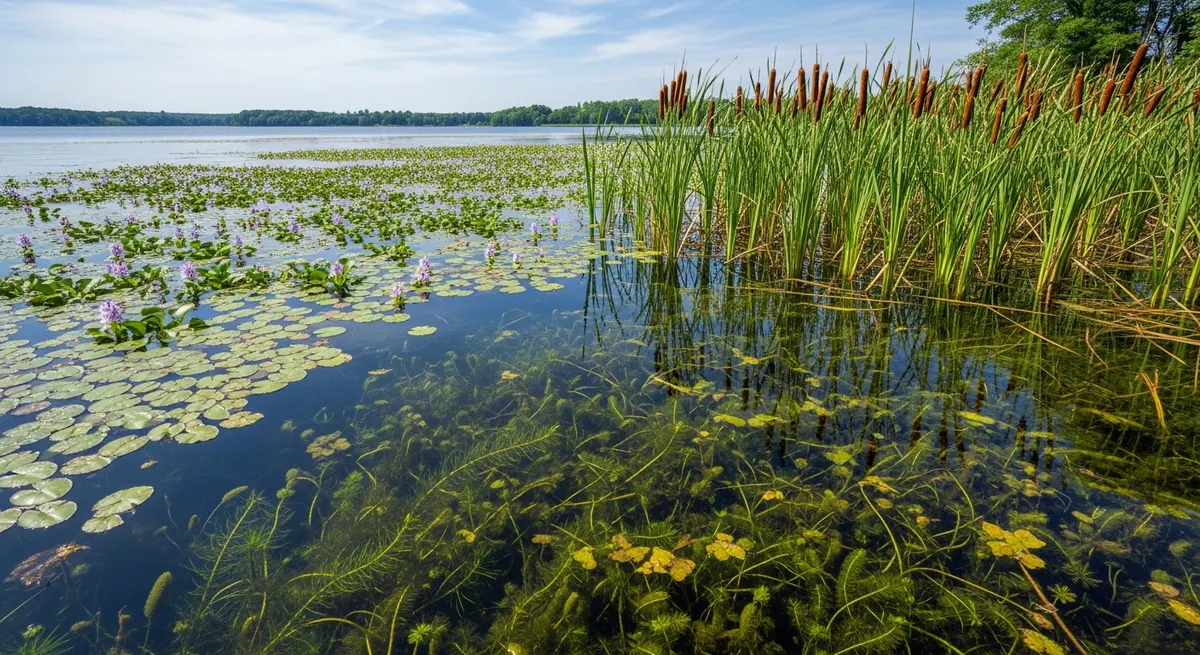
A lake weed management plan is a structured document that defines the current condition of a water body's vegetation community, establishes management goals, prescribes control methods, identifies monitoring requirements, and projects costs over a multi-year planning horizon. Most state permit applications for aquatic herbicide use require at least a basic site management plan. More comprehensive plans are the foundation for grant applications, lake association management programs, and cost-effective multi-year management.
- A formal lake weed management plan documents current conditions, management goals, treatment prescriptions, and monitoring protocols.
- Most state permit applications for aquatic herbicide use require a basic management plan or site-specific treatment plan.
- A professional aquatic biologist or certified lake manager should develop the plan — costs typically range from $1,500–$8,000.
- The plan should cover a 3–5 year horizon with annual review and adaptive management based on monitoring results.
- Lake associations benefit most from management plans — coordinated effort across multiple properties produces better outcomes than individual action.
Step 1: Baseline Assessment
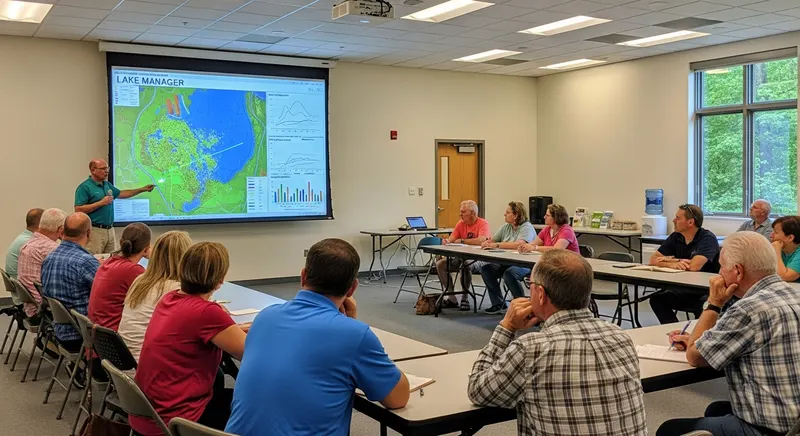
The foundation of any management plan is accurate, current data about the water body's vegetation community. A professional baseline survey should document: all aquatic plant species present (including distinguishing invasive from native species); their spatial distribution (GPS-referenced maps showing where each species occurs); their density and abundance (percent cover, frequency, or biomass estimates); water depth and clarity at each vegetation zone; and any water quality measurements relevant to management planning (phosphorus, nitrogen, dissolved oxygen).
The baseline survey serves multiple functions: it enables accurate species-specific treatment prescriptions; it identifies native plant areas that should be protected from treatment; it provides the pre-treatment reference needed to evaluate management effectiveness; and it satisfies the technical information requirements of most state aquatic herbicide permit applications. Investing in a thorough baseline survey before treatment consistently saves money overall by preventing misdirected treatment. Survey cost guide →
Step 2: Setting Management Goals
Management goals should be specific, measurable, achievable, relevant, and time-bound (SMART). Vague goals — "reduce weeds" or "improve water quality" — cannot be evaluated and do not provide actionable guidance for management decisions. Well-formed aquatic weed management goals include specifics: "Reduce hydrilla coverage from 65% to below 20% of the littoral zone within 3 growing seasons"; "Eliminate water hyacinth from the north bay by the end of the first management year"; "Maintain native submergent plant coverage above 15% while suppressing invasive species to below 10%." Goals should reflect both the management needs and the realistic limits of what is achievable with available methods and budget. What's achievable with weed management →
Step 3: Treatment Prescriptions and Permitting
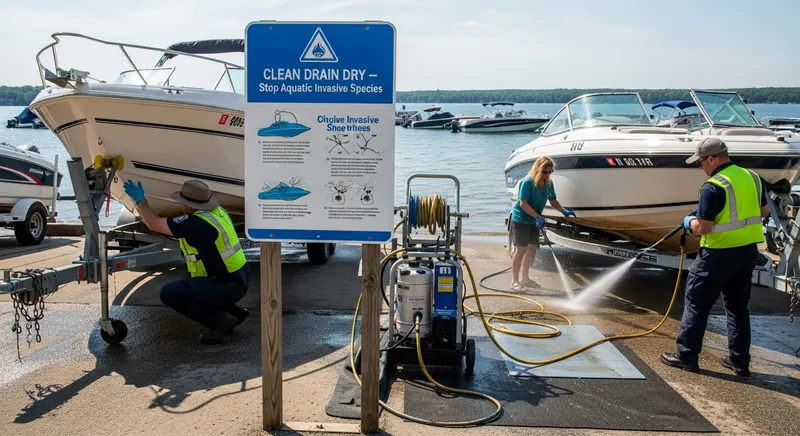
Treatment prescriptions specify: the control method(s) to be used (herbicide, mechanical, biological, physical); the specific products, rates, and formulations (for herbicide treatments); the treatment area (GPS-defined polygons matching the target species distribution map); the timing (spring, early summer, post-bloom — varies by species and method); any water use restrictions that will apply; and buffer zones or exclusion areas where treatment should not occur (native plant beds, intake zones, sensitive habitats). Treatment prescriptions should be developed or reviewed by the licensed professional who will sign the permit application.
Permit applications should be submitted well in advance of the intended treatment date — typically 6–8 weeks minimum, often longer for complex situations or water bodies with special regulatory status. The permit application for most states requires: species identification; treatment area map; product selection with label information; rationale for product selection; acknowledgment of water use restrictions; and the management plan or site description. Some states review permits rapidly; others have 90-day review periods. Planning treatment timing around permit lead times is essential. Permit requirements guide →
Step 4: Monitoring and Adaptive Management
Monitoring is the mechanism by which the management plan learns and improves. Post-treatment surveys (4–8 weeks after herbicide treatment) assess treatment effectiveness and identify areas with poor response. Annual vegetation surveys track population trends of target and non-target species over time. Water quality monitoring (nutrients, clarity, dissolved oxygen) tracks changes in the conditions that support weed growth. Monitoring data should be compiled annually and compared to baseline and goals to inform treatment decisions for the following season. When monitoring reveals that goals are not being met, the plan should be revised — adjusting treatment methods, timing, or management intensity as indicated by the data. A management plan that never changes despite monitoring results is not adaptive management. Integrated management overview →
Sources & Scientific References
- North American Lake Management Society (NALMS). (2022). Lake and Pond Management Guidebook. NALMS.
- Madsen, J.D. (1993). Aquatic weed management. In: Handbook of Integrated Pest Management for Turf and Ornamentals. CRC Press.
- Cooke, G.D. et al. (2005). Restoration and Management of Lakes and Reservoirs. 3rd ed. Taylor & Francis.
Frequently Asked Questions
What is the first step in creating a lake weed management plan?
The first step is a comprehensive baseline survey — a professional assessment of what aquatic plant species are present, where they are located, at what densities, and what environmental conditions (water depth, clarity, nutrient levels, sediment type) are associated with each species distribution. Without accurate baseline data, management goals cannot be meaningfully defined and treatment effectiveness cannot be evaluated. Most state permits for aquatic herbicide use require a current baseline survey as part of the application.
Who should write a lake weed management plan?
A qualified aquatic biologist, certified lake manager, or licensed aquatic plant management professional should lead plan development. Professional credentials to look for include: Certified Lake Manager (CLM) through the North American Lake Management Society (NALMS); state-issued aquatic plant management license; or membership in the Aquatic Plant Management Society (APMS) with relevant experience. University extension services in some states also provide planning assistance and can connect lake associations with professional planners. Costs for professional plan development typically range from $1,500–$8,000 depending on lake size and plan complexity.
What should a lake weed management plan include?
A comprehensive lake weed management plan typically includes: (1) water body description — watershed, size, depth, water use, ecological characteristics; (2) vegetation baseline — species list, distribution maps, density estimates; (3) management goals — specific, measurable objectives for target species and coverage; (4) treatment prescriptions — specific methods, products, timing, and areas for each management action; (5) permit requirements — list of applicable permits and responsible party; (6) monitoring protocol — schedule, methods, and metrics for evaluating progress; (7) nutrient management component — actions to address nutrient sources that sustain weed growth; (8) budget projection — estimated annual costs over the plan horizon; and (9) adaptive management provisions — process for revising the plan based on monitoring results.
How long should a lake management plan cover?
A typical lake management plan covers a 3–5 year horizon. This provides enough time to evaluate treatment effectiveness and adaptive adjustments while remaining close enough to current conditions that baseline data remains relevant. Annual review and adaptive management — adjusting treatment prescriptions based on monitoring results — is more important than rigid adherence to the original plan. Some states require a minimum plan length (usually 3 years) for certain permit types. Plans should be formally updated whenever conditions change significantly (a new invasive species is detected, management objectives change, or water quality conditions shift substantially).
Can a lake association develop its own management plan without a professional?
A lake association can develop a basic framework for a management plan, particularly for small water bodies where the vegetation community is simple and the management objectives are straightforward. However, professional assistance is strongly recommended for: accurate species identification (misidentification leads to ineffective treatment); permit applications (which require specific technical information); grant applications (which typically require professional involvement); and large or complex water bodies with significant invasive species problems. Partial professional involvement — hiring a consultant for the baseline survey and treatment prescription while the association manages implementation — is a cost-effective middle ground for many lake associations.
Key Takeaways
- A formal lake weed management plan documents current conditions, management goals, treatment prescriptions, and monitoring protocols.
- Most state permit applications for aquatic herbicide use require a basic management plan or site-specific treatment plan.
- A professional aquatic biologist or certified lake manager should develop the plan — costs typically range from $1,500–$8,000.
- The plan should cover a 3–5 year horizon with annual review and adaptive management based on monitoring results.
- Lake associations benefit most from management plans — coordinated effort across multiple properties produces better outcomes than individual action.
Ten-Year Lake Management Plan: Lake Wingra, WI
Lake Wingra, a 342-acre urban lake in Madison, WI, developed a comprehensive 10-year management plan coordinating the City of Madison, University of Wisconsin, and adjacent neighborhood associations. The plan addressed Eurasian watermilfoil, curly-leaf pondweed, and purple loosestrife through an integrated approach including targeted herbicide treatment, mechanical harvesting, native plant restoration, and public education.
Key outcome: The structured multi-agency planning process secured consistent funding across multiple budget cycles, a key advantage over ad hoc management. Native plant restoration efforts showed measurable progress in designated restoration zones within three years of initiation.
We used the integrated management framework from this site to structure our Eurasian watermilfoil control program. After three seasons we've reduced lake-wide coverage by 78% on our 340-acre water body.
Susan Thibodeau Lake District Manager, MN · Crow Wing CountyThe seasonal timing guidance has been invaluable. Treating at the right growth stage cut our herbicide costs by nearly 30% without sacrificing efficacy on our county-managed reservoir.
Dale Buchanan County Parks Director, MI · Kalamazoo County