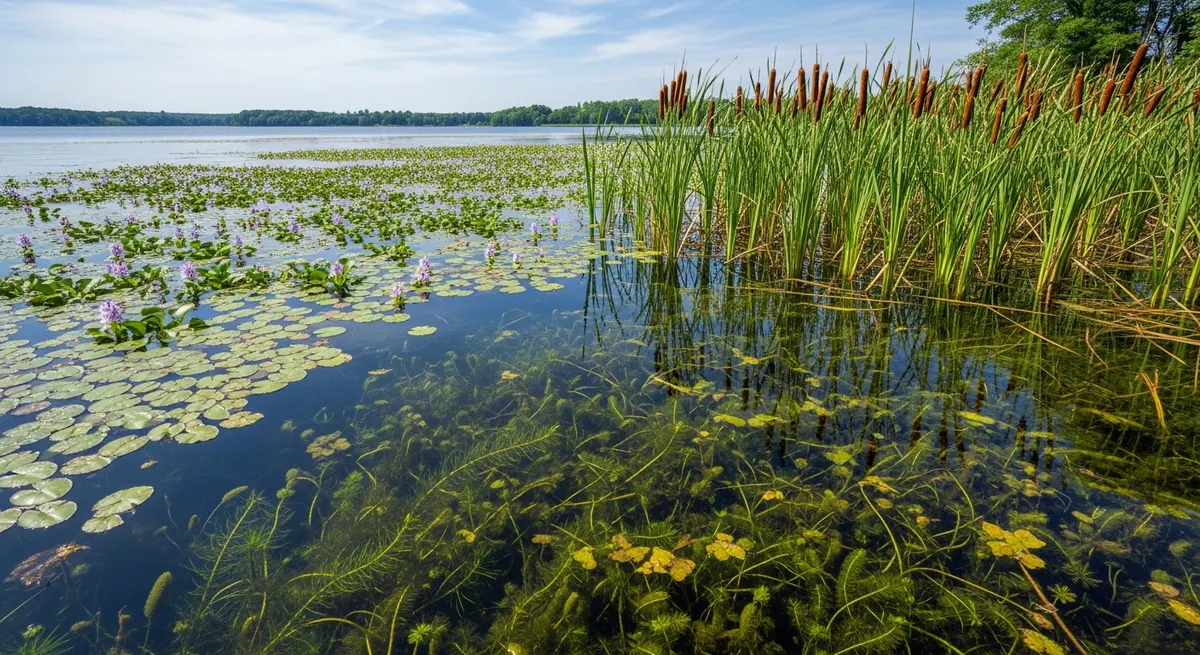
Managing aquatic weeds in a small private pond requires the same foundational steps as managing a large lake — accurate species identification, understanding the growth form, and selecting the most appropriate control method for your specific situation. Private landowners generally have more flexibility than managers of public water bodies, but permit requirements for aquatic herbicide use still apply in most states, even on private ponds.
- Private pond owners have more management flexibility than managers of public water bodies — but permits may still be required for herbicide use.
- Identifying the weed species accurately before treatment is critical — treatments differ significantly by species.
- For ponds under 1 acre, hand-pulling and raking combined with aeration is often sufficient for nuisance native weeds.
- Triploid grass carp (require a stocking permit in most states) can provide long-term control of most submerged weeds.
- Nutrient management (reducing fertilizer runoff, upgrading aeration) addresses root causes rather than just treating symptoms.
Step 1: Identify What You're Managing
Accurate species identification is the essential foundation. The three most important questions are: (1) Is this an alga or a true plant? Algae (filamentous algae, planktonic algae, cyanobacteria) require different treatments — algaecides — than true plants. (2) What growth form is present — floating, submerged, or emergent? Growth form determines which products are effective and how they should be applied. (3) Is this a native species or an invasive exotic? Invasive species may require more aggressive management and may also trigger reporting obligations to your state aquatic invasive species program.
Many land-grant university extension services provide free online identification guides and even email-based ID assistance. County extension offices and state department of natural resources regional offices can also assist with species identification. Before investing in any treatment, confirm what species you're dealing with. Identification guide →
Treatment Options for Private Ponds
Physical and Mechanical Methods
For small ponds (under 1 acre), physical control is often practical for the initial infestation: hand-pulling and raking for emergent species and limited patches of submerged weeds; benthic barriers (burlap, plastic, or synthetic fabric bottom mats) for designated small areas like dock areas or swim zones; and aeration (fountains, diffusers, paddlewheels) to improve dissolved oxygen, reduce thermal stratification, and reduce the stagnant, nutrient-rich conditions that favor weed growth. Physical methods are chemical-free, require no permits, and are often preferred for ponds used for livestock watering or irrigation where water use restrictions are a concern.
Triploid Grass Carp
Triploid (sterile) grass carp are among the most effective and lowest-maintenance long-term management options for ponds with submerged weed problems. They selectively consume submerged vegetation at stocking rates of 5–15 fish per acre, providing significant weed suppression within 1–3 growing seasons. Key requirements: a stocking permit from your state fish and wildlife agency (required in nearly all states); pond containment (grass carp can escape through spillways — exclusion screens are essential); and careful management of stocking density (too many fish eliminate all vegetation including native plants). Full grass carp guide →
Aquatic Herbicides
EPA-registered aquatic herbicides provide the most efficient and comprehensive control for large or persistent weed infestations. Common products used in ponds include: fluridone (systemic, slow-acting, broad spectrum — ideal for established infestations); endothall (contact herbicide effective on many submerged species); diquat (contact herbicide for floating and submerged plants); and 2,4-D (selective for broadleaf species including water hyacinth and milfoil). Most aquatic herbicide applications require a state permit, and in many states a licensed professional applicator must perform the treatment. Water use restrictions (swimming, irrigation, livestock watering) apply to all aquatic herbicides and must be followed strictly. Herbicide safety guide →
Addressing Root Causes in a Private Pond
Treatment without addressing root causes leads to recurring weed problems. The most common root causes in private ponds are: excess nutrient input from lawn fertilizer, nearby agriculture, or waterfowl concentrated on the pond; insufficient water depth (shallow ponds allow light to reach the bottom throughout, enabling unlimited submerged plant growth); inadequate circulation and aeration (stagnant conditions favor weed and algae growth); and absence of natural shading from shoreline vegetation. Establishing a vegetated buffer strip of native grasses and forbs around the pond perimeter reduces nutrient input, provides natural shading in shallow margins, and improves aesthetic appeal. Aerators improve water quality and can significantly reduce problem weed biomass in small ponds over time.
Sources & Scientific References
- Sprecher, S.L. & Getsinger, K.D. (2000). Zebra mussel chemical control guide. ERDC Technical Notes Collection. US Army Corps of Engineers.
- Masser, M.P. et al. (1991). Aquatic Plant Management in Ponds. SRAC Publication No. 360. Southern Regional Aquaculture Center.
- Doll, A. et al. (2014). Aquatic Plant Management for Private Pond Owners. University of Wisconsin Extension.
Frequently Asked Questions
What is the first step in managing pond weeds?
The first step is accurate identification of the species causing the problem. Treatment methods differ significantly between algae and true aquatic plants; between floating, submerged, and emergent species; and between native nuisance plants and invasive exotic species. Taking clear photos of leaves (above and below water), stems, and roots — combined with consulting your state's extension service, a pond management professional, or online identification resources — is the essential starting point. Treating without accurate identification is the most common and costly mistake in private pond weed management.
Do I need a permit to treat weeds in my private pond?
In most US states, yes — if the treatment involves chemical herbicides or algaecides. Permit requirements for private ponds vary by state and by whether the pond is isolated or connected to navigable waters. Ponds with drainage outlets connected to streams, rivers, or lakes are typically subject to the same permit requirements as public waters. Isolated private ponds (no surface connections) may have less restrictive requirements in some states, but you should verify this with your state's department of natural resources or environmental quality before applying any product.
What is the most effective treatment for a small pond full of duckweed?
Duckweed control requires addressing the root cause — excess nutrients — rather than just removing the plants. On its own, raking or skimming duckweed off the surface provides immediate cosmetic relief but typically results in rapid regrowth within days to weeks if nutrient levels remain high. The most durable approach combines physical removal, nutrient source reduction (reducing lawn fertilizer use near the pond, establishing vegetated buffer strips to intercept runoff), and — if needed — aeration to improve water circulation. Fluridone and other EPA-registered herbicides can control duckweed when nutrients are simultaneously addressed.
Can I just pull out the weeds by hand in a small pond?
Hand-pulling and raking are practical for small-scale weed management in ponds under 1 acre, particularly for emergent weeds (cattails, Phragmites) and localized patches of submerged weeds. The limitations are: hand-pulling does not kill roots of most species, so regrowth occurs within weeks to months; it is physically demanding for large infestations; fragment dispersal during removal can spread submerged invasives to new areas of the same pond; and the removed biomass must be disposed of properly off-site. For ongoing management, hand-pulling is most effective as a supplement to other methods rather than a standalone solution.
How do I choose between herbicide treatment and a mechanical/physical approach?
The choice depends on pond size, weed species, water uses, and budget. Herbicides are most cost-effective for large infestations of susceptible species — they treat the entire water volume, killing roots as well as shoots, and a single treatment may provide months of control. Physical methods (hand-pulling, raking, benthic barriers) are chemical-free and preferred near swim areas or when water use restrictions from herbicides are a concern, but they require more labor and more frequent retreatment. For most private ponds, an integrated approach — targeted herbicide treatment for the initial infestation combined with physical management of high-use zones — produces the best results.
Key Takeaways
- Private pond owners have more management flexibility than managers of public water bodies — but permits may still be required for herbicide use.
- Identifying the weed species accurately before treatment is critical — treatments differ significantly by species.
- For ponds under 1 acre, hand-pulling and raking combined with aeration is often sufficient for nuisance native weeds.
- Triploid grass carp (require a stocking permit in most states) can provide long-term control of most submerged weeds.
- Nutrient management (reducing fertilizer runoff, upgrading aeration) addresses root causes rather than just treating symptoms.
Ten-Year Lake Management Plan: Lake Wingra, WI
Lake Wingra, a 342-acre urban lake in Madison, WI, developed a comprehensive 10-year management plan coordinating the City of Madison, University of Wisconsin, and adjacent neighborhood associations. The plan addressed Eurasian watermilfoil, curly-leaf pondweed, and purple loosestrife through an integrated approach including targeted herbicide treatment, mechanical harvesting, native plant restoration, and public education.
Key outcome: The structured multi-agency planning process secured consistent funding across multiple budget cycles, a key advantage over ad hoc management. Native plant restoration efforts showed measurable progress in designated restoration zones within three years of initiation.
The ecological impact section helped our team explain to county commissioners why early intervention matters. The oxygen depletion data alone secured funding for our early-detection monitoring program.
Donna Whitfield State Wildlife Biologist, GA · Okefenokee regionWe used the integrated management framework from this site to structure our Eurasian watermilfoil control program. After three seasons we've reduced lake-wide coverage by 78% on our 340-acre water body.
Susan Thibodeau Lake District Manager, MN · Crow Wing County