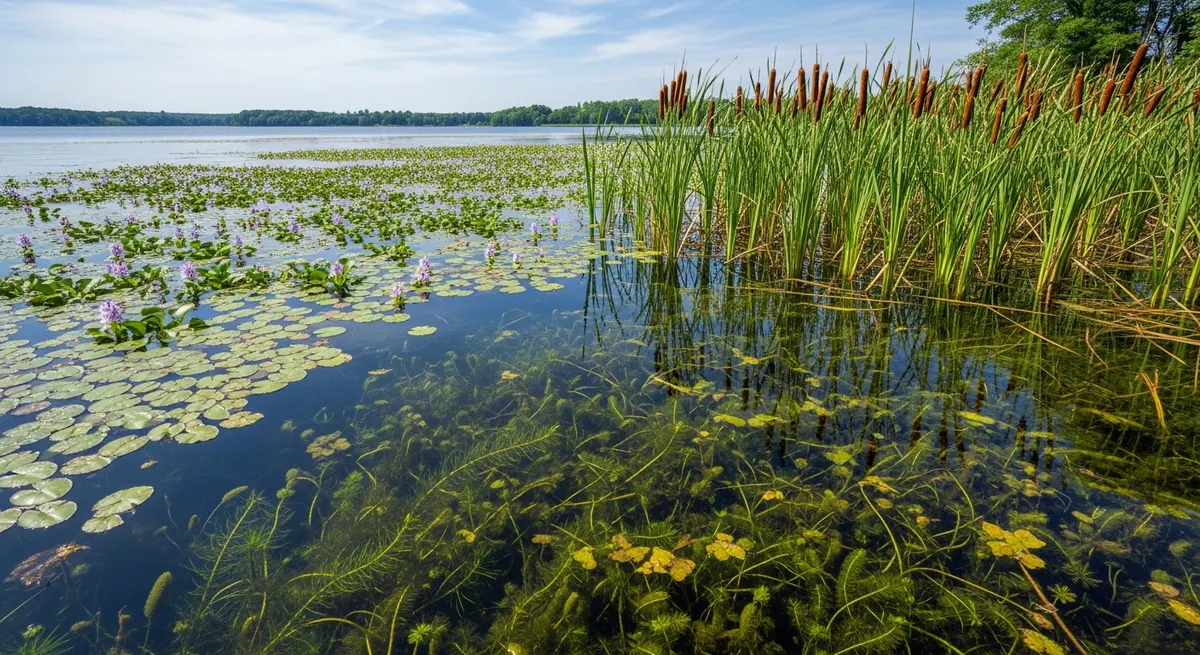
Aquatic weed growth is driven by four primary factors: excess nutrients (especially phosphorus and nitrogen), warm water temperatures, sufficient light penetration, and the reduction or absence of native plant competition. Human activities — agricultural runoff, lawn fertilization, development, and boat traffic — simultaneously intensify all four conditions, explaining why aquatic weed problems have worsened with development pressure.
- Phosphorus is the primary limiting nutrient in most freshwater systems — weed growth explodes when levels rise above natural background.
- Most invasive species grow fastest above 25°C (77°F); Florida's year-round warmth drives its severe weed problem.
- Human activities — agriculture, development, lawn care, boating — simultaneously worsen all four growth drivers.
- Native plant communities act as natural suppression; once disturbed, opportunistic invasives rush to fill the gap.
- Nutrient loading shows threshold behavior — incremental reductions may yield little visible improvement until a tipping point is crossed.
Nutrients: The Primary Driver
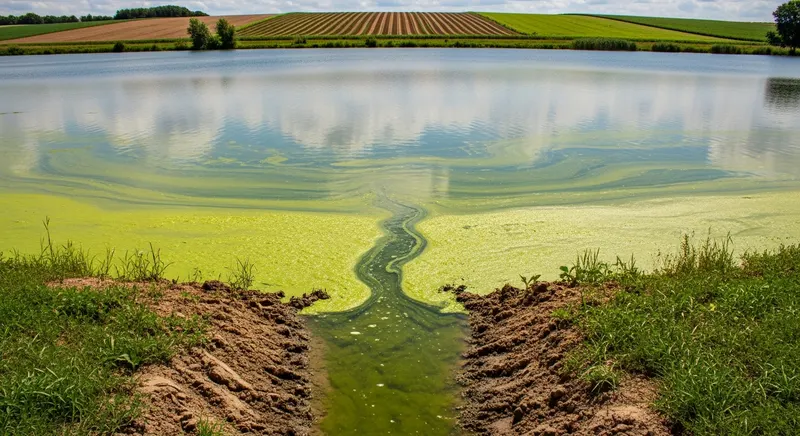
In most freshwater lakes and ponds, phosphorus is the primary nutrient limiting plant and algae growth. Under natural, undisturbed conditions, phosphorus concentrations in lake water are extremely low — often below 10 micrograms per liter. At these concentrations, plant growth is constrained even when temperature and light are favorable. When phosphorus concentrations rise — as they typically do with agricultural runoff, lawn fertilization, septic system leachate, and urban stormwater — aquatic plant communities respond with explosive growth.
Nitrogen plays a secondary but important role, particularly for free-floating species like water hyacinth and duckweed, which can fix atmospheric nitrogen through associated microorganisms. For rooted submerged and emergent species, sediment nitrogen is often more important than water-column nitrogen. Both nutrients typically increase in parallel with development and agricultural intensity, making it difficult to isolate the independent contribution of each.
The relationship between nutrient loading and aquatic weed growth is not linear — it exhibits a threshold behavior. Below a certain nutrient concentration, plant growth remains modest and native diversity remains high. Above the threshold, the system may shift rapidly to a dominance state characterized by dense monocultures of opportunistic species and reduced native biodiversity. This threshold behavior is why incremental nutrient reductions may produce little visible improvement until a sufficient reduction is achieved. Explore nutrient loading and eutrophication →
Temperature and Seasonality
Water temperature governs the metabolic rate of aquatic plants and directly controls the growing season. Most problematic aquatic weeds grow fastest in warm water (above 20–25°C / 68–77°F) and slow dramatically when temperatures drop below 15°C (59°F). In temperate climates, this creates a distinct seasonal pattern: explosive growth from late spring through summer, peak biomass in August–September, and dieback or dormancy in fall and winter. Explore seasonal growth cycles →
In frost-free climates — primarily Florida, the Gulf Coast, and Southern California — warm-water invasive species like water hyacinth, hydrilla, and giant salvinia grow continuously year-round. This extended growing season allows infestations to reach densities that are simply not possible in colder climates and makes management far more demanding. As climate warming extends warm-water periods northward, the effective range of these species is gradually expanding.
Light Availability
Photosynthesis requires light. For submerged aquatic weeds, the depth to which light penetrates the water column (the euphotic zone) sets the maximum colonization depth. In highly turbid water, submerged plants may be limited to depths of 1–2 feet. In clear water, they can establish to depths of 15 feet or more. Eurasian watermilfoil in particular has unusually efficient light capture for a submerged plant, allowing it to establish in moderately turbid water where native submerged plants cannot compete effectively.
Paradoxically, very high water clarity — which might seem like it would reduce weed problems by reducing nutrient concentrations — can increase submerged weed establishment depth and density. Many clear, oligotrophic lakes have significant submerged weed problems simply because light penetrates deeply. The interaction between nutrients and light, and between different growth forms, makes management more complex than a simple nutrient-reduction approach can address.
Loss of Native Plant Competition
Native aquatic plant communities, when diverse and intact, competitively suppress many invasive species by occupying the same niche. Dense native vegetation uses available nutrients, light, and growing space in ways that make establishment by new species more difficult. When native plant communities are disrupted — through herbicide overapplication, shoreline development, dredging, or dramatic fluctuations in water level — the resulting open space is rapidly colonized by opportunistic weeds.
Research has consistently shown that water bodies with intact native plant communities are more resistant to invasive species establishment than degraded systems. This is one reason restoration of native plant communities is now considered an important component of integrated management programs, not just cosmetic restoration. Learn to distinguish weeds from beneficial native plants →
The Role of Human Activity
Human activities simultaneously intensify all four growth drivers. Agricultural operations load nutrients into waterways through runoff and tile drainage. Residential development increases impervious surface area and stormwater discharge. Septic systems leak phosphorus and nitrogen into groundwater and surface water. Recreational boating disturbs shoreline vegetation and resuspends sediment-bound nutrients. And the global trade in aquatic ornamental plants has introduced dozens of invasive species that lack natural controls in their new environment.
This convergence of pressures explains why aquatic weed problems have intensified in parallel with population growth and land development over the past century. Addressing the root causes — reducing nutrient loading, protecting native vegetation, preventing new introductions — is far more cost-effective than repeated treatment of symptoms. Explore integrated management planning →
Sources & Scientific References
- Wetzel, R.G. (2001). Limnology: Lake and River Ecosystems. Academic Press.
- Smith, V.H. et al. (1999). Eutrophication: impacts of excess nutrient inputs on freshwater, marine, and terrestrial ecosystems. Environmental Pollution, 100(1–3), 179–196.
- Chambers, P.A. et al. (1999). Macrophyte growth and sediment phosphorus and nitrogen. Freshwater Biology, 41, 491–502.
- USEPA (2000). Ambient Water Quality Criteria Recommendations: Lakes and Reservoirs in Nutrient Ecoregion XIV.
Frequently Asked Questions
What nutrients cause aquatic weeds to grow?
Phosphorus is the primary limiting nutrient in most freshwater systems — aquatic weeds and algae proliferate when phosphorus concentrations rise above natural background levels. Nitrogen is a secondary driver, particularly for free-floating species. Agricultural runoff, lawn fertilizer, septic system leachate, and urban stormwater are the dominant phosphorus loading sources in managed landscapes.
Does warm water cause more aquatic weeds?
Yes. Most problematic aquatic weed species — especially floating plants like water hyacinth — grow fastest in warm water (above 25°C/77°F). Florida and Gulf Coast states have the most severe aquatic weed problems partly because warm water temperatures extend the growing season to year-round in frost-free areas. Climate warming is gradually expanding the northern range limits of warm-water invasive species.
Why do aquatic weeds grow in some lakes but not others?
The key variables are nutrient levels, water clarity, disturbance history, and the integrity of the native plant community. Deep, clear, low-nutrient lakes in undisturbed watersheds typically have far fewer weed problems than shallow, turbid, nutrient-rich lakes surrounded by agricultural or developed land. Native plant communities also competitively suppress many invasive species when they are intact.
Does shade reduce aquatic weed growth?
Yes, in most cases. Submerged aquatic weeds require light to photosynthesize and generally cannot establish in water deeper than light penetrates. Management strategies that reduce light — aeration to promote turbidity, shoreline shading, or even deliberate turbidity management — can reduce submerged weed establishment. However, floating weeds are largely unaffected by water clarity since they capture light at the surface.
Key Takeaways
- Phosphorus is the primary limiting nutrient in most freshwater systems — weed growth explodes when levels rise above natural background.
- Most invasive species grow fastest above 25°C (77°F); Florida's year-round warmth drives its severe weed problem.
- Human activities — agriculture, development, lawn care, boating — simultaneously worsen all four growth drivers.
- Native plant communities act as natural suppression; once disturbed, opportunistic invasives rush to fill the gap.
- Nutrient loading shows threshold behavior — incremental reductions may yield little visible improvement until a tipping point is crossed.
Ten-Year Lake Management Plan: Lake Wingra, WI
Lake Wingra, a 342-acre urban lake in Madison, WI, developed a comprehensive 10-year management plan coordinating the City of Madison, University of Wisconsin, and adjacent neighborhood associations. The plan addressed Eurasian watermilfoil, curly-leaf pondweed, and purple loosestrife through an integrated approach including targeted herbicide treatment, mechanical harvesting, native plant restoration, and public education.
Key outcome: The structured multi-agency planning process secured consistent funding across multiple budget cycles, a key advantage over ad hoc management. Native plant restoration efforts showed measurable progress in designated restoration zones within three years of initiation.
Running a golf course with three retention ponds means constant weed pressure. The prevention and best management practices guide gave us a systematic approach that replaced our reactive spray schedule.
Paul Esteban Golf Course Superintendent, SC · Myrtle Beach areaAs a lakefront property owner I was completely lost until I found AquaticWeed.org. The permit guidance alone saved me from making costly, potentially illegal treatment mistakes.
Gerald Renfrew Lakefront Landowner, WI · Vilas County